
3D Structured Light Smart Lock vs 2D Face Unlock: Key Differences for Access Control
3D Structured Light Smart Lock vs 2D Face Unlock: Key Differences for Access Control
When evaluating facial access control, the gap between a 3D structured light smart lock and a 2D face unlock system goes far beyond convenience.
The real issue is not whether a face can be recognized.
It is whether recognition stays reliable under spoofing pressure, weak lighting, changing angles, and daily operational wear.
That is where a 3D structured light smart lock usually separates itself from a basic 2D face unlock device.
In residential projects, office entries, rental properties, and controlled commercial doors, this difference directly affects risk, maintenance, and user trust.
A procurement decision made on convenience alone often creates security gaps later.
A decision made on sensing architecture, by contrast, tends to hold up better over time.
Why the Sensing Method Matters First
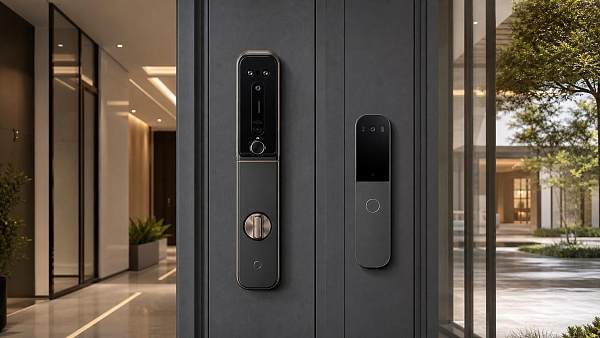
A 2D face unlock system captures a flat image.
It mainly analyzes visible facial features from a camera feed.
That method can work well for convenience-focused access, especially in lower-risk settings.
But it has a structural weakness.
A flat image does not inherently confirm real facial depth.
A 3D structured light smart lock projects an invisible light pattern onto the face.
It then reads distortion in that pattern to build a depth map.
This gives the system actual three-dimensional facial data, not just a photo-like surface record.
That difference shapes everything that follows.
Spoof resistance improves, liveness detection becomes stronger, and environmental tolerance is often more consistent.
For access control, the sensing method is not a background detail.
It is the basis of the security model.
Core Security Difference: Depth vs Flat Imaging
The strongest advantage of a 3D structured light smart lock is depth recognition.
It measures contours around the nose, eyes, cheeks, and surrounding facial geometry.
A 2D face unlock system cannot verify those contours with the same confidence.
This matters because many common attacks are presentation attacks.
They rely on printed photos, replayed videos, screen displays, or image-based masks.
A well-designed 3D structured light smart lock is better positioned to reject those attempts.
That does not mean 3D systems are impossible to attack.
It means the attacker faces a more difficult path.
In real procurement terms, that raises the attack cost and reduces low-effort spoofing risk.
- 2D face unlock mainly checks image similarity.
- 3D structured light smart lock checks shape, position, and depth.
- Stronger depth data usually supports better liveness logic.
- Better liveness logic usually means fewer false accepts in risky conditions.
That difference becomes more important at entry points with parcel traffic, visitors, contractors, or semi-public exposure.
Performance in Low Light, Backlight, and Daily Use
Access control rarely operates in perfect conditions.
Apartment corridors, villa gates, side entrances, and office vestibules all create different lighting problems.
A 2D face unlock system often depends more heavily on ambient visible light.
Strong backlight can wash out details.
Dim conditions can reduce matching confidence.
A 3D structured light smart lock usually performs more steadily because it generates its own projected pattern.
That gives it more control over how facial depth is captured.
In practice, this can improve unlock consistency in evening use, shadowed hallways, and indoor-outdoor transitions.
However, buyers should avoid assuming all 3D systems perform equally.
Sensor quality, algorithm tuning, infrared design, and housing protection still matter.
A weak 3D implementation can underperform a well-optimized 2D product in certain routine scenarios.
So the evaluation should stay product-specific, even when the technology path is clear.
False Acceptance, False Rejection, and Decision Quality
Selection errors often happen when teams focus only on unlock speed.
Speed matters, but decision quality matters more.
For any facial access device, two metrics need attention.
One is false acceptance.
The other is false rejection.
A 3D structured light smart lock is generally chosen to reduce false acceptance risk under spoof-oriented conditions.
That makes it attractive for higher-security doors, premium residences, executive offices, and controlled internal zones.
A 2D face unlock solution may still be reasonable when convenience is the primary goal and attack exposure is low.
The tradeoff is straightforward.
Lower-cost image-based recognition may raise operational uncertainty in edge cases.
A stronger 3D structured light smart lock often reduces that uncertainty, but with higher hardware complexity and cost.
Integration, Installation, and Lifecycle Considerations
Technology choice should not stop at recognition accuracy.
A smart lock also lives inside a larger access control workflow.
That includes lock body design, power management, mobile credential support, audit logs, cloud control, and mechanical override planning.
A 3D structured light smart lock may require more careful calibration at the product engineering stage.
It may also need stronger processor support and tighter thermal management.
For buyers, that means the supplier’s firmware maturity becomes highly relevant.
The best product is rarely the one with the longest sensor specification sheet.
It is the one that keeps stable performance after repeated field use.
A 2D face unlock solution may be simpler to deploy at scale.
That can appeal to cost-sensitive projects or temporary rollout programs.
Still, if the site later faces spoofing complaints or recognition instability, the initial savings can disappear quickly.
How to Choose the Right Facial Access Approach
The most useful selection method starts with threat level, not feature count.
Ask what kind of unauthorized attempts the door may realistically face.
Then ask how much friction users will tolerate.
From there, compare sensing method, algorithm maturity, and mechanical reliability together.
- Use a 3D structured light smart lock when spoof resistance is a primary requirement.
- Use 2D face unlock when convenience, lower budget, and moderate risk define the project.
- Request test evidence for low-light performance, liveness detection, and false acceptance rates.
- Check whether the supplier supports firmware updates and secure data handling.
- Evaluate the full door system, not only the facial module.
In many current access control decisions, the more visible trend is a shift toward stronger biometric assurance.
That is why the 3D structured light smart lock is gaining attention across premium residential, enterprise, and security-sensitive deployments.
The technology is not just about looking advanced.
It is about reducing uncertainty where physical access decisions carry real consequences.
If the decision requires stronger anti-spoof performance, better depth recognition, and more dependable real-world security, a 3D structured light smart lock is usually the more defensible choice.
Have questions about this sector analysis, or seeking best practices specific to your niche? Drop us a line below and let the senior consultants at MHLS assist you.
We respect your privacy. Your information is strictly confidential.
Recommended News
 Parcel Locker Network Pricing: Setup Costs, Fees and Contract TermsUnmanned Terminal FellowCompare parcel locker networks pricing, from setup costs and recurring fees to contract terms. Discover hidden charges and choose the right model.
 JR East Plans UWB Walk-Through Gates at 40 Stations in Spring 2028Access Control StrategistJR East plans UWB walk-through gates at 40 stations in spring 2028. Explore the rollout timeline and what suppliers should watch.
 Bank Vault Security Standards: UL and EN Ratings ExplainedVault Structural ArchitectExplore bank vault security standards and learn how UL 608 classes and EN 1143-1 grades differ, what they test, and how to verify certification before you buy.
 Mechanical Lock Hardware Prices: What Buyers Should Budget for Bulk OrdersMr. Gideon CrossMechanical lock hardware price is just the starting point. Discover what drives bulk-order costs and how to compare supplier quotes with confidence.
 IndexBox Forecasts Steady Global Security Keypad Market Growth Through 2035Dr. Valerius ThorneGlobal security keypad market growth is forecast at 3.3% annually through 2035. Explore the smart home and replacement trends shaping demand.
 Choosing an Infrared Safety Sensors Manufacturer: What Buyers Should CheckUnmanned Terminal FellowChoosing an infrared safety sensors manufacturer? Compare safety evidence, integration, environmental performance and lifecycle costs before you buy.
 Choosing a Security Material Testing Service: What to Check for Lock and Safe MaterialsProf. Elara SterlingChoose a security material testing service with confidence. Learn what to check for lock and safe materials, from attack methods and accreditation to reliable reports.
 How Precision Anti-Pick Lock Cylinders Resist ManipulationSecurity Metallurgy ExpertDiscover how precision anti-pick lock technology resists manipulation, and learn what to check when comparing security features, test evidence, and everyday reliability.
 Dermalog Joins NIST FastCAP Program for Contactless Fingerprint TestingProf. Elara SterlingDermalog joins the NIST FastCAP program for contactless fingerprint testing. Discover what this means for biometric identification and digital identity.
 Choosing Security Export Compliance Services: What Providers Should CoverMr. Gideon CrossSecurity export compliance services can help prevent costly delays. Discover what to look for in classification, licensing, screening, and documentation.
 European Security Compliance Standards for Safes: EN 1143-1 vs EN 14450Dr. Valerius ThorneExplore security compliance standards Europe buyers need to know. Compare EN 1143-1 and EN 14450 to choose the right safe with confidence.
 HID Global Acquires inepro ID to Expand RFID and BLE Access SolutionsUnmanned Terminal FellowHID Global acquires inepro ID to expand RFID and BLE access solutions for printers, smart lockers and shared devices. Explore what the deal could mean for your organization.











