
GCC Raises Testing Bar for 3D Facial Smart Locks
On July 11, 2026, the Gulf Standardization Organization (GSO) issued a new notice that changes market-access expectations for 3D structured-light facial recognition smart locks sold in the GCC six-country market. From October 1, 2026, these products must pass ISO/IEC 30107-3:2026 Level 4 presentation attack testing, which directly affects product compliance, export recertification, testing schedules, procurement timing, and Q4 delivery planning for manufacturers, exporters, certification teams, and buyers serving the region.
What the new GCC requirement now requires
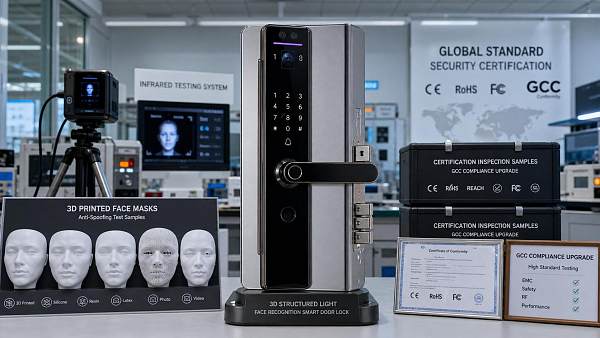
According to GSO notice GSO/TECH/SEC/2026/003, issued on July 11, 2026, all 3D structured-light facial recognition smart locks intended for sale in the GCC six-country market, including Saudi Arabia and the United Arab Emirates, must pass ISO/IEC 30107-3:2026 Level 4 liveness attack testing starting October 1, 2026.
The required test scope includes 3D printed masks, infrared spoofing, and thermoplastic material replication. Compared with the previous version, the new requirement raises the testing level by two grades and removes products that only defend against 2D photo attacks from continued suitability under the updated rule.
The provided information also indicates that Chinese exporters need to submit products for testing again. The testing cycle is extended to 21 working days, and companies are advised to leave additional Q4 delivery buffer time.
Where the pressure will show up first across the supply chain
Export-facing manufacturers will feel the compliance shift at the product gate
For manufacturers shipping 3D facial smart locks into GCC markets, the immediate issue is no longer only product functionality but whether the model can still meet the revised certification threshold. The main impact is likely to appear in compliance review, model qualification, shipment readiness, and delivery commitments tied to the October 1, 2026 implementation date.
From an industry perspective, what deserves closer attention is whether current product files, test arrangements, and market-entry preparations still align with the new Level 4 requirement rather than older assumptions based on lower spoof-resistance expectations.
Chinese exporters and trading companies face a tighter shipping calendar
The need for resubmission means export-oriented companies may need to revisit order sequencing, booking plans, and customer communication for GCC-bound products. The longer 21-working-day testing cycle matters not only for certification timing but also for contract execution, warehouse turnover, and Q4 dispatch planning.
Analysis shows that the practical exposure here is timing risk: even where demand remains intact, products that are not retested in time may face delays in documentation readiness or shipment release planning for the GCC market.
Buyers, distributors, and procurement teams may need to reset qualification checks
For importers, channel partners, and procurement teams sourcing facial smart locks for GCC markets, the rule change can affect vendor screening and specification review. Products previously considered acceptable because they resisted 2D photo attacks may no longer meet the new entry condition.
What deserves closer attention is whether procurement documents, technical requirements, and supplier qualification reviews are still based on older test assumptions. In practice, this can influence bid evaluation, model selection, and delivery scheduling decisions.
Testing and certification workflows are becoming a delivery variable
Certification-related businesses and testing service providers are also implicated because the rule change turns testing lead time into a more visible commercial factor. The updated requirement and the stated 21-working-day cycle mean certification scheduling may have a stronger effect on production release and export dispatch than before.
Observably, companies that treat testing as a late-stage formality may face more disruption than those that pull compliance review forward in the order cycle.
What companies should review now
Recheck whether current models still match the new test threshold
Companies serving GCC buyers should first identify which exported or planned-to-export smart lock models fall within the scope of 3D structured-light facial recognition products and whether those models were previously positioned around lower-level spoof defense. The critical point is not to assume earlier acceptance remains valid after the Level 4 jump.
Rebuild certification and document timing into Q4 order planning
The stated 21-working-day testing cycle makes timing a core operational issue. Companies should review whether internal approval flows, external testing reservations, shipping dates, and customer delivery promises leave enough room for retesting and any related documentation updates. This is particularly relevant for Q4 orders because the summary specifically advises keeping delivery buffer time.
Check technical files, bid materials, and customer-facing claims
Where technical dossiers, tender submissions, specification sheets, or product declarations refer to facial recognition security performance, those materials may need review against the new requirement. Analysis shows that this is less about marketing language and more about avoiding mismatches between what is submitted, what is tested, and what is offered into the GCC market.
Keep watching for execution language and market-side interpretation
The provided information confirms the new requirement and implementation date, but it does not provide fuller execution detail beyond the testing obligation, retesting need, and timing impact. It is therefore appropriate for companies to keep watching for subsequent official wording, certification application handling, procurement-side acceptance standards, and any changes in customer document requests.
How this change is best understood at this stage
Analysis shows that this development is best read as a concrete compliance tightening rather than a distant policy signal. The effective date has been stated, the testing level has been raised by two grades, and the affected product category has been identified clearly enough to create immediate implications for exporters and buyers.
At the same time, it is more appropriate to understand this as an executed rule change with follow-on implementation details still worth monitoring. The market still needs to watch how certification practice, tender language, and transaction documents reflect the updated standard in day-to-day execution.
Why this matters beyond the notice itself
This update matters because it shifts the compliance threshold for GCC-bound 3D facial smart locks from basic anti-photo resistance toward a more demanding anti-spoofing test framework. In practical terms, it affects not just product acceptance but also recertification workload, testing lead time, order planning, and cross-border delivery discipline.
Current observation suggests the notice should be treated as an active market-entry requirement with immediate operational consequences, while companies continue to track how the rule is applied in certification workflows, procurement reviews, and shipment planning.
Basis of this article and what still needs verification
This article is based on the user-provided news title, event date, and event summary concerning the July 11, 2026 GSO notice on ISO/IEC 30107-3:2026 Level 4 liveness attack testing for 3D facial smart locks sold in the GCC market.
For this type of development, relevant source categories would normally include official notices, regulator or standards-body releases, trade or customs-related information, industry association updates, standardization documents, and reporting by authoritative trade media. A specific official source link was not provided in the input, so the exact publication path still requires follow-up verification.
Further observation is still needed on implementation detail, certification handling, procurement-document updates, market feedback, and how affected companies execute retesting and delivery adjustments in practice.
Have questions about this sector analysis, or seeking best practices specific to your niche? Drop us a line below and let the senior consultants at MHLS assist you.
We respect your privacy. Your information is strictly confidential.
Recommended News
 Parcel Locker Network Pricing: Setup Costs, Fees and Contract TermsUnmanned Terminal FellowCompare parcel locker networks pricing, from setup costs and recurring fees to contract terms. Discover hidden charges and choose the right model.
 JR East Plans UWB Walk-Through Gates at 40 Stations in Spring 2028Access Control StrategistJR East plans UWB walk-through gates at 40 stations in spring 2028. Explore the rollout timeline and what suppliers should watch.
 Bank Vault Security Standards: UL and EN Ratings ExplainedVault Structural ArchitectExplore bank vault security standards and learn how UL 608 classes and EN 1143-1 grades differ, what they test, and how to verify certification before you buy.
 Mechanical Lock Hardware Prices: What Buyers Should Budget for Bulk OrdersMr. Gideon CrossMechanical lock hardware price is just the starting point. Discover what drives bulk-order costs and how to compare supplier quotes with confidence.
 IndexBox Forecasts Steady Global Security Keypad Market Growth Through 2035Dr. Valerius ThorneGlobal security keypad market growth is forecast at 3.3% annually through 2035. Explore the smart home and replacement trends shaping demand.
 Choosing an Infrared Safety Sensors Manufacturer: What Buyers Should CheckUnmanned Terminal FellowChoosing an infrared safety sensors manufacturer? Compare safety evidence, integration, environmental performance and lifecycle costs before you buy.
 Choosing a Security Material Testing Service: What to Check for Lock and Safe MaterialsProf. Elara SterlingChoose a security material testing service with confidence. Learn what to check for lock and safe materials, from attack methods and accreditation to reliable reports.
 How Precision Anti-Pick Lock Cylinders Resist ManipulationSecurity Metallurgy ExpertDiscover how precision anti-pick lock technology resists manipulation, and learn what to check when comparing security features, test evidence, and everyday reliability.
 Dermalog Joins NIST FastCAP Program for Contactless Fingerprint TestingProf. Elara SterlingDermalog joins the NIST FastCAP program for contactless fingerprint testing. Discover what this means for biometric identification and digital identity.
 Choosing Security Export Compliance Services: What Providers Should CoverMr. Gideon CrossSecurity export compliance services can help prevent costly delays. Discover what to look for in classification, licensing, screening, and documentation.
 European Security Compliance Standards for Safes: EN 1143-1 vs EN 14450Dr. Valerius ThorneExplore security compliance standards Europe buyers need to know. Compare EN 1143-1 and EN 14450 to choose the right safe with confidence.
 HID Global Acquires inepro ID to Expand RFID and BLE Access SolutionsUnmanned Terminal FellowHID Global acquires inepro ID to expand RFID and BLE access solutions for printers, smart lockers and shared devices. Explore what the deal could mean for your organization.











