
How to Evaluate a 3D Facial Access Control Manufacturer for Enterprise Projects
A 3D facial access control manufacturer should be evaluated as a long-term project partner, not as a device vendor with an attractive recognition-speed claim. For enterprise deployments, the cost of a poor choice usually appears after installation: false rejections at peak entry times, weak presentation-attack resistance, difficult software integration, unsupported firmware, or hardware that cannot survive the site environment.
A sensible procurement decision starts with the operating model. Define where the devices will be installed, who will use them, what level of access risk applies, and which existing systems must exchange data. Then assess manufacturers against that requirement set. A terminal that works well at a controlled office reception may be a poor fit for an outdoor factory gate, a high-throughput turnstile lane, or a restricted server room.
Start with the access scenario, not the product brochure
Before comparing suppliers, document the actual access points. This prevents a common mistake: requesting one device specification for locations with very different lighting, traffic, security, and installation conditions.
For example, a commercial office entrance may prioritize a smooth visitor experience and integration with a reception or visitor-management workflow. A factory may need reliable identification when staff wear safety equipment, arrive in groups, or enter during changing daylight conditions. A campus may need a flexible credential policy for employees, contractors, and temporary visitors. A sensitive area may require face verification to be combined with a card, PIN, mobile credential, or guard approval.
The manufacturer should be able to turn these conditions into a clear recommendation about terminal placement, mounting height, lane design, authentication mode, enrollment process, network design, and fallback access method. If the answer is simply “the device supports face recognition,” the technical discussion is not yet detailed enough for a project purchase.
Evaluate biometric performance in real operating conditions
“3D” is not a complete performance description. A 3D facial access control system may use different sensing approaches and software pipelines, and their practical results depend heavily on light, user movement, camera positioning, enrollment quality, and the intended matching distance.
Ask the supplier to explain how its system handles the conditions that matter at your sites:
- Direct sunlight, backlight, dim corridors, and transitions between indoor and outdoor light.
- Users wearing glasses, masks, hats, helmets, or other site-required protective equipment.
- Changes in appearance, including facial hair or seasonal clothing around the face.
- People approaching individually versus people moving through an entry lane in quick succession.
- Children, visitors, contractors, and personnel who may not be enrolled in the same way as permanent staff.
- Recognition from the expected distance and angle, rather than under a carefully staged demonstration setup.
Do not reduce this review to a request for a single accuracy figure. One number rarely explains whether a terminal will create friction at a specific entrance. A better approach is to define acceptance tests that mirror the project environment. Test representative users, relevant lighting conditions, normal walking behavior, and the intended door, turnstile, or gate sequence.
Liveness detection must be assessed as an operational control
Liveness detection is intended to distinguish a real, present person from an attempted presentation using a photograph, screen image, video, or mask-like artifact. Its value is highest where access has financial, safety, privacy, or operational consequences. It matters less at a low-risk convenience entrance, but it should not be treated as optional at every high-security door merely because face recognition is present.
Ask what attack types the manufacturer designs against, how the device responds when it is uncertain, and whether security settings can be adjusted by access point. Aggressive anti-spoofing settings may reduce risk but can also increase failed attempts for legitimate users. The right setting depends on the door’s risk level and the availability of a practical fallback credential.
Manufacturers should be willing to demonstrate the configured system, not only show a general feature list. Procurement teams should also establish who owns security tuning after handover: the manufacturer, the integrator, or the facility security team.
Check integration before selecting the terminal
Enterprise projects rarely begin with a blank security stack. The facial terminal may need to work with an access control platform, door controllers, turnstiles, visitor systems, HR attendance tools, elevator controls, alarm workflows, or building-management systems. The hardware can perform well and still become expensive if integration relies on custom work that cannot be maintained after deployment.
Request a clear architecture diagram and identify where identities, access permissions, event logs, templates, and audit records are stored. Confirm whether the device can operate during a network interruption, what events are buffered locally, and how it reconnects without creating duplicate or missing records.
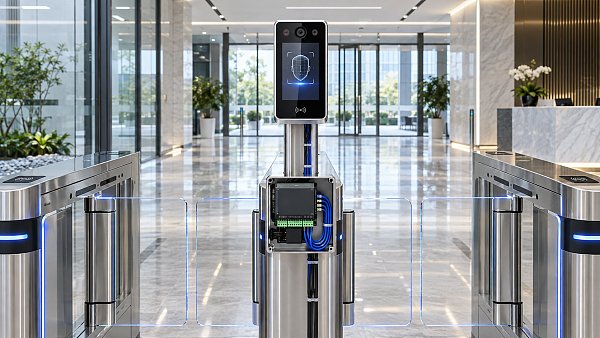
For turnstile and speed-gate projects, examine the complete passage sequence rather than the facial terminal in isolation. Recognition, authorization, lane opening, infrared safety detection, anti-tailgating logic, and alarm handling must work as one system. A fast terminal cannot compensate for a poorly matched gate controller or an entry lane that encourages people to crowd together.
Data handling is part of supplier qualification
Facial templates and associated access records require more disciplined handling than ordinary device settings. The relevant question is not simply whether the system is “cloud-based” or “on-premises.” Procurement should establish where biometric data is enrolled, stored, processed, transmitted, backed up, retained, and deleted.
A capable 3D facial access control manufacturer should provide a usable explanation of template protection, encryption in transit, administrative access controls, audit logging, account management, and data deletion procedures. The supplier should also distinguish between biometric templates, face images, access events, and personally identifiable employee records, because these may have different handling needs within an organization.
Require a practical answer to offboarding. When an employee leaves, a contractor finishes work, or a terminal is retired, who can remove the relevant records, from which systems, and how is completion recorded? This is more useful than a broad privacy statement because it tests whether the supplier’s design supports normal enterprise administration.
Compare total project cost, not terminal price
Low hardware pricing can be appropriate for a simple, standalone deployment. It becomes misleading when a project needs integration, multi-site administration, local installation support, specialized mounting, outdoor protection, custom software work, or staged commissioning. The procurement comparison should separate one-time project costs from ongoing operating costs.
Build the comparison around the full scope: terminals, licenses or platform access, enrollment equipment if needed, controllers, power and network work, turnstile or lock interfaces, installation, configuration, integration, staff training, support coverage, replacement units, and planned software maintenance. It is also useful to price the cost of a failed enrollment, a rejected employee during peak traffic, or a manual exception process. Those items are difficult to see in a unit quotation but often determine whether the deployment is accepted by operations.
Do not assume the lowest-cost architecture is the one with the fewest components. In some environments, a combined face-and-card workflow lowers operational disruption because users retain a dependable alternative when facial matching cannot be completed. In other locations, fully touchless access may justify more capable sensing hardware because throughput and hygiene are central to the use case.
Assess whether the manufacturer can deliver beyond the pilot
A successful pilot proves that a configuration can work at one location. It does not prove that the supplier can manufacture consistently, manage firmware versions, provide spares, answer integration questions, and support installers across a wider rollout.
Ask for evidence of production and quality-control processes relevant to the proposed product, including traceability, incoming component controls, final testing, packaging for the intended shipping route, and procedures for handling defective units. Review the manufacturer’s lead-time assumptions alongside their capacity to support replacement stock. A project can be delayed by a small number of unavailable devices if the installation schedule is tightly coordinated with doors, gates, electrical work, and network commissioning.
Support terms need equal attention. Clarify escalation paths, response expectations, remote diagnostic capability, warranty boundaries, spare-parts availability, documentation language, installer training, and the expected lifecycle for firmware maintenance. These are commercial and technical questions; leaving them until after the purchase order turns them into avoidable change requests.
Use a staged evaluation instead of a feature-score exercise
Feature matrices are useful, but they can give excessive weight to long specification lists. A staged process produces stronger evidence and makes competing quotations easier to compare.
- Define access-point categories. Group entrances by risk, traffic, environment, and required integrations.
- Set non-negotiable requirements. These may include liveness controls, offline behavior, data administration, supported interfaces, or dual-authentication capability.
- Shortlist manufacturers based on technical fit. Eliminate suppliers that cannot document the required architecture or support model.
- Run a site-relevant proof of concept. Test the proposed configuration at representative doors or lanes, with normal users and operating conditions.
- Review commercial scope after the trial. Compare implementation effort, maintenance responsibilities, spare strategy, and expansion costs, not just device pricing.
- Document acceptance criteria for rollout. This gives the installer, manufacturer, and internal stakeholders a shared standard for commissioning.
Independent procurement resources can help teams compare biometric technology, turnstile interfaces, access-control architectures, and supplier documentation without treating any one product category as a standalone purchase. SHPS covers these connected physical-security considerations, including 3D facial recognition, access control platforms, speed gates, and infrared anti-tailgating systems, which is useful when the project scope crosses devices and building infrastructure.
Questions that expose weak supplier fit
A manufacturer may be technically competent and still be the wrong partner for the project. The following questions usually reveal whether the supplier understands the deployment rather than only the terminal:
- Which parts of the proposed solution are standard, and which require custom development?
- How will the system behave when the network, central platform, or a connected door controller is unavailable?
- What is the recommended fallback method for denied or failed face verification?
- Which party is responsible for enrollment quality, user support, firmware updates, and access-policy changes?
- Can the proposed equipment support the expected rollout without changing the management platform later?
- What project information is needed before the supplier can confirm mounting, lighting, and lane-layout recommendations?
The best choice is usually not the manufacturer with the longest feature list. It is the one that can show a credible match between its biometric design, security controls, integration method, production support, and the daily reality of the sites being secured. That alignment reduces both deployment risk and the less visible cost of operating the system after installation.
Have questions about this sector analysis, or seeking best practices specific to your niche? Drop us a line below and let the senior consultants at MHLS assist you.
We respect your privacy. Your information is strictly confidential.
Recommended News
 Physical Security System Engineering: From Risk Assessment to System DesignUnmanned Terminal FellowExplore physical security system engineering, from risk assessment to integrated design, procurement and testing. Build a safer, more resilient facility.
 Apple Home Collection Smart Lock and Other Accessories Open for Preorder November 13Biometric Auth ScientistApple Home Collection preorders open November 13, 2026. Explore the LG smart lock’s Matter and Aliro support and what buyers should verify before ordering.
 Choosing Servo-Driven Flap Barriers: Throughput, Safety and Access ControlAccess Control StrategistServo-driven flap barriers can balance throughput, safety and access control. Discover how to compare lanes, test performance and choose with confidence.
 Parcel Locker Network Pricing: Setup Costs, Fees and Contract TermsUnmanned Terminal FellowCompare parcel locker networks pricing, from setup costs and recurring fees to contract terms. Discover hidden charges and choose the right model.
 JR East Plans UWB Walk-Through Gates at 40 Stations in Spring 2028Access Control StrategistJR East plans UWB walk-through gates at 40 stations in spring 2028. Explore the rollout timeline and what suppliers should watch.
 Bank Vault Security Standards: UL and EN Ratings ExplainedVault Structural ArchitectExplore bank vault security standards and learn how UL 608 classes and EN 1143-1 grades differ, what they test, and how to verify certification before you buy.
 Mechanical Lock Hardware Prices: What Buyers Should Budget for Bulk OrdersMr. Gideon CrossMechanical lock hardware price is just the starting point. Discover what drives bulk-order costs and how to compare supplier quotes with confidence.
 IndexBox Forecasts Steady Global Security Keypad Market Growth Through 2035Dr. Valerius ThorneGlobal security keypad market growth is forecast at 3.3% annually through 2035. Explore the smart home and replacement trends shaping demand.
 Choosing an Infrared Safety Sensors Manufacturer: What Buyers Should CheckUnmanned Terminal FellowChoosing an infrared safety sensors manufacturer? Compare safety evidence, integration, environmental performance and lifecycle costs before you buy.
 Choosing a Security Material Testing Service: What to Check for Lock and Safe MaterialsProf. Elara SterlingChoose a security material testing service with confidence. Learn what to check for lock and safe materials, from attack methods and accreditation to reliable reports.
 How Precision Anti-Pick Lock Cylinders Resist ManipulationSecurity Metallurgy ExpertDiscover how precision anti-pick lock technology resists manipulation, and learn what to check when comparing security features, test evidence, and everyday reliability.
 Dermalog Joins NIST FastCAP Program for Contactless Fingerprint TestingProf. Elara SterlingDermalog joins the NIST FastCAP program for contactless fingerprint testing. Discover what this means for biometric identification and digital identity.











