
Residential Entry Security Solutions: How to Choose for Apartments, Villas, and Homes
Residential Entry Security Solutions: How to Choose for Apartments, Villas, and Homes
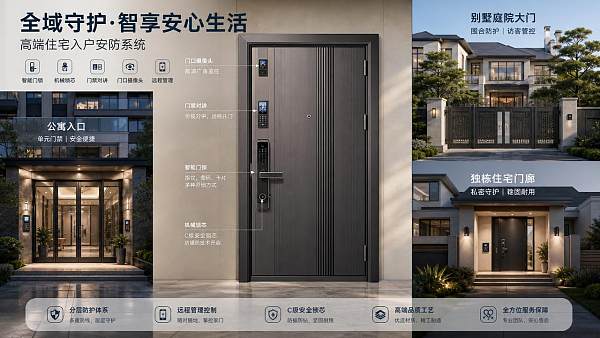
Choosing the right residential entry security solutions is no longer a simple hardware decision.
Developers, property managers, and sourcing teams now face different risk profiles across apartments, villas, and single-family homes.
A city apartment usually needs controlled shared access.
A villa often needs stronger perimeter defense and better visitor management.
A standalone home may need a balanced mix of convenience, resilience, and upgrade flexibility.
That is why effective residential entry security solutions should be evaluated as a full system.
The door, lock, cylinder, credential method, software, and maintenance workflow all affect long-term performance.
In practical projects, the best decision is rarely the most complex option.
It is usually the solution that matches real entry risks, user behavior, and property operations.
Start with the access risk profile
Good residential entry security solutions begin with a clear risk assessment.
This sounds obvious, but many procurement mistakes start with feature-first buying.
The better approach is to map access points, likely threats, and operational pressure.
For apartments, common concerns include unauthorized tailgating, key duplication, tenant turnover, and fragmented access control.
For villas, risks shift toward forced entry, blind spots, delivery access, and temporary staff movement.
For single-family homes, concerns often include daily convenience, remote unlocking, and reliable fallback during power loss.
A useful evaluation checklist should cover:
- Entry volume and time patterns
- Resident turnover and credential management needs
- Exposure to picking, drilling, prying, or credential sharing
- Need for visitor, courier, or service access
- Integration with intercoms, gates, or building platforms
- Local compliance, fire egress, and emergency override requirements
This early step helps narrow the right residential entry security solutions before budget talks begin.
Match security architecture to property type
Not every property needs the same security stack.
This is where many projects either overspend or underprotect.
Apartments
Apartment environments need layered residential entry security solutions.
The main entrance, floor access, and unit door should work as one coordinated system.
Smart locks can reduce key management overhead.
However, mechanical lock cylinders still matter for anti-picking performance and emergency fallback.
For multi-unit projects, audit trails and permission control usually add more value than premium cosmetic features.
Villas
Villas require broader residential entry security solutions because the entrance is only one exposure point.
Front doors, side doors, garage entries, and garden gates often need linked control logic.
Higher-grade door structures, reinforced cylinders, and biometric verification can make sense here.
So can remote status monitoring for owners who travel often.
Single-family homes
Homes usually benefit from practical residential entry security solutions that are easy to use every day.
That often means one reliable smart lock, one strong mechanical backup, and clear user management rules.
The ideal choice supports family access without making maintenance complicated.
Compare smart and mechanical protection together
One of the biggest selection errors is treating smart locks and mechanical locks as separate decisions.
Strong residential entry security solutions combine both.
The smart layer handles convenience, auditability, and remote control.
The mechanical layer handles resistance to force, manipulation, and system fallback.
When reviewing options, focus on these practical questions:
- Does the lock body resist prying and repeated impact?
- Is the cylinder designed for anti-picking and anti-drilling performance?
- Does the credential method reduce sharing or spoofing risk?
- Can access rights be updated quickly when occupants change?
- Is there a safe fallback during battery failure or network interruption?
Fingerprint, PIN, RFID, mobile credentials, and facial recognition each fit different use cases.
But no credential is strong enough if the underlying door and cylinder are weak.
This is why balanced residential entry security solutions usually outperform feature-heavy but structurally weak packages.
Evaluate lifecycle cost, not just purchase price
Entry security buying decisions often look simple on paper.
Then the hidden costs appear after installation.
The real value of residential entry security solutions comes from total operating efficiency over time.
For apartments, rekeying and lost credential handling can quickly exceed the initial hardware savings.
For villas, false alarms or poor remote visibility can create both security gaps and service costs.
For homes, unreliable battery alerts or weak support can damage user trust fast.
A better cost review should include:
- Installation complexity and door compatibility
- Credential issuance and revocation workload
- Battery replacement cycles and downtime risk
- Warranty coverage and spare part availability
- Software subscription, platform, or integration fees
- Expected service life under real use conditions
This more complete view leads to residential entry security solutions that stay cost-effective beyond the first procurement cycle.
Use a practical comparison framework
When several suppliers look similar, a weighted comparison model helps.
It keeps residential entry security solutions aligned with actual project priorities.
In real sourcing work, this framework makes supplier conversations more concrete and less marketing-driven.
Look for integration, scalability, and service readiness
From recent market changes, a clearer signal is the move toward connected building security.
That means residential entry security solutions should not be chosen only for today’s door opening needs.
They should also support future upgrades.
Apartments may later connect locks with intercoms, elevators, or parcel locker access.
Villas may add gate automation, cameras, or remote visitor workflows.
Homes may want easier app-based control for deliveries or short-term guest access.
This also means supplier service capability matters almost as much as product features.
Ask about firmware support, replacement lead times, technical training, and after-sales response.
Reliable residential entry security solutions depend on service continuity as much as design quality.
Make the final choice with a scenario-based shortlist
The most useful final step is to test each option against real scenarios.
This turns residential entry security solutions from product comparison into decision-ready planning.
Review what happens when a tenant moves out.
Check how a villa handles temporary staff access.
Confirm how a family enters during battery depletion or network failure.
If a solution performs well under these moments, it is far more likely to succeed after deployment.
In the end, the strongest residential entry security solutions are not chosen by trend alone.
They are chosen by fit.
Fit with property type, fit with user behavior, fit with risk exposure, and fit with operational reality.
Use that lens, and the final decision becomes clearer, more defensible, and more valuable over time.
Have questions about this sector analysis, or seeking best practices specific to your niche? Drop us a line below and let the senior consultants at MHLS assist you.
We respect your privacy. Your information is strictly confidential.
Recommended News
 Physical Security Infrastructure Cost: Budgeting for Installation and MaintenanceUnmanned Terminal FellowUnderstand physical security infrastructure cost and build a smarter budget for installation, maintenance, and long-term ownership.
 Financial Facility Security: Choosing Vault Doors for Bank BranchesVault Structural ArchitectStrengthen financial facility security with the right bank vault door. Explore certification, installation, locking controls and maintenance before you buy.
 MACO Acquires Majority Stake in Fingerprint Access Provider ekeyProf. Elara SterlingMACO acquires a majority stake in ekey, bringing fingerprint access and door hardware closer together. Discover what the deal could mean for smart buildings.
 Physical Security System Engineering: From Risk Assessment to System DesignUnmanned Terminal FellowExplore physical security system engineering, from risk assessment to integrated design, procurement and testing. Build a safer, more resilient facility.
 Apple Home Collection Smart Lock and Other Accessories Open for Preorder November 13Biometric Auth ScientistApple Home Collection preorders open November 13, 2026. Explore the LG smart lock’s Matter and Aliro support and what buyers should verify before ordering.
 Choosing Servo-Driven Flap Barriers: Throughput, Safety and Access ControlAccess Control StrategistServo-driven flap barriers can balance throughput, safety and access control. Discover how to compare lanes, test performance and choose with confidence.
 Parcel Locker Network Pricing: Setup Costs, Fees and Contract TermsUnmanned Terminal FellowCompare parcel locker networks pricing, from setup costs and recurring fees to contract terms. Discover hidden charges and choose the right model.
 JR East Plans UWB Walk-Through Gates at 40 Stations in Spring 2028Access Control StrategistJR East plans UWB walk-through gates at 40 stations in spring 2028. Explore the rollout timeline and what suppliers should watch.
 Bank Vault Security Standards: UL and EN Ratings ExplainedVault Structural ArchitectExplore bank vault security standards and learn how UL 608 classes and EN 1143-1 grades differ, what they test, and how to verify certification before you buy.
 Mechanical Lock Hardware Prices: What Buyers Should Budget for Bulk OrdersMr. Gideon CrossMechanical lock hardware price is just the starting point. Discover what drives bulk-order costs and how to compare supplier quotes with confidence.
 IndexBox Forecasts Steady Global Security Keypad Market Growth Through 2035Dr. Valerius ThorneGlobal security keypad market growth is forecast at 3.3% annually through 2035. Explore the smart home and replacement trends shaping demand.
 Choosing an Infrared Safety Sensors Manufacturer: What Buyers Should CheckUnmanned Terminal FellowChoosing an infrared safety sensors manufacturer? Compare safety evidence, integration, environmental performance and lifecycle costs before you buy.











