
Are Biometric Locks Suitable for Shared Parcel Locker Access?
Biometric locks can be suitable for shared parcel locker access when the locker system needs a stronger link between a compartment opening and a verified individual. They reduce the weaknesses of shared PIN codes, forwarded pickup links, copied keys, and credentials left on a lost phone. Their value is highest where parcels have elevated value, access disputes are frequent, or the same locker bank serves a defined group with a manageable enrollment process.
They are not automatically the best primary access method for every locker. A fingerprint reader that works well on a private residential door faces different conditions on an outdoor or semi-public parcel locker: hurried collection, wet hands, cold surfaces, glare, parcel carriers opening many doors in sequence, changing residents, and a need to resolve failures without leaving a parcel inaccessible. The decision turns on operational design as much as biometric matching accuracy.
Where biometric access fits well
Shared parcel lockers are often used by several groups with different access rights. A courier needs temporary authority to deposit an item. The intended recipient needs authority to open one assigned compartment. A site attendant may need supervised maintenance access, while a technician needs a limited service credential. Biometrics are most useful on the recipient and privileged-access side of this arrangement, where confirming that a particular person is present matters.
A resident-only locker installation can use an enrolled fingerprint or palm-vein template to identify the recipient at the terminal, then retrieve the correct active compartment from the locker management system. This avoids asking the recipient to remember a code and reduces the chance that a pickup credential is casually shared. It also creates a clearer event record: the system can record that a biometric match was accepted, which door was released, and when the release occurred.
Biometric verification is especially relevant when a locker stores regulated, confidential, high-value, or repeatedly disputed deliveries. It can also work well in managed buildings where identity enrollment already exists for other physical access points. In that setting, the locker does not need a separate, poorly maintained identity database. The remaining issue is whether the existing identity credential is permitted to be used for parcel collection and whether consent, notice, retention, and deletion procedures support that use.
For open public locker networks, the fit is weaker. A recipient may collect from a locker only once, may not be pre-enrolled, and may be unwilling to submit biometric data for a routine delivery. Requiring enrollment before every pickup creates friction that can outweigh the security benefit. A one-time pickup code, app-based credential, or secure link is generally more practical for that transaction, with biometrics reserved for optional account-level verification or special parcel categories.
Identification and verification lead to different designs
The word “biometric” can conceal an important design choice. A system can perform verification, where a person first presents an account, phone credential, card, or pickup reference and the reader checks whether the live biometric matches the stored template for that identity. It can also perform identification, where the reader searches a larger enrolled database to determine who is standing at the locker.
Verification is usually easier to deploy at a shared locker. The candidate identity is already narrowed by an app session, QR token, NFC credential, or typed reference. The biometric step confirms possession by the enrolled person rather than searching every template associated with the property. This can shorten the interaction and limits the impact of a poor image or partial fingerprint.
Identification offers a more direct experience: touch the sensor or present a face, then receive access to the assigned door. Yet its apparent simplicity moves complexity into enrollment quality, template search performance, privacy governance, and failure handling. The reader must cope with people of different heights, presentation angles, lighting conditions, and physical changes. A face camera mounted on a shared locker must also avoid capturing irrelevant bystanders as part of normal operation.
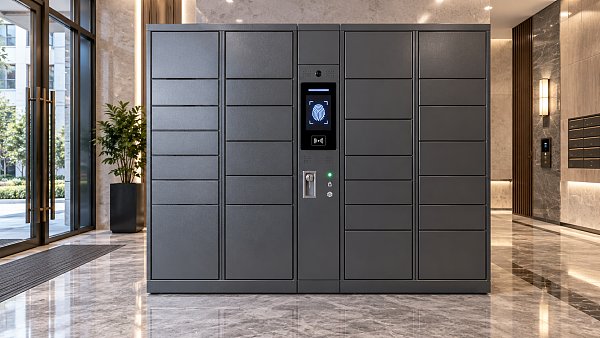
For this reason, a biometric reader should not be selected from a match-rate claim alone. The relevant question is whether the complete transaction works at the installed height, under the available light, with the expected queue behavior, network condition, and parcel-door release sequence. A reader with excellent laboratory performance can still produce poor locker throughput if the screen prompts are unclear or the sensor is positioned where rain, dust, hand lotion, or direct sun interferes with capture.
The delivery handoff must remain simple
Recipient authentication and delivery authentication are separate problems. A courier depositing a parcel needs a fast, auditable way to obtain a correctly sized empty compartment and close the door after loading. Requiring biometric recognition for every delivery person can create enrollment churn and delays, particularly where routes are subcontracted or staff rotate. It can also make urgent access dependent on whether the person has been registered at that specific location.
A practical design commonly gives the delivery workflow a scoped digital authorization. The carrier’s handheld application, dispatch token, QR credential, or centrally managed account requests a compartment for a particular consignment. The locker records the parcel identifier, chosen compartment, door-open interval, close confirmation, and any exception. The recipient's biometric then serves a different purpose at collection: binding the release decision to the enrolled individual.
That separation also helps investigate discrepancies. If a locker door reopened after a failed close sensor, the event log should distinguish a courier deposit event, a remote support release, an attempted biometric match, a successful collection, and a forced-door alarm. Treating every door opening as a single generic event removes the context needed to determine whether a parcel was never deposited, was placed in the wrong compartment, or was collected through an approved fallback route.
Reader choice is tied to the installation environment
Fingerprint readers are compact and familiar, but their placement deserves careful attention. A reader near a parcel door can be exposed to condensation, abrasive dust, cleaning chemicals, and fingers carrying moisture from rain. A recessed bezel may protect the sensor face, yet a deep recess can make it awkward for different hand sizes. The surrounding metal panel must not flex enough to disturb the sensor mount or allow water to collect around cable entries.
Face recognition avoids the need to touch a shared surface, but a locker cabinet is not a controlled access lane. People may approach while holding boxes, wearing hats, or looking down at a phone. A camera aimed toward a walkway needs a field of view that captures a usable face only during a deliberate authentication interaction. Poor placement can create backlighting in the morning or afternoon, while a bright screen at night can produce reflections in nearby glazing. A small canopy, controlled fill light, or a correctly positioned capture zone can matter as much as the algorithm.
Palm-vein or other near-infrared approaches can be attractive where a contactless or low-spoofing modality is required. They still need a natural hand position, clear visual prompts, and enough time for capture. The benefit should be weighed against the physical space needed around the reader and the time required for first-time enrollment. A modality that requires a precise pose can be suitable at a staffed, indoor collection point but frustrating at a busy exterior bank.
Liveness detection is necessary, but it is not the whole security model
A biometric locker reader should distinguish a live presenting person from an artifact such as a printed image, display replay, lifted fingerprint, or other presentation attempt appropriate to the modality. This is the purpose of liveness or presentation-attack detection. Its operating thresholds must be tuned carefully. An overly permissive setting weakens the reason for deploying biometrics; an overly strict setting rejects legitimate people who have dry skin, temporary injuries, strong eyewear reflections, or imperfect positioning.
Even a well-tuned liveness function cannot protect a locker if door control is weak. The electronic lock must report a reliable closed and latched state. The cabinet structure should resist simple pulling or prying around the latch area. A door that is released for the correct person but fails to relock after a partial close creates a security failure that biometric matching cannot repair. The controller should treat an open-door timeout, an unconfirmed close, and a lock fault as distinct events rather than assuming the collection completed successfully.
Network loss also needs explicit treatment. If the system requires a remote biometric template lookup for every opening, a connectivity interruption can strand recipients at the locker. Local encrypted template matching can preserve availability, but it introduces synchronization requirements when access is revoked or a template is replaced. A hybrid arrangement may keep only the minimum active template data locally, queue audit events during an outage, and apply revocation updates when the connection returns. The acceptable behavior depends on the threat level and the consequences of an unavailable parcel.
Enrollment is the hidden operational cost
Enrollment quality determines later recognition quality. A rushed first capture, weak lighting, a damaged sensor, or incomplete instructions can create a template that appears valid in the database but fails repeatedly at collection. The enrollment flow should capture the modality in the conditions required by the reader, confirm the result through a live verification step, and offer a way to correct or renew a template without disabling access to an active parcel.
Identity proofing must be considered separately from biometric capture. A clean fingerprint or face template only proves that the same person appears again; it does not establish that the person was correctly associated with the locker account in the first place. Where identity binding matters, enrollment should occur through an existing trusted process or include a controlled confirmation step. Allowing anyone with access to an email inbox or a forwarded invite to enroll their own biometric can transfer the original credential-sharing problem into the enrollment process.
Privacy design should be settled before hardware selection. A biometric template is sensitive personal data even when the system does not store a raw face image or fingerprint image. The implementation needs a defined purpose, a clear notice at enrollment, retention rules, a deletion process, access controls for administrative functions, and documented handling of failed or disputed authentication events. Local storage is not automatically preferable to central storage; the better choice is the one whose protection, lifecycle control, breach response, and operational dependencies can be managed consistently.
A fallback route determines whether the system is usable
Every shared locker needs an alternative path for failed biometric recognition, damaged fingers, changed appearance, accessibility needs, lost connectivity, a reader fault, or a person who never enrolled. The fallback should be deliberately designed rather than improvised by support staff. A one-time credential delivered through a verified channel, a remote identity check with a limited release, or staffed override access may be appropriate depending on the site.
Fallback authority should be narrower than routine access. It can be limited to one compartment, one parcel, one short time window, and one logged attempt. The system should record the reason code and the person or service account that authorized the exception. A universal mechanical override key stored without control may restore availability, but it erases much of the accountability gained from the biometric layer. Where an emergency mechanical release is necessary, key custody and post-use inspection need the same attention as electronic permissions.
A sound deployment also tests the whole failure chain before launch: an unsuccessful match, a door that does not unlatch, a door left ajar, a controller restart, a network interruption, a parcel assigned to the wrong recipient, and a disputed collection. These events reveal whether the hardware, application, support workflow, and audit log agree on the locker’s actual state.
Biometric locks are therefore well suited to shared parcel lockers with recurring, enrolled users and a real need for accountable collection. They are less suitable as a mandatory gate for anonymous or occasional pickup. The strongest arrangement treats biometrics as one controlled identity factor within a resilient locker workflow, supported by reliable door sensing, limited fallback access, durable installation details, and lifecycle management for the enrolled template.
Have questions about this sector analysis, or seeking best practices specific to your niche? Drop us a line below and let the senior consultants at MHLS assist you.
We respect your privacy. Your information is strictly confidential.
Recommended News
 Physical Security Infrastructure Cost: Budgeting for Installation and MaintenanceUnmanned Terminal FellowUnderstand physical security infrastructure cost and build a smarter budget for installation, maintenance, and long-term ownership.
 Financial Facility Security: Choosing Vault Doors for Bank BranchesVault Structural ArchitectStrengthen financial facility security with the right bank vault door. Explore certification, installation, locking controls and maintenance before you buy.
 MACO Acquires Majority Stake in Fingerprint Access Provider ekeyProf. Elara SterlingMACO acquires a majority stake in ekey, bringing fingerprint access and door hardware closer together. Discover what the deal could mean for smart buildings.
 Physical Security System Engineering: From Risk Assessment to System DesignUnmanned Terminal FellowExplore physical security system engineering, from risk assessment to integrated design, procurement and testing. Build a safer, more resilient facility.
 Apple Home Collection Smart Lock and Other Accessories Open for Preorder November 13Biometric Auth ScientistApple Home Collection preorders open November 13, 2026. Explore the LG smart lock’s Matter and Aliro support and what buyers should verify before ordering.
 Choosing Servo-Driven Flap Barriers: Throughput, Safety and Access ControlAccess Control StrategistServo-driven flap barriers can balance throughput, safety and access control. Discover how to compare lanes, test performance and choose with confidence.
 Parcel Locker Network Pricing: Setup Costs, Fees and Contract TermsUnmanned Terminal FellowCompare parcel locker networks pricing, from setup costs and recurring fees to contract terms. Discover hidden charges and choose the right model.
 JR East Plans UWB Walk-Through Gates at 40 Stations in Spring 2028Access Control StrategistJR East plans UWB walk-through gates at 40 stations in spring 2028. Explore the rollout timeline and what suppliers should watch.
 Bank Vault Security Standards: UL and EN Ratings ExplainedVault Structural ArchitectExplore bank vault security standards and learn how UL 608 classes and EN 1143-1 grades differ, what they test, and how to verify certification before you buy.
 Mechanical Lock Hardware Prices: What Buyers Should Budget for Bulk OrdersMr. Gideon CrossMechanical lock hardware price is just the starting point. Discover what drives bulk-order costs and how to compare supplier quotes with confidence.
 IndexBox Forecasts Steady Global Security Keypad Market Growth Through 2035Dr. Valerius ThorneGlobal security keypad market growth is forecast at 3.3% annually through 2035. Explore the smart home and replacement trends shaping demand.
 Choosing an Infrared Safety Sensors Manufacturer: What Buyers Should CheckUnmanned Terminal FellowChoosing an infrared safety sensors manufacturer? Compare safety evidence, integration, environmental performance and lifecycle costs before you buy.











