Choosing Networked Hotel Lock Systems: Connectivity, Integration and Security
Select networked hotel lock systems against the failures and workflows the property must handle: a lost network connection, a cancelled reservation, a staff credential that needs immediate removal, and a guest arriving while the property management system is unavailable. A suitable system must perform acceptably under those conditions as well as during normal operation.
The central selection question is where access decisions are made and how quickly changes reach each door. A lock that validates credentials locally can continue admitting guests during a network outage, but it may not receive a newly issued revocation until communication returns. A centrally connected lock can support faster changes when online, yet still needs a defined local fallback. Ask suppliers to demonstrate both paths rather than treating “online” or “offline capable” as a complete description.
Choose connectivity around the required response time
Hotel lock architectures range from locally administered locks that receive updates through a mobile device or programming tool to wireless locks linked through gateways, and wired locks connected to the property network. Some combine these approaches. The appropriate architecture follows the property’s tolerance for delayed changes, the building layout and the infrastructure available at each door.
“Real-time” deserves a precise definition. Determine whether it describes a command leaving the management platform, reaching a gateway, being acknowledged by the lock, or taking effect at the reader. Those events are different. A useful acceptance test records the time from a credential being revoked in the management system to a denied presentation at the door, including the result when the lock is asleep or temporarily disconnected.
Wireless coverage should be measured at installed lock positions with doors closed, not inferred from a corridor survey alone. Metal doors, fire-rated assemblies, service risers and reinforced walls can alter the radio path. A strong signal does not prove that commands are delivered reliably when many locks communicate at once. Test representative rooms at the edge of coverage and establish how the system reports a gateway or lock that has stopped communicating.
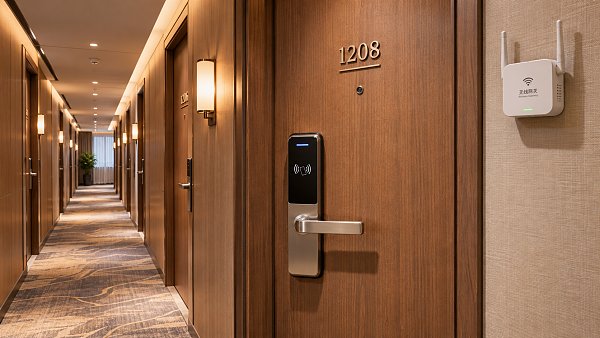
Gateway design also affects failure isolation. If one gateway serves an entire floor, its power supply and network connection become shared dependencies. Ask whether locks can connect through an alternate gateway, how that transition is detected, and whether the proposed layout has been tested with a gateway switched off. For wired systems, inspect the complete route from lock to switch, including door transfers and any local power supplies.
Define offline access before comparing credentials
A guest credential often carries an authorization that the lock can verify locally, such as a validity period and a room assignment. That arrangement allows entry when the management platform is unreachable. It also creates a difficult question: what happens when a reservation is cancelled or a card is reported lost after the credential has been issued?
Some systems invalidate an earlier guest credential when a new one is presented at the door. Others require the lock to receive a revocation or updated access list. The first approach still leaves an exposure window before the replacement credential reaches the lock; the second depends on communication or a physical update. Establish the actual sequence for guest cards, mobile credentials and staff credentials separately. Their revocation mechanisms need not be identical.
Time-limited credentials reduce the duration of stale authorization, but only if the lock has a reliable clock and the issuance process sets validity correctly. Ask how clock drift is detected and corrected, what happens after a battery replacement, and whether daylight-saving changes or time-zone configuration affect access. Test early arrival, late checkout and a room change across the relevant time boundary.
Mobile access adds dependencies outside the lock itself: credential delivery, the guest’s device, the mobile application or wallet path, and any service used to provision the credential. A phone communicating directly with a lock does not necessarily mean that a new credential can be issued when the internet is down. Separate the ability to use an already provisioned credential from the ability to issue, change or revoke one during an outage. Keep a documented alternative for guests whose device or credential cannot be used.
Evaluate the property management integration as a sequence
A claim of property management system integration says little about the transactions supported. Request a current interface specification for the exact versions under consideration and map the events that must cross the boundary: check-in, room assignment, room move, extension, early departure, cancellation and checkout. Include shared rooms, multiple guests and access to common areas where relevant.
The direction of authority matters. Identify which system owns the reservation, which issues or modifies the credential, and which records the final room assignment. If a room move succeeds in the property management system but fails in the lock platform, staff need a visible exception and a way to reconcile the two records. Silent retries without an expiry or duplicate-handling rule can create an access right after the underlying booking has changed.
Test the interface with the network interrupted between systems. Observe whether transactions queue, whether their order is preserved, and what happens when service resumes after a reservation has been edited again. A delayed checkout event must not remove access from a later, legitimate stay in the same room. The integration should identify the affected reservation and credential, rather than relying on a room number alone.
Account lifecycle is part of integration too. A shared service account with broad privileges is harder to audit and contain than a dedicated integration identity with limited permissions. Document credential rotation, certificate ownership where applicable, supported authentication methods, and the procedure for disabling the connection. Confirm who maintains the interface after either connected system is upgraded.
Inspect security at the lock, network and management layers
Encryption claims need context. Ask which communications are protected: credential-to-lock, lock-to-gateway, gateway-to-server and server-to-property management system are separate paths. Identify how devices authenticate each other, how keys are provisioned and rotated, and what happens if a lock or gateway is replaced. An encrypted channel does not by itself establish that the device at the other end is authorized.
At the credential layer, distinguish between a unique identifier being read and a credential that proves possession of a protected secret. A system that grants access solely from an identifier can expose itself to copying or replay. Request a description of the challenge-response or equivalent authentication process, including how the system handles credential loss and the compromise of an issuing device. Avoid accepting the name of a card technology alone as evidence of the configured security level.
Management permissions deserve the same scrutiny as door hardware. Separate routine guest issuance from the ability to create master credentials, change access schedules, alter integrations or export logs. Individual accounts support attribution; shared accounts obscure it. Where supported, require multifactor authentication for privileged remote access and establish an approval and removal process for temporary vendor access.
Audit trails should record enough context to reconstruct an event: door, event type, credential or account reference, timestamp and outcome. Confirm whether the timestamp originates at the lock or server, how long events remain on a disconnected lock, and what happens when local storage fills. An entry recorded after synchronization is not proof that the server received it at the time of entry. Protect exported logs and limit access because room movements and guest identifiers can be sensitive.
Firmware updates introduce another trust boundary. Establish whether locks verify update authenticity before installation, how a failed update is detected, and whether recovery requires a door visit or hardware replacement. A staged rollout to representative doors reduces the chance that a compatibility problem affects an entire property. Agree on the support period, vulnerability reporting channel and responsibility for testing updates against the installed integration.
Validate the installed door, not only the reader
Connectivity cannot compensate for an incompatible mechanical installation. Confirm door thickness, handing, existing mortise preparation, latch and strike alignment, and the clearance around seals. A retrofit that requires extensive modification can affect the door assembly and its fire or accessibility characteristics. Any proposed change should be reviewed against the applicable requirements and the door assembly documentation; a lock specification alone does not establish compliance for the completed installation.
Battery life figures are meaningful only with their assumptions. Credential traffic, wireless polling, signal quality, temperature and motor load all influence consumption. A misaligned strike can make the motor work harder, while a weak radio path can lead to repeated transmissions. Examine low-battery warnings, the interval between warning and loss of normal operation, and whether staff receive alerts centrally or must discover them at the door.
Emergency entry and egress need separate treatment. Establish the approved means of entering a room when electronics or batteries fail, how that means is controlled and logged, and whether the door permits required egress without electronic authorization. Demonstrate the procedure on the installed assembly; an emergency power contact or mechanical override is useful only if it remains accessible and functional in the actual door configuration.
Make acceptance tests part of the specification
A short pilot should use representative doors, the intended network topology and the actual integration path. Include a weak-coverage location, a door with the proposed retrofit hardware and at least one gateway or switch failure. Record expected results before testing so that a delayed update is not later treated as an acceptable outcome by default.
- Revocation: issue a credential, revoke it, and measure when the door denies it while connected and while disconnected.
- Recovery: restore communication after several conflicting reservation changes and verify the final access rights at the lock.
- Audit: generate an entry offline, reconnect the lock and compare the event time, upload time and recorded outcome.
- Power: remove the relevant gateway or switch power, then demonstrate guest access, alerting and restoration.
- Administration: remove a staff account and confirm that associated privileges and active sessions are handled as specified.
Document any behavior that relies on manual intervention, including who performs it and what evidence confirms completion. The resulting acceptance criteria give the property a basis for comparing systems whose feature lists look similar but whose behavior under interruption is materially different.
Have questions about this sector analysis, or seeking best practices specific to your niche? Drop us a line below and let the senior consultants at MHLS assist you.
We respect your privacy. Your information is strictly confidential.
Recommended News
 JR East Plans UWB Walk-Through Gates at 40 Stations in Spring 2028Access Control StrategistJR East plans UWB walk-through gates at 40 stations in spring 2028. Explore the rollout timeline and what suppliers should watch.
 Bank Vault Security Standards: UL and EN Ratings ExplainedVault Structural ArchitectExplore bank vault security standards and learn how UL 608 classes and EN 1143-1 grades differ, what they test, and how to verify certification before you buy.
 Mechanical Lock Hardware Prices: What Buyers Should Budget for Bulk OrdersMr. Gideon CrossMechanical lock hardware price is just the starting point. Discover what drives bulk-order costs and how to compare supplier quotes with confidence.
 IndexBox Forecasts Steady Global Security Keypad Market Growth Through 2035Dr. Valerius ThorneGlobal security keypad market growth is forecast at 3.3% annually through 2035. Explore the smart home and replacement trends shaping demand.
 Choosing an Infrared Safety Sensors Manufacturer: What Buyers Should CheckUnmanned Terminal FellowChoosing an infrared safety sensors manufacturer? Compare safety evidence, integration, environmental performance and lifecycle costs before you buy.
 Choosing a Security Material Testing Service: What to Check for Lock and Safe MaterialsProf. Elara SterlingChoose a security material testing service with confidence. Learn what to check for lock and safe materials, from attack methods and accreditation to reliable reports.
 How Precision Anti-Pick Lock Cylinders Resist ManipulationSecurity Metallurgy ExpertDiscover how precision anti-pick lock technology resists manipulation, and learn what to check when comparing security features, test evidence, and everyday reliability.
 Dermalog Joins NIST FastCAP Program for Contactless Fingerprint TestingProf. Elara SterlingDermalog joins the NIST FastCAP program for contactless fingerprint testing. Discover what this means for biometric identification and digital identity.
 Choosing Security Export Compliance Services: What Providers Should CoverMr. Gideon CrossSecurity export compliance services can help prevent costly delays. Discover what to look for in classification, licensing, screening, and documentation.
 European Security Compliance Standards for Safes: EN 1143-1 vs EN 14450Dr. Valerius ThorneExplore security compliance standards Europe buyers need to know. Compare EN 1143-1 and EN 14450 to choose the right safe with confidence.
 HID Global Acquires inepro ID to Expand RFID and BLE Access SolutionsUnmanned Terminal FellowHID Global acquires inepro ID to expand RFID and BLE access solutions for printers, smart lockers and shared devices. Explore what the deal could mean for your organization.
 Choosing Networked Hotel Lock Systems: Connectivity, Integration and SecurityBiometric Auth ScientistCompare networked hotel lock systems by connectivity, PMS integration and security. Learn what to test before choosing a system for your property.