
Hotel Security Systems in the USA: Choosing Locks That Work With Your PMS
A guest changes rooms, the front desk issues a replacement key, and the original credential still opens the previous room. The lock may be operating exactly as designed; the failure lies in how the property management system (PMS), access software, and door hardware exchange updates. Choosing compatible locks means verifying complete guest-access workflows, not simply finding a PMS logo on a supplier’s integration page.
For teams comparing hotel security systems USA properties can operate reliably, the strongest choice is a documented, supported integration that proves credential issuance, room moves, revocation, and outage recovery on the proposed configuration. Start with your exact PMS deployment and operational requirements, then select the lock architecture. Reversing that sequence can leave the front desk dependent on manual workarounds.
Define what “works with our PMS” must include
A PMS usually manages reservations, room assignments, and stay dates. The lock-management platform controls access permissions, while an encoder or mobile credential service delivers credentials. These functions may appear inside one front-desk interface without sharing the same database, availability, or support owner.
Before requesting proposals, record the PMS product and version, whether it is cloud-hosted or locally deployed, the property’s room identifiers, and existing interfaces. Include suites, connecting rooms, shared entrances, elevators, and staff-only areas where guest permissions may differ. A connector that supports ordinary guestrooms may not support every access zone.
Ask suppliers to identify the exact supported configuration in writing:
- Interface scope: Which reservation or check-in actions trigger access changes, and which require a separate operator command?
- Supported versions: Which PMS releases, lock firmware, encoders, middleware, and credential services are covered?
- Delivery responsibility: Who installs, licenses, monitors, and maintains each integration component?
- Support boundaries: Who investigates when the PMS reports success but the credential fails at the door?
“API available” does not establish that a production connector exists. Similarly, a working interface at another hotel does not prove compatibility with your PMS hosting model, enabled modules, or proposed lock generation.
Choose the architecture around update speed and failure behavior
The important distinction is not simply card versus mobile. It is how authorization reaches the door, how quickly changes take effect, and what remains functional when a component is unavailable.
Mobile capability and network connectivity are not interchangeable. A phone may communicate locally with a lock that has no continuous back-end connection. Conversely, a connected lock can still use physical cards. Ask vendors to draw both the credential-delivery path and the door-update path.
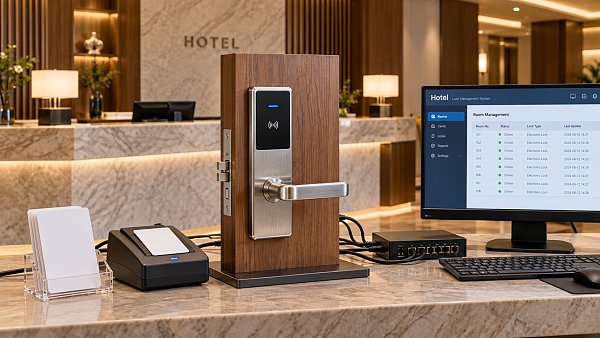
The drawing should identify the PMS, connector, access server, encoder, mobile service, gateways, and locks. Mark what crosses the property network or internet, where credentials are generated, and which component confirms an update. This exposes dependencies that a feature comparison can hide.
Test room changes before testing convenience features
A successful initial check-in proves relatively little. Exceptions reveal whether the integration preserves access boundaries under normal hotel pressure. Use a test reservation and representative doors to validate the following transactions before approving the purchase.
Room reassignment and replacement keys
Move a checked-in reservation to another room. Confirm that the new credential opens the correct guestroom and authorized shared areas. Then present the old credential at the original room. Record whether it is rejected immediately, only after another credential updates the lock, after a network command arrives, or only at its original expiration.
Repeat the exercise for a lost key and for an additional key issued to a second occupant. Replacement and duplicate credentials may follow different rules: one may supersede earlier keys, while the other intentionally preserves them. Front-desk labels and permissions must make that distinction clear.
Extensions, early departures, and shared reservations
Extend a stay without changing rooms. Determine whether existing cards must be re-encoded and whether mobile access updates automatically. Next, check out early and test the credential at both the guestroom and shared entrances. Changing the reservation record alone is not proof that door access has ended.
For multiple occupants, establish whether access is tied to the reservation, room, individual guest, or credential. Removing one guest should not accidentally remove another authorized occupant unless that is the documented policy. Test partial departures and separate credential revocation where required.
Delayed or repeated messages
Ask the integration team to demonstrate behavior when a request times out, is retried, or arrives after a newer change. The system should prevent an older room assignment from overwriting the current one and avoid creating unintended extra credentials. Operators need a visible pending or failed state rather than a misleading success message.
Turn revocation promises into measurable acceptance criteria
Revocation is complete only when the relevant door rejects the credential. A disabled record in the access platform, a deleted mobile key, and confirmed door-side enforcement are different events.
Require suppliers to describe enforcement for each credential type and door class. For connected locks, distinguish command submission, gateway receipt, and lock acknowledgment. For offline locks, document any replacement-key sequence, cancellation credential, physical visit, or expiration rule needed to remove access.
Define your acceptable enforcement interval based on the event. A routine checkout and a reported stolen credential may require different responses. Where the system cannot meet the required interval, specify the operational alternative and who performs it. Do not accept an unqualified “instant cancellation” claim without a demonstration under disconnected conditions.
Run an outage test that follows the guest journey
Existing credentials may continue opening doors during an outage even when the hotel cannot issue new ones. That distinction matters during arrivals, late-night room moves, and stay extensions. Test dependencies separately rather than treating “offline mode” as one feature.
- Disconnect the PMS interface. Check whether authorized staff can issue access through a controlled fallback and how those actions are reconciled later.
- Remove internet access. Test card issuance, mobile provisioning, and local management separately. A locally installed component may still depend on cloud authentication or licensing.
- Interrupt the lock network. Verify existing credentials, pending updates, door status indicators, and the operator warning for unreachable locks.
- Restore services. Check that queued actions do not reinstate obsolete access or produce duplicate credentials.
The fallback procedure should identify authorized users, available equipment, credential storage, and reconciliation responsibilities. Emergency credentials need controlled custody and an audit process; they should not become an unrestricted shortcut whenever the normal interface is inconvenient.
Also test power loss at the encoder, local server, and gateway. Door batteries do not protect the rest of the issuance chain. Confirm which components require backup power and which functions stop when backup power is exhausted.
Check the door, network, and security boundary together
PMS compatibility cannot compensate for unsuitable hardware. Survey representative doors for thickness, preparation, handing, mortise or latch configuration, alignment, and closer performance. A door that does not reliably latch remains a security problem even when every access transaction is correct.
For USA deployments, have the proposed opening assembly reviewed against applicable accessibility, fire, and egress requirements. Verify the scope of any listing or test evidence for the actual hardware configuration; a component claim does not automatically cover a modified door assembly.
Network evaluation should include gateway placement, wireless coverage at installed doors, segmentation, firewall rules, and remote support access. Require named administrative accounts, appropriate role separation, and controlled service credentials. The PMS connector should receive only the permissions necessary for its documented functions.
For cards and mobile keys, ask how credentials are authenticated, how cryptographic keys are managed, and whether compromised credentials or devices can be replaced without unnecessarily disrupting the property. A radio technology name alone does not establish resistance to cloning or replay.
Make audit evidence useful during an incident
When access is disputed, staff need to connect a reservation change to credential issuance and then to a door event. Request sample logs showing identifiers, timestamps, operator actions, issuance results, delivery failures, and access outcomes. Avoid relying on a dashboard screenshot without exportable records.
Confirm time synchronization, time-zone handling, and daylight-saving behavior across the PMS, access server, and locks. Offline lock clocks can drift, and event retrieval may require a physical visit. Determine whether the displayed time reflects the event itself or the later upload.
Define retention and access permissions according to operational needs and applicable privacy obligations. Collecting unnecessary guest information increases exposure without necessarily improving investigations. Staff access logs also need coverage: PMS-driven guest access is not a substitute for managing employee and contractor permissions.
Award the contract against evidence, not the demo
Require a property-specific acceptance plan using the proposed PMS interface, production-equivalent firmware, credential types, and representative door conditions. Record the expected result, observed behavior, logs, and responsible party for each scenario. Any unsupported workflow should become an explicit exclusion, not an informal promise.
Compare lifecycle costs across the complete chain: locks, encoders, gateways, interface licenses, mobile services, subscriptions, batteries, replacement devices, training, and support. Establish who funds regression testing after PMS or firmware upgrades and how failed upgrades can be rolled back.
Use staged deployment where practical. A pilot should include difficult network locations and operational exceptions, not only a convenient door near the front desk. Before wider rollout, resolve failed revocation tests, unclear outage procedures, and gaps in support ownership. A polished check-in demonstration should never outweigh a system’s inability to enforce a room move or recover safely after an interrupted update.
Have questions about this sector analysis, or seeking best practices specific to your niche? Drop us a line below and let the senior consultants at MHLS assist you.
We respect your privacy. Your information is strictly confidential.
Recommended News
 Financial Facility Security: Choosing Vault Doors for Bank BranchesVault Structural ArchitectStrengthen financial facility security with the right bank vault door. Explore certification, installation, locking controls and maintenance before you buy.
 MACO Acquires Majority Stake in Fingerprint Access Provider ekeyProf. Elara SterlingMACO acquires a majority stake in ekey, bringing fingerprint access and door hardware closer together. Discover what the deal could mean for smart buildings.
 Physical Security System Engineering: From Risk Assessment to System DesignUnmanned Terminal FellowExplore physical security system engineering, from risk assessment to integrated design, procurement and testing. Build a safer, more resilient facility.
 Apple Home Collection Smart Lock and Other Accessories Open for Preorder November 13Biometric Auth ScientistApple Home Collection preorders open November 13, 2026. Explore the LG smart lock’s Matter and Aliro support and what buyers should verify before ordering.
 Choosing Servo-Driven Flap Barriers: Throughput, Safety and Access ControlAccess Control StrategistServo-driven flap barriers can balance throughput, safety and access control. Discover how to compare lanes, test performance and choose with confidence.
 Parcel Locker Network Pricing: Setup Costs, Fees and Contract TermsUnmanned Terminal FellowCompare parcel locker networks pricing, from setup costs and recurring fees to contract terms. Discover hidden charges and choose the right model.
 JR East Plans UWB Walk-Through Gates at 40 Stations in Spring 2028Access Control StrategistJR East plans UWB walk-through gates at 40 stations in spring 2028. Explore the rollout timeline and what suppliers should watch.
 Bank Vault Security Standards: UL and EN Ratings ExplainedVault Structural ArchitectExplore bank vault security standards and learn how UL 608 classes and EN 1143-1 grades differ, what they test, and how to verify certification before you buy.
 Mechanical Lock Hardware Prices: What Buyers Should Budget for Bulk OrdersMr. Gideon CrossMechanical lock hardware price is just the starting point. Discover what drives bulk-order costs and how to compare supplier quotes with confidence.
 IndexBox Forecasts Steady Global Security Keypad Market Growth Through 2035Dr. Valerius ThorneGlobal security keypad market growth is forecast at 3.3% annually through 2035. Explore the smart home and replacement trends shaping demand.
 Choosing an Infrared Safety Sensors Manufacturer: What Buyers Should CheckUnmanned Terminal FellowChoosing an infrared safety sensors manufacturer? Compare safety evidence, integration, environmental performance and lifecycle costs before you buy.
 Choosing a Security Material Testing Service: What to Check for Lock and Safe MaterialsProf. Elara SterlingChoose a security material testing service with confidence. Learn what to check for lock and safe materials, from attack methods and accreditation to reliable reports.











