
Integrating Hotel Smart Locks with a Mobile App: APIs, SDKs, and Access Security
Hotel smart lock integration with mobile app platforms requires a clear separation between reservation data, access authorization, and the credential presented at the door. A successful unlock demonstration proves only one path through that system. A deployable integration must also handle room changes, duplicate events, offline locks, lost phones, and checkout updates without leaving access rights in an uncertain state.
The central technical question is where each access decision occurs. The hotel backend decides whether a stay qualifies for access; the credential service issues the corresponding rights; the lock validates the credential against its local state and security rules. API specifications and SDK documentation should make those boundaries explicit, including what happens when any component loses connectivity.
Separate the reservation workflow from the door transaction
A typical architecture connects the property management system, a hotel integration backend, a mobile key service, the guest application, and the lock. Gateways provide a separate communication path for connected doors. The property management system supplies stay and room assignment information, while the integration backend converts approved changes into credential operations.
The mobile application should never receive a property-wide management secret or unrestricted credential issuance authority. It authenticates the guest, registers the device, requests an eligible key, and invokes the lock SDK. Backend services retain authority over room assignment, validity periods, and administrative actions.
At the door, the phone communicates through a supported transport such as Bluetooth Low Energy or NFC. The exchange should authenticate the credential and establish freshness, preventing a captured unlock transaction from being replayed. Transport encryption alone does not establish that a particular phone has permission to open a particular room.
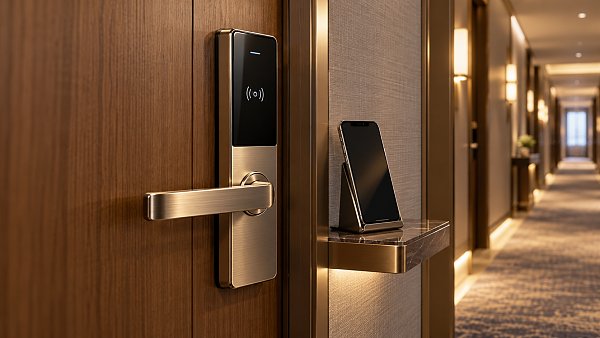
Two paths deserve separate documentation: the provisioning path that delivers access rights to the phone, and the presentation path that proves those rights to the lock. A phone might require internet access to download a key while subsequently opening an offline door. Describing both operations simply as “offline support” conceals an important operational difference.
API behavior determines whether access follows the stay correctly
Credential APIs need explicit operations for issuing, retrieving status, replacing, and revoking access. Their data model should distinguish the reservation, stay, guest, room assignment, device, and credential. Using a room number as the primary identifier creates ambiguity when room labels change or multiple properties share the same numbering scheme.
Authorization must be enforced against the authenticated identity and its permitted property and stay. An application-supplied room identifier is a request parameter, not evidence of entitlement. Backend validation must prevent a guest from requesting another room’s credential by changing an identifier, even when the request is otherwise authenticated.
For service authentication, evaluate credential rotation, narrowly scoped permissions, and separation between test and production environments. OAuth-based access tokens are one possible mechanism; their presence does not prove correct authorization. The important evidence is whether each endpoint enforces the required property, resource, and action boundaries.
Event delivery also needs a defined consistency model. Reservation updates and webhooks can arrive late, repeat, or arrive out of order. A checkout event must not be reversed by an older check-in update delivered afterward. Durable event identifiers, source versions where available, and explicit state-transition rules help prevent that outcome.
Issuance should support idempotency so that retrying a timed-out request does not create multiple independent keys. When the response is lost after issuance succeeds, the integration needs a way to retrieve the existing result. Webhook authentication, replay protection, retry behavior, and reconciliation queries belong in the API contract rather than being left to application assumptions.
SDK compatibility extends beyond supported phone models
The SDK owns a sensitive boundary between application code, device storage, operating-system permissions, and the lock protocol. Its evaluation should cover supported operating-system versions, firmware dependencies, application lifecycle behavior, and how security fixes reach deployed applications. A compatibility statement without specific combinations leaves upgrade risk unresolved.
Bluetooth permissions, foreground requirements, and background execution restrictions affect the unlock experience. NFC availability depends on the operating system, device capabilities, and access to the required platform interfaces. An integration that works while the application is open does not automatically support a locked-screen or background experience.
SDK packaging matters when the application uses a cross-platform framework. A wrapper can expose basic unlocking while omitting device enrollment, detailed error reporting, or key deletion events. Required functions should be traced through the actual application stack, including native components and their release dependencies.
Error handling needs enough detail to distinguish missing credentials, expired rights, denied permissions, radio discovery failures, protocol rejection, and mechanical actuation faults. Repeatedly prompting a guest to retry Bluetooth will not resolve an expired key. Production diagnostics should retain useful error categories without recording credential material or unnecessary guest information.
Credential design sets the security boundary
A mobile key should carry, or securely reference, a bounded authorization: which doors it covers, when it becomes valid, when it expires, and which device or credential instance may present it. Room access and shared-area access require deliberate scoping. A room move should not unintentionally preserve access to the previous room because both assignments remain attached to the same stay.
Device binding reduces the usefulness of copied application data. Where supported, device-generated private keys should remain in hardware-backed storage, with issuance tied to proof that the device controls the corresponding key. Hardware-backed storage protects key extraction; it does not independently establish that the person requesting a room key is the authorized guest.
Account recovery and adding a second device therefore deserve the same attention as initial issuance. An authenticated session alone may provide insufficient assurance when an account was recently recovered or a new phone requests active room access. Step-up authentication and explicit device enrollment provide additional control, with recovery procedures defined before deployment.
The door protocol should use authenticated exchanges and freshness controls. A static identifier transmitted over an encrypted connection remains vulnerable if possession of that identifier is enough to unlock and it can be copied elsewhere. Protocol documentation should explain replay resistance, secret protection, and how compromised credentials or lock keys are replaced.
Bluetooth signal strength does not reliably prove that a phone is immediately beside a door. Relay attacks require separate analysis, especially for automatic or hands-free unlocking. Claims of proximity protection need evidence about the actual protocol and hardware rather than assumptions based on radio range.
Offline doors impose a limit on revocation
An offline lock cannot immediately enforce a revocation it has not received. Removing a key from the application or disabling a cloud account does not guarantee that a previously provisioned credential will stop working at that door. The result depends on credential expiration, local lock state, and available update paths.
Shorter credential lifetimes reduce the period during which revoked rights remain usable, but increase dependence on refresh availability. A guest with a valid stay and no mobile connectivity could lose access after the stored credential expires. That tradeoff needs an explicit operational policy and a fallback credential process.
Time-based enforcement also depends on the lock’s clock. Clock drift, battery replacement, and time synchronization affect validity checks at offline doors. Credential timestamps should use an unambiguous reference, with local hotel time translated carefully for scheduled arrivals and departures. Any clock tolerance creates an associated extension to the effective access window.
For a lost phone, disabling future provisioning and attempting supported revocation are separate actions. Remote deletion from the application is useful only if the device receives and obeys it. The incident workflow must identify which doors have acknowledged invalidation and which remain dependent on expiration or a local update.
Room moves and shared access expose lifecycle defects
A room move is a useful test because it changes authorization while the stay remains active. The integration must establish when the new room becomes accessible, when the previous room stops accepting the old credential, and whether shared-area permissions persist. If the two changes cannot be applied atomically, the temporary overlap or access gap needs a defined handling rule.
Additional guests introduce another distinction: revoking one person’s device should not necessarily revoke every credential associated with the room. Conversely, checkout should close all relevant guest credentials, including those issued to secondary devices. A complete credential inventory is necessary to perform either operation reliably.
Checkout extensions present the reverse problem. Updating the reservation does not prove that a phone has received an extended key or that a lock has received changed authorization. The interface should distinguish requested, issued, delivered, and applied states wherever the underlying system exposes them. A generic “success” response is insufficient if it only confirms that a job entered a queue.
Acceptance evidence should reproduce failures at the door
Security evaluation should connect documentation to observable behavior. Mobile application security guidance and API security testing provide useful assessment frameworks, but neither establishes that a particular lock protocol or installation is secure. Independent testing should cover the deployed application, backend authorization, credential lifecycle, and relevant lock firmware together.
A focused acceptance exercise should include these scenarios:
- Interrupted issuance: drop connectivity after the service creates a key but before the application receives confirmation. A retry should resolve the original operation without creating uncontrolled duplicates.
- Move an active stay to another room, then attempt entry at both doors with every issued device. Record actual door behavior alongside backend status.
- Offline revocation: disconnect the door and phone, revoke the credential, and establish precisely when access stops under the supported design.
- Exercise clock boundaries and permission failures, then confirm that diagnostics identify the cause without exposing secrets.
- Upgrade the application and relevant firmware across supported combinations. Previously issued credentials, device enrollment, and recovery behavior need to remain consistent with the documented migration policy.
Audit records should correlate the stay change, credential operation, delivery status, and door event through stable identifiers. An unlock request accepted by an API, a credential accepted by a lock, and a door physically opening are different observations. Where door-position sensing is absent, logs should describe the event they actually establish.
The strongest deployment evidence is a traceable result for each transition: what access was intended, which component accepted the change, and what the door subsequently enforced. Any transition that remains unobservable needs a defined reconciliation or recovery procedure before live guest access depends on it.
Have questions about this sector analysis, or seeking best practices specific to your niche? Drop us a line below and let the senior consultants at MHLS assist you.
We respect your privacy. Your information is strictly confidential.
Recommended News
 Parcel Locker Network Pricing: Setup Costs, Fees and Contract TermsUnmanned Terminal FellowCompare parcel locker networks pricing, from setup costs and recurring fees to contract terms. Discover hidden charges and choose the right model.
 JR East Plans UWB Walk-Through Gates at 40 Stations in Spring 2028Access Control StrategistJR East plans UWB walk-through gates at 40 stations in spring 2028. Explore the rollout timeline and what suppliers should watch.
 Bank Vault Security Standards: UL and EN Ratings ExplainedVault Structural ArchitectExplore bank vault security standards and learn how UL 608 classes and EN 1143-1 grades differ, what they test, and how to verify certification before you buy.
 Mechanical Lock Hardware Prices: What Buyers Should Budget for Bulk OrdersMr. Gideon CrossMechanical lock hardware price is just the starting point. Discover what drives bulk-order costs and how to compare supplier quotes with confidence.
 IndexBox Forecasts Steady Global Security Keypad Market Growth Through 2035Dr. Valerius ThorneGlobal security keypad market growth is forecast at 3.3% annually through 2035. Explore the smart home and replacement trends shaping demand.
 Choosing an Infrared Safety Sensors Manufacturer: What Buyers Should CheckUnmanned Terminal FellowChoosing an infrared safety sensors manufacturer? Compare safety evidence, integration, environmental performance and lifecycle costs before you buy.
 Choosing a Security Material Testing Service: What to Check for Lock and Safe MaterialsProf. Elara SterlingChoose a security material testing service with confidence. Learn what to check for lock and safe materials, from attack methods and accreditation to reliable reports.
 How Precision Anti-Pick Lock Cylinders Resist ManipulationSecurity Metallurgy ExpertDiscover how precision anti-pick lock technology resists manipulation, and learn what to check when comparing security features, test evidence, and everyday reliability.
 Dermalog Joins NIST FastCAP Program for Contactless Fingerprint TestingProf. Elara SterlingDermalog joins the NIST FastCAP program for contactless fingerprint testing. Discover what this means for biometric identification and digital identity.
 Choosing Security Export Compliance Services: What Providers Should CoverMr. Gideon CrossSecurity export compliance services can help prevent costly delays. Discover what to look for in classification, licensing, screening, and documentation.
 European Security Compliance Standards for Safes: EN 1143-1 vs EN 14450Dr. Valerius ThorneExplore security compliance standards Europe buyers need to know. Compare EN 1143-1 and EN 14450 to choose the right safe with confidence.
 HID Global Acquires inepro ID to Expand RFID and BLE Access SolutionsUnmanned Terminal FellowHID Global acquires inepro ID to expand RFID and BLE access solutions for printers, smart lockers and shared devices. Explore what the deal could mean for your organization.











