
EN 1143-1 Burglary Resistance Explained: How Grades Are Tested for Safes and Vault Doors
EN 1143-1 burglary resistance is one of the most practical benchmarks for judging how a safe or vault door performs under forced attack. In day-to-day evaluation, the standard matters because appearance, steel thickness, and lock count rarely tell the full story.
What usually matters more is verified resistance. That includes how long a product can delay drilling, cutting, prying, or punching, and whether the result was confirmed by an accredited test body rather than a catalog claim.
For teams comparing secure storage products across sites, insurers, and export markets, EN 1143-1 burglary resistance offers a common language. It helps connect engineering details, test evidence, and real deployment decisions in a way that reduces guesswork.
What does EN 1143-1 burglary resistance actually measure?
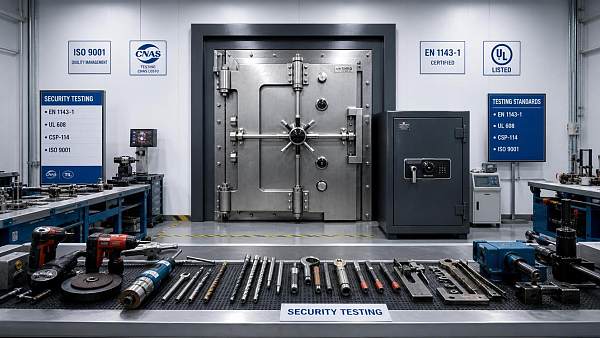
In simple terms, EN 1143-1 burglary resistance measures how well safes, strongroom doors, and vault components withstand professional attack methods under controlled testing conditions.
The standard does not certify a product as “unbreakable.” It assigns a resistance grade based on attack time, tool effectiveness, and the amount of work required to create an opening or defeat the barrier.
That distinction is important. A heavy body, decorative cladding, or multiple locks may look impressive, yet EN 1143-1 burglary resistance focuses on proven attack resistance, not visual confidence.
The standard typically applies to products such as:
- Burglar-resistant safes for cash, records, and valuables
- Vault doors and strongroom doors
- Night safes and deposit systems in some configurations
- High-security storage used in commercial, financial, and mixed-use facilities
Across the SHPS physical security landscape, this matters because burglary resistance is only one layer. Lock intelligence, relocking design, composite materials, and installation quality all shape the final protection level.
How are the grades tested, and what do the attackers try to do?
A common misunderstanding is that grades come from static material tests. They do not. EN 1143-1 burglary resistance is determined through practical attack testing performed with defined tools and structured scoring rules.
Test teams simulate realistic burglary attempts. Their goal is not to damage the finish. Their goal is to gain partial or full access, or to create an opening large enough to compromise security.
Attack methods may include drilling, grinding, chiseling, punching, levering, and other mechanical or thermal actions allowed by the grade procedure. Different tools carry different resistance values in the scoring model.
This is why two products with similar wall thickness can perform very differently. Fill materials, hard plates, anti-drill barriers, boltwork geometry, and relocking systems change how quickly tools can make progress.
More advanced constructions often use layered steel, concrete composites, ceramics, corundum-rich barriers, or special aggregate structures. Those details are central in SHPS coverage because material science strongly influences EN 1143-1 burglary resistance outcomes.
The table below helps translate test language into practical review points.
Do higher grades always mean the right safe or vault door?
Not necessarily. A higher EN 1143-1 burglary resistance grade means greater certified resistance, but the right choice depends on threat profile, insurance rules, asset concentration, and operational reality.
In actual deployment, overgrading can create unnecessary cost, transport difficulty, floor loading issues, and installation delays. Undergrading creates the opposite problem: low purchase cost, but higher exposure and weaker compliance.
A more useful question is whether the grade matches the risk. A retail back-office cash safe, a pharmaceutical controlled-storage room, and a financial vault door may all require different resistance levels.
When comparing options, it helps to check these points together:
- Declared EN 1143-1 burglary resistance grade
- Whether the exact size or series was covered by certification
- Lock type, relocker count, and emergency relocking behavior
- Anchoring method and approved installation conditions
- Internal use case, such as cash, documents, media, or controlled assets
This is where SHPS-style comparison becomes useful. Burglary resistance should be reviewed alongside lock architecture, access control integration, protective doors, and wider site security rather than treated as an isolated badge.
What are the most common mistakes when reading EN 1143-1 certificates?
The first mistake is assuming every product in a brochure shares the same certification. In reality, EN 1143-1 burglary resistance applies to tested configurations, dimensions, and build details, not broad product families by default.
The second mistake is focusing only on the grade label. The report scope, locking arrangement, optional modules, and test body all matter. Small specification changes can affect whether the delivered unit still aligns with the certified design.
Another issue is ignoring the installation environment. A certified safe placed on a weak floor, poorly anchored, or exposed through bad room design may not provide the practical protection expected from its grade.
There is also confusion between burglary resistance and other forms of protection. EN 1143-1 burglary resistance does not automatically cover fire endurance, data media protection, environmental resistance, or digital lock cybersecurity.
That matters more now because many secure storage products combine mechanical barriers with electronic locks, audit trails, biometric access, and networked controls. Physical certification remains essential, but it is only one part of the system picture.
A quick review checklist
- Confirm the certificate name, grade, and issuing body
- Match the tested model to the quoted model number
- Check whether lock options affect the approved configuration
- Review anchoring and placement requirements
- Separate burglary performance from fire and cyber claims
How should EN 1143-1 burglary resistance guide procurement and quality decisions?
The most effective use of EN 1143-1 burglary resistance is as a filtering tool early in the decision process, not as a last-minute document check after commercial terms are already fixed.
Start by defining the asset risk clearly. Consider what is being protected, how long delayed response may be, whether the location is public-facing, and what level of attack capability is realistic.
Then compare certified products against practical constraints. Weight, footprint, door swing, floor capacity, service access, and lock maintenance can all affect whether a high-grade product is usable in the intended site.
For quality review, ask for more than the certificate. Test reports, material descriptions, lock approvals, production consistency controls, and installation instructions provide better evidence that the shipped product will match the certified performance.
Where multiple security layers are involved, align the safe or vault decision with adjacent systems. Protective doors, access control, surveillance coverage, and response procedures may allow a more balanced and defendable specification.
This integrated view reflects how SHPS approaches security infrastructure. A certified barrier performs best when the surrounding hardware, operational rules, and maintenance discipline support the same protection goal.
So what is the practical takeaway before you compare suppliers?
The key point is straightforward: EN 1143-1 burglary resistance is valuable because it translates engineering design into verified resistance grades that can be compared with less subjectivity.
Still, the grade alone should not close the discussion. The smarter approach is to review the tested configuration, installation conditions, lock package, site risk, and any adjacent requirements such as fire or access control performance.
Before making a final choice, prepare a short comparison sheet. List the certified grade, model scope, locking setup, anchoring conditions, service needs, and deployment constraints for each candidate.
That process usually reveals more than broad marketing claims. It also makes supplier discussions more precise, especially when comparing safes, strongroom doors, and other physical security systems across different facilities and risk levels.
Used this way, EN 1143-1 burglary resistance becomes more than a compliance line. It becomes a practical decision tool for matching certified protection to real application needs, budget boundaries, and long-term security reliability.
Have questions about this sector analysis, or seeking best practices specific to your niche? Drop us a line below and let the senior consultants at MHLS assist you.
We respect your privacy. Your information is strictly confidential.
Recommended News
 Physical Security System Engineering: From Risk Assessment to System DesignUnmanned Terminal FellowExplore physical security system engineering, from risk assessment to integrated design, procurement and testing. Build a safer, more resilient facility.
 Apple Home Collection Smart Lock and Other Accessories Open for Preorder November 13Biometric Auth ScientistApple Home Collection preorders open November 13, 2026. Explore the LG smart lock’s Matter and Aliro support and what buyers should verify before ordering.
 Choosing Servo-Driven Flap Barriers: Throughput, Safety and Access ControlAccess Control StrategistServo-driven flap barriers can balance throughput, safety and access control. Discover how to compare lanes, test performance and choose with confidence.
 Parcel Locker Network Pricing: Setup Costs, Fees and Contract TermsUnmanned Terminal FellowCompare parcel locker networks pricing, from setup costs and recurring fees to contract terms. Discover hidden charges and choose the right model.
 JR East Plans UWB Walk-Through Gates at 40 Stations in Spring 2028Access Control StrategistJR East plans UWB walk-through gates at 40 stations in spring 2028. Explore the rollout timeline and what suppliers should watch.
 Bank Vault Security Standards: UL and EN Ratings ExplainedVault Structural ArchitectExplore bank vault security standards and learn how UL 608 classes and EN 1143-1 grades differ, what they test, and how to verify certification before you buy.
 Mechanical Lock Hardware Prices: What Buyers Should Budget for Bulk OrdersMr. Gideon CrossMechanical lock hardware price is just the starting point. Discover what drives bulk-order costs and how to compare supplier quotes with confidence.
 IndexBox Forecasts Steady Global Security Keypad Market Growth Through 2035Dr. Valerius ThorneGlobal security keypad market growth is forecast at 3.3% annually through 2035. Explore the smart home and replacement trends shaping demand.
 Choosing an Infrared Safety Sensors Manufacturer: What Buyers Should CheckUnmanned Terminal FellowChoosing an infrared safety sensors manufacturer? Compare safety evidence, integration, environmental performance and lifecycle costs before you buy.
 Choosing a Security Material Testing Service: What to Check for Lock and Safe MaterialsProf. Elara SterlingChoose a security material testing service with confidence. Learn what to check for lock and safe materials, from attack methods and accreditation to reliable reports.
 How Precision Anti-Pick Lock Cylinders Resist ManipulationSecurity Metallurgy ExpertDiscover how precision anti-pick lock technology resists manipulation, and learn what to check when comparing security features, test evidence, and everyday reliability.
 Dermalog Joins NIST FastCAP Program for Contactless Fingerprint TestingProf. Elara SterlingDermalog joins the NIST FastCAP program for contactless fingerprint testing. Discover what this means for biometric identification and digital identity.











