
EN 1143-1 Burglary Resistance Grades: What the Ratings Mean for Safes
A safe’s grade is useful only when it belongs to a certified product and covers the configuration being purchased. EN 1143-1 burglary resistance grades classify resistance demonstrated under defined attack tests. They do not describe wall thickness, provide a guaranteed number of minutes against every burglar, or establish how much an insurer will cover.
For a purchasing decision, three questions matter: what performance does the grade represent, does the certification cover the proposed safe, and will the installation preserve that protection? Understanding these points makes grade comparisons more meaningful than comparing weight, steel thickness, or descriptions such as “high security.”
What an EN 1143-1 grade actually measures
EN 1143-1 addresses burglary resistance for secure storage units, including safes, strongroom doors, and strongrooms. Its classifications come from prescribed testing and assessment. A higher grade represents higher resistance requirements within the applicable classification scheme.
The assessment concerns the protective assembly. For a safe, this includes the interaction between the body, door, locking arrangement, and other construction details. A thick door alone cannot establish a grade if another part of the enclosure provides an easier route to the contents.
During attack testing, the test team works within defined rules governing tools, timing, and successful access. The resulting classification therefore has a specific technical meaning. It is not simply a manufacturer’s opinion about how difficult its safe looks to open.
There is also a difference between a test claim and product certification. A laboratory report records the assessment of submitted specimens. Product certification connects an approved design and defined product range to a certification scheme, which may also include production surveillance. For procurement, the certificate and its scope are essential evidence.
Reading the grade numbers without turning them into minutes
Grades are commonly shown using Roman numerals, with Grade 0 also appearing in the classification. The following safe grades illustrate how the minimum resistance requirements progress. The figures are resistance units, abbreviated as RU.
This is a selected range of safe classifications, not the complete classification table for every product covered by the standard. Strongrooms and their doors must be assessed using the requirements applicable to those products.
The table also shows why a grade cannot be understood through one headline number. Grade 0 and Grade I share the same minimum partial-access value, while their complete-access requirements differ. Both access criteria contribute to interpreting the safe’s classification.
Resistance units account for tools as well as working time
Resistance units combine measured tool operating time with values assigned to the tools used under the standard. The calculation incorporates tool coefficients and basic values. Consequently, one RU does not equal one minute.
This matters because tools differ in their attack capability. A classification system based only on elapsed time would lose important information about the equipment used to obtain access. Resistance units provide a structured way to account for those differences within the test method.
A Grade III safe is therefore not a promise of a fixed number of minutes of protection at a site. Laboratory operating time differs from the total duration of a burglary. Real incidents also vary in equipment, preparation, access to the enclosure, interruption, and the attacker’s objective.
The practical use of RU is to understand the classification requirements and compare certified performance. Converting RU into an advertised “burglary time” creates a precision the rating does not provide.
Partial access and complete access represent different outcomes
Partial access concerns an opening that meets the standard’s smaller access criterion. Complete access concerns opening the unit or creating an opening that meets the larger access criterion. Defined gauges establish whether the relevant opening has been achieved.
These distinctions reflect different security outcomes. An attacker may not need to open the door fully to remove accessible contents. Conversely, producing a limited opening does not establish that the entire storage volume is readily accessible.
Content arrangement can therefore matter operationally. Small valuables placed close to an accessible surface may present a different exposure from bulky assets stored deeper inside. Internal organization can support protection, but an ordinary drawer or compartment does not independently increase the enclosure’s certified grade.
The grade belongs to a defined construction
A safe achieves resistance through a combination of materials and mechanisms. These may include barrier materials, reinforcement, protection around the locking system, and devices intended to obstruct opening after an attack. Their effectiveness depends on how they work together.
Claims about a particular material cannot substitute for assembly testing. A composite containing hard aggregates may impede some tools, but its contribution depends on its formulation, thickness, placement, and integration with the enclosure. The same applies to steel grades and anti-drill plates.
Weight is similarly incomplete evidence. It influences handling and installation, but does not describe every weakness an attack test may expose. A lighter certified safe can have a higher classification than a heavier product whose construction has not demonstrated equivalent resistance.
Locks require separate attention. EN 1300 addresses high-security locks used in this field, while EN 1143-1 addresses the secure storage unit. Applicable lock classes, quantities, and approved arrangements form part of the product requirements. Installing a separately certified lock does not automatically give an enclosure an EN 1143-1 grade.
An electronic keypad, biometric reader, or remote management feature also says little by itself about burglary resistance. Its security significance depends on the locking architecture and whether the proposed arrangement falls within the certified configuration.
How to establish that certification covers the proposed safe
Begin with the exact model designation on the quotation. Then connect it to the certificate, the certificate’s product scope, and the identification marking on the delivered unit. A brochure statement that a range is “built to EN 1143-1” does not establish that every model and option has certification.
The documentary review should answer a short set of concrete questions:
- Product identity: Does the certificate cover the manufacturer, model or series, and relevant size?
- Classification: Is the burglary grade clearly stated against EN 1143-1?
- Certification source: Can the certificate and its current status be traced through the issuing certification body?
- Configuration: Are the specified lock arrangement and security-relevant options included?
- Installation: Are the anchoring and installation instructions available for that model?
- Delivery evidence: Do the unit’s identification and certification markings match the approved product?
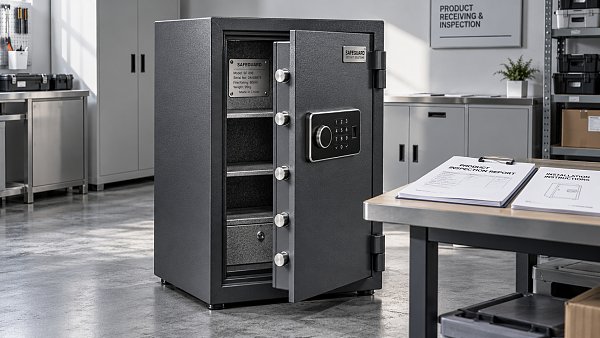
A certificate may cover a product family through defined scope and assessment rules. It is not necessary to assume that every size has undergone an identical destructive test. However, a visually similar model outside the certified range cannot inherit the grade simply because it shares a brand or construction style.
Pay particular attention to modifications. Cable openings, replacement locks, deposit features, and changes to the door or barrier can affect the certified construction. A deposit function may also bring additional standards or certification requirements into consideration.
For used safes, evidence of identity and modification history becomes especially valuable. An original certification label helps identify the product, but does not establish that later alterations preserve the approved configuration.
Installation determines whether the rated protection is useful
A burglary-resistant enclosure can still present a removal risk. If attackers can take the entire safe away, they gain time and control over the conditions of a later attack. Anchoring addresses this exposure where required by the product’s certification and installation instructions.
The fixing arrangement is a system: the safe’s anchoring provision, the anchor, the supporting substrate, and the installation method all contribute. A substantial bolt installed in unsuitable material may provide poor restraint. Floor finishes and raised floors should not be mistaken for structural anchoring substrates.
Assess the site before selecting the model. Confirm floor loading, delivery access, the supporting construction, and the feasibility of the prescribed fixing arrangement. A safe that cannot be installed correctly in its intended location is an unsuitable selection, even if its grade meets the purchasing specification.
Position also changes attack opportunities. Exposure around the sides and rear, nearby equipment, and access outside business hours influence the practical risk. These factors belong in the site assessment; they do not alter the grade printed on the certificate.
Keep burglary, fire, and insurance requirements separate
EN 1143-1 burglary certification does not establish fire protection. Resistance to forced entry and protection against heat are different performance questions, assessed through different tests.
If the contents require fire protection, specify the relevant certified performance separately. Paper records and temperature-sensitive media may need different protection conditions. A burglary-resistant safe’s heavy construction does not prove that it will protect either during a fire.
Insurance acceptance is another separate decision. Insurers may associate grades with cash or valuables limits, but those limits depend on the market, policy, contents, premises, and additional security measures. There is no single universal monetary value attached to each EN 1143-1 grade.
Obtain acceptance for the proposed model and installation before purchase. This is particularly useful when an insurance schedule specifies a grade alongside conditions for alarms, anchoring, occupancy, or overnight storage. Meeting the grade alone may not satisfy the full requirement.
Choosing a grade that fits the exposure
Start with the assets, their concentration, and the consequences of loss. Consider replacement difficulty, business interruption, and any contractual storage conditions as well as monetary value. Then establish the insurer’s requirements and the site’s installation constraints.
A higher grade can provide greater tested resistance, but selecting it involves practical tradeoffs. Increased weight, reduced usable space, delivery constraints, and installation work can affect the project. Compare the complete installed solution, including the certified lock arrangement and operational requirements.
Detection and response deserve equal attention. A safe in an unattended building with delayed alarm response faces different conditions from one inside a monitored, access-controlled area. The safe provides a physical barrier; alarms, access control, and response arrangements influence the opportunity available to attack it.
Before issuing a purchase order, assemble an acceptance record containing the selected model, grade, certificate reference, approved configuration, installation requirements, and insurance acceptance. That record gives procurement, the installer, and the receiving team a common basis for checking the delivered safe—and makes the rating a usable purchasing requirement.
Have questions about this sector analysis, or seeking best practices specific to your niche? Drop us a line below and let the senior consultants at MHLS assist you.
We respect your privacy. Your information is strictly confidential.
Recommended News
 Parcel Locker Network Pricing: Setup Costs, Fees and Contract TermsUnmanned Terminal FellowCompare parcel locker networks pricing, from setup costs and recurring fees to contract terms. Discover hidden charges and choose the right model.
 JR East Plans UWB Walk-Through Gates at 40 Stations in Spring 2028Access Control StrategistJR East plans UWB walk-through gates at 40 stations in spring 2028. Explore the rollout timeline and what suppliers should watch.
 Bank Vault Security Standards: UL and EN Ratings ExplainedVault Structural ArchitectExplore bank vault security standards and learn how UL 608 classes and EN 1143-1 grades differ, what they test, and how to verify certification before you buy.
 Mechanical Lock Hardware Prices: What Buyers Should Budget for Bulk OrdersMr. Gideon CrossMechanical lock hardware price is just the starting point. Discover what drives bulk-order costs and how to compare supplier quotes with confidence.
 IndexBox Forecasts Steady Global Security Keypad Market Growth Through 2035Dr. Valerius ThorneGlobal security keypad market growth is forecast at 3.3% annually through 2035. Explore the smart home and replacement trends shaping demand.
 Choosing an Infrared Safety Sensors Manufacturer: What Buyers Should CheckUnmanned Terminal FellowChoosing an infrared safety sensors manufacturer? Compare safety evidence, integration, environmental performance and lifecycle costs before you buy.
 Choosing a Security Material Testing Service: What to Check for Lock and Safe MaterialsProf. Elara SterlingChoose a security material testing service with confidence. Learn what to check for lock and safe materials, from attack methods and accreditation to reliable reports.
 How Precision Anti-Pick Lock Cylinders Resist ManipulationSecurity Metallurgy ExpertDiscover how precision anti-pick lock technology resists manipulation, and learn what to check when comparing security features, test evidence, and everyday reliability.
 Dermalog Joins NIST FastCAP Program for Contactless Fingerprint TestingProf. Elara SterlingDermalog joins the NIST FastCAP program for contactless fingerprint testing. Discover what this means for biometric identification and digital identity.
 Choosing Security Export Compliance Services: What Providers Should CoverMr. Gideon CrossSecurity export compliance services can help prevent costly delays. Discover what to look for in classification, licensing, screening, and documentation.
 European Security Compliance Standards for Safes: EN 1143-1 vs EN 14450Dr. Valerius ThorneExplore security compliance standards Europe buyers need to know. Compare EN 1143-1 and EN 14450 to choose the right safe with confidence.
 HID Global Acquires inepro ID to Expand RFID and BLE Access SolutionsUnmanned Terminal FellowHID Global acquires inepro ID to expand RFID and BLE access solutions for printers, smart lockers and shared devices. Explore what the deal could mean for your organization.











