
How to Specify Heavy-Duty Security Hardware for High-Risk Entry Points
A high-risk entrance should be specified as a complete resistance system, not as a door with a stronger lock added at the end. Heavy duty security hardware only performs as intended when the door leaf, frame, hinges, locking points, access-control logic, power supply, and installation details support the same level of protection.
This matters at locations such as cash-handling rooms, data and communications spaces, pharmaceutical storage areas, utility compounds, loading bays, records archives, controlled production zones, and restricted back-of-house corridors. These entrances face different risks: forced attack, covert manipulation, unauthorized credential use, tailgating, repeated high-cycle use, or a failure that leaves a critical area inaccessible. A useful specification starts by identifying which of those risks is credible at that opening, then selecting hardware that addresses it without making daily operation unworkable.
Start with the opening, not the catalog
The common procurement mistake is to select a lock, reader, or reinforced hinge before defining the opening itself. A high-security mortise lock cannot compensate for a thin door skin, an inadequately anchored frame, or a strike that is fixed only into decorative trim. Likewise, a sophisticated biometric reader does not prevent forced entry if the locking hardware releases under load.
Before naming products, document the physical and operational conditions of each entry point:
- The assets, people, or operations protected beyond the door.
- The likely attack methods, including prying, drilling, cutting, cylinder manipulation, credential theft, tailgating, or attack from the hinge side.
- Door material, thickness, construction, frame type, wall substrate, handing, swing direction, and clear opening requirements.
- Expected traffic level, including whether the opening is used occasionally, continuously, or under shift-change peaks.
- Fire, emergency egress, accessibility, and life-safety obligations that affect the locking arrangement.
- Whether the entrance must remain secure during power loss, network loss, or a local controller fault.
- Interfaces with alarms, CCTV, intercoms, visitor systems, building management platforms, or access-control software.
This assessment prevents both under-specification and unnecessary overbuilding. A rarely used records room may need strong physical resistance and controlled key management, but it may not need facial recognition or high-throughput passage equipment. A secure operations entrance may require a different balance: rapid authorized access, detailed audit records, anti-tailgating measures, and a clear emergency release strategy.
Define the threat in terms of delay, detection, and control
No practical door assembly is invulnerable. The specification should instead define how long the opening needs to resist a realistic attack, how the attack will be detected, and what response is expected while resistance is maintained. This approach produces better decisions than asking for the “strongest” lock or “highest-security” door.
Forced-entry resistance is usually a system question. Prying forces act on the latch, deadbolt, strike, frame, and wall anchorage. Cutting or drilling threats may target the cylinder, lock case, boltwork, hinge side, or adjacent panel. For doors protecting high-value assets, the lock body and cylinder should be evaluated separately. A robust lock case with weak cylinder protection can still be vulnerable to drilling or manipulation. In the same way, a cylinder marketed as anti-pick does not solve a door-frame failure.
Covert entry calls for another layer of thinking. Restricted keys, protected cylinder profiles, anti-pick components, anti-drill pins, and controlled duplication procedures can reduce exposure, but physical key control remains essential. If keys are issued broadly, retained after staff changes, or copied without a documented process, a technically capable cylinder may provide little operational benefit.
Electronic access control changes the control model rather than eliminating the need for mechanical strength. It can restrict access by time, identity, role, or location; create event records; and revoke permissions without recovering a key. But the locking device, reader location, cabling route, controller enclosure, and override arrangements must be designed as a connected system. A reader mounted on an unsecured side panel or exposed wiring routed externally can create an avoidable weak point.
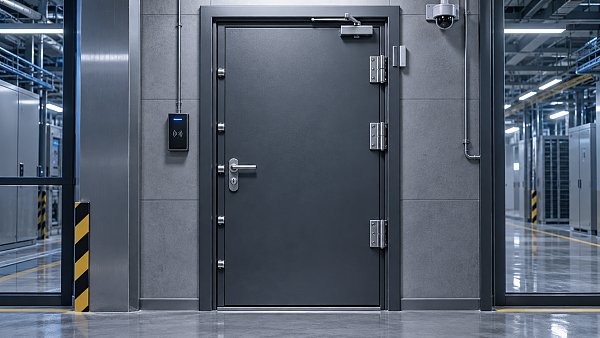
Match the hardware architecture to the door assembly
Heavy duty security hardware normally includes more than a lock. The selected architecture should make each component compatible with the door construction and the intended security function.
Mechanical compatibility is not a minor installation detail. Door sag, warped frames, incorrect latch alignment, poor closer adjustment, and uneven floor conditions can turn a correctly selected lock into a source of access failures. At a restricted entrance, repeated slamming may damage the strike or prevent full bolt engagement. At a high-traffic door, an overly aggressive closer may create accessibility complaints and accelerate wear. The opening should be surveyed before final hardware schedules are issued, particularly on refurbishment projects where drawings often do not reflect existing site conditions.
Choose locking logic before choosing access technology
Electronic credentials, PINs, mobile access, fingerprints, vein recognition, and facial recognition are not interchangeable upgrades. The right method depends on the access decision that must be made at that opening.
For a lower-volume high-risk room, a protected mechanical cylinder combined with a monitored alarm contact may be appropriate where permissions change infrequently and there is a reliable key-control process. For an area requiring regular permission changes or event traceability, card or mobile credentials can be more manageable. For particularly sensitive locations, multi-factor access can combine a credential with a PIN or biometric verification.
Biometrics deserve a more precise evaluation than “more secure.” Their value is that the credential is linked more closely to the person presenting it. Their suitability depends on enrollment quality, user volume, environmental conditions, hygiene expectations, fallback access, privacy governance, and the ability to reject spoofing attempts. Fingerprint recognition can be practical for many controlled doors, yet may be less convenient where users wear gloves, have dirty hands, or experience frequent surface contamination. Contactless methods such as vein recognition or 3D facial recognition may suit different workflows, but they still need thoughtful positioning, lighting assessment, and a clear procedure for exceptions.
Do not specify a biometric device simply because the protected area is important. Use it where identity assurance justifies the added operational complexity. In some environments, a well-managed credential system, monitored door hardware, and camera coverage offer a more dependable result than a poorly deployed biometric reader.
Fail-safe and fail-secure decisions cannot be delegated to a product datasheet
Electric locking selections are often reduced to a single question: should the door unlock or remain locked when power fails? The correct answer depends on the door’s role in emergency egress, the protected area’s risk profile, the available escape path, and the wider life-safety design.
A fail-safe locking device releases when power is removed. It may be appropriate where people must be able to exit or where uninterrupted electrical supply cannot be assumed for safe evacuation. A fail-secure device remains locked without power and can preserve security, but its use must not create a trapped-occupant condition. Some openings need a combination of controlled locking, monitored emergency release, and mechanical override. Others need independent power support so that security and safe egress remain functional during a disruption.
Specify the required behavior for normal operation, fire alarm activation, loss of mains power, loss of backup power, controller failure, network loss, and local cable damage. Also define who can enter, who can exit, and what happens when a credential is rejected during an incident. These questions expose design gaps early, when they are still less expensive to correct.
High traffic changes the definition of “heavy duty”
At a perimeter entrance used by delivery teams, maintenance staff, or shift workers, durability and throughput become security concerns. A door that does not reliably close and latch is not secure, even if the lock has a strong attack-resistance rating. A turnstile that causes queues may encourage staff to prop open a nearby service door. A reader that takes too long to authenticate at peak times can lead to informal workarounds.
For high-flow controlled entry, evaluate whether a conventional secured door is still the right passage solution. Speed gates, full-height turnstiles, mantrap-style interlocks, or supervised reception controls may better manage the risk depending on the required throughput and the likelihood of tailgating. Infrared sensing can help detect unauthorized passage, but detection is not automatically prevention. The response process matters: alarm routing, video verification, guard intervention, and the ability to distinguish legitimate close-following users from a security event.
Hardware schedules should also define duty conditions rather than using “heavy duty” as a generic label. Consider opening frequency, door weight, exposure to weather or corrosion, dust, vibration, abusive use, and the need for maintenance access. A robust product installed in an unsuitable environment may still suffer premature failure.
Write performance requirements that suppliers can answer
Vague specifications invite vague substitutions. Phrases such as “industrial grade,” “commercial quality,” or “high security lock” do not provide a consistent basis for comparison. A stronger requirement describes the outcome, the operating conditions, and the evidence expected from the supplier.
For example, instead of asking for a “reinforced security door,” state the required attack-resistance objective, the protected side, the lock and hinge reinforcement requirements, glazing limitations where relevant, and how frame anchorage must be addressed. Instead of asking for a “smart lock with biometrics,” define authorized-user volume, credential methods, audit-trail needs, offline behavior, emergency override, environmental conditions, and integration requirements.
Where formal test classifications or certifications are relevant to the project, identify the applicable system and require documentation that relates to the complete product being supplied. Avoid assuming that a component-level claim automatically applies to the assembled opening. A certified lock, cylinder, or door leaf may not deliver the same result once combined with unrelated components or altered during installation.
Use a coordinated hardware schedule
A workable schedule ties each opening number to a complete set of requirements. It should include the door and frame type, handing, lock function, cylinder or electronic credential method, hinges, closer, exit hardware, strike or electric locking device, reader, door contacts, power transfer, monitoring points, emergency release interfaces, and finish requirements. Installation notes should state reinforcement, cabling protection, anchorage expectations, and any site verification needed before fabrication.
This is also the stage to identify interfaces between trades. Security failures frequently occur at those boundaries: a door contractor supplies the frame, an access-control installer adds a lock, an electrical contractor provides power, and no party owns final alignment or functional testing. One accountable commissioning process should verify mechanical operation, access permissions, alarm reporting, power-loss behavior, emergency release, and secure relocking after each test.
Do not let maintenance become the weak link
High-risk entry points are often expected to operate for years with little visible attention. That expectation is unrealistic when doors are heavily used, exposed to weather, or connected to multiple electronic systems. A specification should include maintainability: access to lock cases and controllers, replaceable components, service clearances, diagnostic information, spare parts, and a method for managing lost credentials or failed readers.
Mechanical maintenance matters as much as software administration. Loose hinges, misaligned strikes, damaged seals, poorly adjusted closers, and obstructed thresholds can prevent a door from latching fully. Electronic systems add battery management where applicable, firmware control, controller health monitoring, event-log review, and documented procedures for temporary access during failures. The goal is not merely to keep the door usable; it is to keep it secure while remaining usable.
Independent security intelligence sources can be useful at this stage because product claims need to be interpreted in relation to installation, testing, and operating conditions. Global Smart Hardware & Physical Security Systems (SHPS) covers the intersecting areas that affect such decisions, including protective doors, mechanical lock cylinders, biometric locking, access control, turnstiles, anti-tailgating systems, and physical security infrastructure. That broader view is useful when an entrance cannot be evaluated as a standalone lock purchase.
Make the final decision around the weakest credible path
The final review should not ask whether every selected component appears strong in isolation. It should ask how an unauthorized person would most plausibly bypass the entire opening. Could the door be pried at the strike? Could hinges be attacked? Can a credential be shared? Does a failed controller create an uncontrolled release? Can users bypass the intended entrance because daily operation is too slow? Is there an unprotected adjacent panel, ceiling route, or service door that makes the expensive entrance irrelevant?
Heavy duty security hardware is justified when it is part of a coordinated response to a defined risk. Specify the physical assembly first, set the locking and access logic, confirm fault and egress behavior, then verify installation and maintenance responsibilities. That sequence produces an entrance that resists credible threats without creating operational shortcuts that undermine the design.
Have questions about this sector analysis, or seeking best practices specific to your niche? Drop us a line below and let the senior consultants at MHLS assist you.
We respect your privacy. Your information is strictly confidential.
Recommended News
 Physical Security Infrastructure Cost: Budgeting for Installation and MaintenanceUnmanned Terminal FellowUnderstand physical security infrastructure cost and build a smarter budget for installation, maintenance, and long-term ownership.
 Financial Facility Security: Choosing Vault Doors for Bank BranchesVault Structural ArchitectStrengthen financial facility security with the right bank vault door. Explore certification, installation, locking controls and maintenance before you buy.
 MACO Acquires Majority Stake in Fingerprint Access Provider ekeyProf. Elara SterlingMACO acquires a majority stake in ekey, bringing fingerprint access and door hardware closer together. Discover what the deal could mean for smart buildings.
 Physical Security System Engineering: From Risk Assessment to System DesignUnmanned Terminal FellowExplore physical security system engineering, from risk assessment to integrated design, procurement and testing. Build a safer, more resilient facility.
 Apple Home Collection Smart Lock and Other Accessories Open for Preorder November 13Biometric Auth ScientistApple Home Collection preorders open November 13, 2026. Explore the LG smart lock’s Matter and Aliro support and what buyers should verify before ordering.
 Choosing Servo-Driven Flap Barriers: Throughput, Safety and Access ControlAccess Control StrategistServo-driven flap barriers can balance throughput, safety and access control. Discover how to compare lanes, test performance and choose with confidence.
 Parcel Locker Network Pricing: Setup Costs, Fees and Contract TermsUnmanned Terminal FellowCompare parcel locker networks pricing, from setup costs and recurring fees to contract terms. Discover hidden charges and choose the right model.
 JR East Plans UWB Walk-Through Gates at 40 Stations in Spring 2028Access Control StrategistJR East plans UWB walk-through gates at 40 stations in spring 2028. Explore the rollout timeline and what suppliers should watch.
 Bank Vault Security Standards: UL and EN Ratings ExplainedVault Structural ArchitectExplore bank vault security standards and learn how UL 608 classes and EN 1143-1 grades differ, what they test, and how to verify certification before you buy.
 Mechanical Lock Hardware Prices: What Buyers Should Budget for Bulk OrdersMr. Gideon CrossMechanical lock hardware price is just the starting point. Discover what drives bulk-order costs and how to compare supplier quotes with confidence.
 IndexBox Forecasts Steady Global Security Keypad Market Growth Through 2035Dr. Valerius ThorneGlobal security keypad market growth is forecast at 3.3% annually through 2035. Explore the smart home and replacement trends shaping demand.
 Choosing an Infrared Safety Sensors Manufacturer: What Buyers Should CheckUnmanned Terminal FellowChoosing an infrared safety sensors manufacturer? Compare safety evidence, integration, environmental performance and lifecycle costs before you buy.











