
Lock Security Certification Standards Explained: UL, EN, BHMA, and What They Mean
Why lock certifications are often misunderstood
The biggest mistake in reading lock security certification standards is assuming that a certification is a universal proof of “high security.” It is not. UL, EN, and BHMA do not measure the same thing, do not use the same attack logic, and do not answer the same procurement question. A lock can perform very well in one framework and still tell you little about another risk category. For technical evaluation, that distinction matters more than the logo on a datasheet.
In practice, these standards sit at the intersection of three different concerns: forced-entry resistance, durability under repeated use, and suitability for a specific door or building context. That is why comparing certifications without first defining the application often leads to poor conclusions. A residential smart deadbolt, a commercial mortise lock, and a detention-grade or high-abuse opening do not live in the same testing world, even if all are described as “secure.”
If you are evaluating products for sourcing, specification, export, or project deployment, the right question is not “Which standard is best?” It is “What exactly was tested, under which conditions, and how closely does that map to my use case?”
UL, EN, and BHMA are solving different problems
UL standards are widely recognized in North America, but even within UL, the meaning depends on the exact standard number. Some UL standards focus on attack resistance, some on fire performance, and some on access control hardware or electronic locking system safety. When buyers say a lock is “UL certified,” that statement is incomplete by itself. You need the full reference. A claim tied to burglary attack resistance is not the same as one tied to electrical safety or door hardware listing.
EN standards, commonly used across Europe and many export markets, also require more precision than shorthand marketing language suggests. In the lock and cylinder space, EN standards often separate the lock body, cylinder, door set, panic or emergency exit function, and burglary-resistance performance of the complete assembly. The European approach is often more system-oriented than buyers expect. A cylinder may comply with one EN standard, but the overall security outcome still depends on the escutcheon, fixing method, door leaf, frame reinforcement, and installation quality.
BHMA, usually referenced through ANSI/BHMA standards in the US market, is especially important for builders, architects, and commercial hardware specifiers because it grades operational durability and performance classes across hardware categories. BHMA grades are frequently treated as a direct measure of burglary resistance. That is a category error. A higher grade often tells you the hardware is more robust for repeated service cycles and commercial use, but it does not automatically mean it will resist sophisticated physical attack in the same way an attack-focused standard would evaluate.
That is the first filter technical evaluators should apply:
What a certification usually tells you in real procurement work
For a technical evaluator, the practical value of a certification lies in the test boundary. A useful certificate narrows uncertainty. It tells you which product configuration was tested, what kind of abuse or attack it faced, how success or failure was defined, and whether the result applies to a component or to the full opening system.
This is why experienced buyers ask for more than the certificate title. They want the standard reference, grade or class, test scope, door preparation assumptions, and any hardware dependencies. A lock body tested with one cylinder format and one reinforced door edge may not behave the same way in a lighter door, a different backset, or a lower-quality installation. In electronic locks, the same caution applies to power-loss behavior, fail-safe or fail-secure logic, cycle endurance, and environmental reliability.
A serious review also separates security language from compliance language. “Meets market requirements” can mean the product is acceptable for code, insurance, tender, or distributor entry. It does not necessarily mean it is the strongest technical option for attack resistance. Those are related but different procurement outcomes.
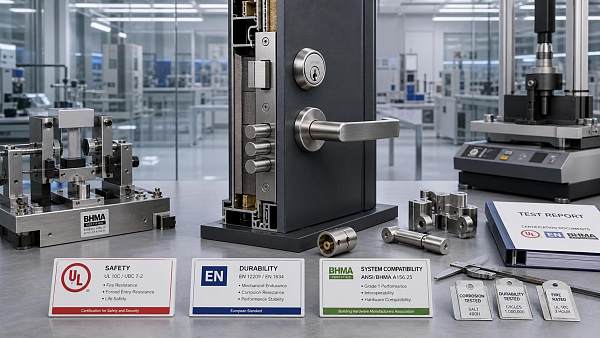
Where UL is most useful, and where people overread it
UL references carry weight because they signal structured third-party evaluation, but the value depends entirely on the standard involved. In the lock and physical security field, UL can be relevant to locking hardware, access control system components, electric strikes, electromagnetic locks, safe-related testing, and resistance-oriented product claims. The discipline here is simple: never accept “UL listed” as a complete technical answer.
Overreading usually happens in cross-border sourcing. A manufacturer may present UL status to support product credibility in North America, while the buyer is actually trying to understand burglary resistance, long-term field durability, or suitability for insurance-sensitive premises. Those questions may require additional standards, separate hardware schedules, or assembly-level test evidence. UL can be part of that picture, but rarely the whole picture.
How EN standards change the conversation
European lock certification often pushes evaluators to think more carefully about interfaces. EN standards are less forgiving of vague product claims because they often classify components in relation to a defined function. That is especially useful when comparing cylinders, mortise locks, protective hardware, exit devices, or complete door assemblies across projects with different risk profiles.
The main benefit of EN-based review is that it helps expose weak links. A cylinder with strong anti-picking and anti-drill characteristics may still be compromised by poor projection control, exposed fixing points, or inadequate escutcheon protection. A smart locking product may look advanced at the credential layer but still require closer scrutiny of mechanical override design, clutch protection, or attack access to internal components. EN thinking tends to bring those interfaces back into focus.
That matters in sectors such as residential development, hospitality, mixed-use commercial buildings, and export hardware supply, where products are often compared across both mechanical and electronic criteria. The certification does not replace engineering judgment. It gives that judgment a cleaner starting point.
BHMA grades are valuable, but they answer a narrower question than many buyers think
BHMA grading is highly useful when the concern is service intensity. In offices, schools, multifamily buildings, healthcare facilities, and other high-traffic environments, hardware is punished every day by cycle count, misuse, door weight, and maintenance reality. A BHMA grade helps buyers judge whether the product belongs in that operating environment.
This becomes especially relevant for commercial locksets, exit devices, closers, and related hardware where endurance and operational consistency affect both security and life-cycle cost. A product that looks acceptable on a bench may become a warranty and maintenance problem if its grade does not match the door usage profile.
The misunderstanding begins when BHMA grades are treated as a shortcut for intrusion resistance. They are not. A well-graded lockset may still need separate evaluation for cylinder security, latch protection, door edge strength, frame anchoring, and forced-entry exposure. In other words, BHMA is strong on hardware performance discipline, but it is not a substitute for an attack-path analysis.
Common evaluation mistakes
One common mistake is comparing standards at the brand-claim level instead of the test-scope level. “UL certified versus EN certified” is not a meaningful technical comparison unless the exact standards and performance categories are aligned.
Another is treating the cylinder, lock body, and door assembly as if they contribute equally and independently. They do not. A strong cylinder on a weak door preparation is still a weak opening. A robust lock body paired with poor strike reinforcement can fail at the surrounding structure instead of the lock itself.
A third mistake is focusing only on attack resistance and ignoring reliability. In smart locks and electronic locking systems, field failure can create its own security risk. The evaluator should still ask about endurance, power behavior, environmental exposure, user abuse, override design, and maintenance burden. Certifications may cover parts of that picture, but rarely all of it in one document.
How to use these standards in a sourcing or specification decision
A practical approach is to start with the opening, not the product brochure. Define the threat model, traffic intensity, compliance market, and installation constraints. Then map certifications to those conditions. For a residential export smart lock, the useful question may revolve around cycle endurance, credential security, mechanical override vulnerability, and local market acceptance. For a commercial project, the mix may shift toward BHMA grade, fire door compatibility, access control integration, and system-level hardware coordination. For higher-risk applications, forced-entry and assembly-level resistance become more central.
The documents worth requesting are usually straightforward: the exact certification reference, grade or class, scope of tested configuration, installation conditions, and any limitations stated by the issuing body. If a supplier cannot clearly explain what was certified and under which product configuration, that is already a meaningful signal.
Lock security certification standards are most useful when they reduce ambiguity rather than decorate a specification sheet. UL, EN, and BHMA each have real value, but only when read in their own logic. For technical evaluation, the discipline is to stop asking whether a lock is “certified” in the abstract and start asking what risk the certification actually helps you control.
Have questions about this sector analysis, or seeking best practices specific to your niche? Drop us a line below and let the senior consultants at MHLS assist you.
We respect your privacy. Your information is strictly confidential.
Recommended News
 Parcel Locker Network Pricing: Setup Costs, Fees and Contract TermsUnmanned Terminal FellowCompare parcel locker networks pricing, from setup costs and recurring fees to contract terms. Discover hidden charges and choose the right model.
 JR East Plans UWB Walk-Through Gates at 40 Stations in Spring 2028Access Control StrategistJR East plans UWB walk-through gates at 40 stations in spring 2028. Explore the rollout timeline and what suppliers should watch.
 Bank Vault Security Standards: UL and EN Ratings ExplainedVault Structural ArchitectExplore bank vault security standards and learn how UL 608 classes and EN 1143-1 grades differ, what they test, and how to verify certification before you buy.
 Mechanical Lock Hardware Prices: What Buyers Should Budget for Bulk OrdersMr. Gideon CrossMechanical lock hardware price is just the starting point. Discover what drives bulk-order costs and how to compare supplier quotes with confidence.
 IndexBox Forecasts Steady Global Security Keypad Market Growth Through 2035Dr. Valerius ThorneGlobal security keypad market growth is forecast at 3.3% annually through 2035. Explore the smart home and replacement trends shaping demand.
 Choosing an Infrared Safety Sensors Manufacturer: What Buyers Should CheckUnmanned Terminal FellowChoosing an infrared safety sensors manufacturer? Compare safety evidence, integration, environmental performance and lifecycle costs before you buy.
 Choosing a Security Material Testing Service: What to Check for Lock and Safe MaterialsProf. Elara SterlingChoose a security material testing service with confidence. Learn what to check for lock and safe materials, from attack methods and accreditation to reliable reports.
 How Precision Anti-Pick Lock Cylinders Resist ManipulationSecurity Metallurgy ExpertDiscover how precision anti-pick lock technology resists manipulation, and learn what to check when comparing security features, test evidence, and everyday reliability.
 Dermalog Joins NIST FastCAP Program for Contactless Fingerprint TestingProf. Elara SterlingDermalog joins the NIST FastCAP program for contactless fingerprint testing. Discover what this means for biometric identification and digital identity.
 Choosing Security Export Compliance Services: What Providers Should CoverMr. Gideon CrossSecurity export compliance services can help prevent costly delays. Discover what to look for in classification, licensing, screening, and documentation.
 European Security Compliance Standards for Safes: EN 1143-1 vs EN 14450Dr. Valerius ThorneExplore security compliance standards Europe buyers need to know. Compare EN 1143-1 and EN 14450 to choose the right safe with confidence.
 HID Global Acquires inepro ID to Expand RFID and BLE Access SolutionsUnmanned Terminal FellowHID Global acquires inepro ID to expand RFID and BLE access solutions for printers, smart lockers and shared devices. Explore what the deal could mean for your organization.











