
Physical Security Standards Explained: EN, UL, CE, and FCC for Door Hardware
For quality control teams and security managers, door hardware compliance is more than a label—it is proof that locks, hinges, access devices, and electronic components can perform under real-world risk.
Understanding physical security standards such as EN, UL, CE, and FCC helps verify burglary resistance, fire safety, electromagnetic compatibility, and market access requirements before products reach a facility or export channel.
This guide explains what each certification means, where it applies, and how to evaluate compliant door hardware with confidence.
Physical Security Standards for Door Hardware: A Practical Overview
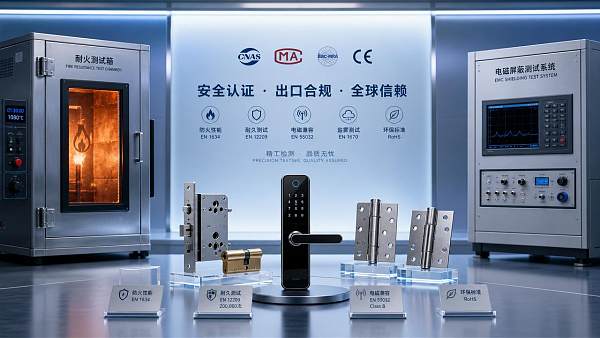
Physical security standards define measurable performance for products that protect openings, assets, people, and restricted spaces.
For door hardware, these standards may cover forced entry, endurance, fire exposure, electrical safety, radio emissions, and installation reliability.
A certified lock is not automatically suitable for every site.
A compliant product must match the door type, threat model, building code, insurance requirement, and country of use.
In global trade, physical security standards also work as a common technical language.
They help compare products made in different regions, even when terminology, test methods, and legal obligations vary.
For mechanical cylinders, standards often focus on drilling, picking, torque, key control, and durability.
For smart locks, the scope expands to electronics, batteries, wireless modules, firmware behavior, and electromagnetic compatibility.
For exits and fire doors, physical security standards must align with life safety rules.
Security cannot block evacuation, delay emergency access, or compromise certified fire performance.
EN Standards and the European Security Framework
EN standards are European Norms used across many European markets and referenced by insurers, specifiers, architects, and testing laboratories.
For door hardware, EN documents provide structured grades for strength, durability, corrosion resistance, fire behavior, and attack resistance.
Common examples include EN 12209 for mechanically operated locks and latches, and EN 1303 for cylinders.
EN 1906 applies to lever handles and knob furniture, while EN 1935 covers single-axis hinges.
For panic and emergency exits, EN 1125 and EN 179 are central references.
These physical security standards are important because they separate decorative hardware from tested safety-critical hardware.
A lock may look robust, but EN grades show whether it has endured defined cycles, loads, and attack methods.
In higher-security environments, EN 1627 to EN 1630 classify burglar-resistant doors, windows, and shutters.
These tests consider manual attack tools, resistance time, and complete assembly behavior.
Door hardware should be evaluated as part of that assembly, not as an isolated component.
Key EN Considerations
- Confirm the exact EN standard, grade, and test report version.
- Check whether fire door suitability is included or separately certified.
- Verify corrosion grades for coastal, industrial, or outdoor installations.
- Review whether the product was tested with the same strike, cylinder, and fixing method.
UL Standards for North American Safety and Security
UL standards are widely recognized in North America and many international projects that follow American specifications.
They are particularly influential for fire safety, access control hardware, electric locking systems, and burglary-resistant products.
UL 10C addresses positive pressure fire tests of door assemblies.
UL 294 covers access control system units, including controllers, readers, power supplies, and related equipment.
UL 437 is often referenced for high-security key locks and cylinders.
It may include resistance to picking, impressioning, drilling, forcing, and other physical attacks.
For physical security standards, UL listings are valuable because they connect laboratory testing with ongoing production surveillance.
This means a listed product is not only tested once; its manufacturing consistency may also be monitored.
UL marks should be checked carefully.
The mark must apply to the specific product category, not merely to a power adapter or internal component.
Where UL Matters Most
CE Marking and Regulatory Access in Europe
CE marking is not a quality award.
It is a declaration that a product complies with applicable European legislation.
For door hardware, CE may relate to construction products, electrical safety, electromagnetic compatibility, radio equipment, or machinery-related functions.
The applicable directive or regulation depends on the product design and intended use.
A purely mechanical hinge is assessed differently from a Wi-Fi smart lock with a motorized gearbox.
Physical security standards and CE marking often intersect, but they are not identical.
An EN test may support compliance, while CE addresses broader legal market access.
For electronic smart locks, CE documentation usually involves EMC, radio performance, safety, RoHS, and technical file preparation.
Labels, user manuals, risk analysis, and declarations of conformity must be consistent.
A missing manual warning can create problems even when hardware testing is strong.
CE Review Points
- Identify every applicable EU directive or regulation.
- Match EN test standards to the declared product scope.
- Keep technical files, test reports, labels, and manuals aligned.
- Check notified body involvement when required.
FCC Requirements for Connected Door Hardware
FCC compliance applies to products sold in the United States that emit radio frequency energy.
This includes smart locks, wireless keypads, Bluetooth readers, Wi-Fi gateways, RFID devices, and smart parcel locker controllers.
FCC rules do not measure burglary resistance.
They control radio emissions and help prevent harmful interference with other electronic systems.
For connected hardware, physical security standards must therefore be combined with radio compliance.
A strong deadbolt can still fail market entry if its wireless module lacks proper authorization.
FCC Part 15 is commonly relevant for intentional and unintentional radiators.
If a certified module is used, integration rules still matter.
Antenna changes, enclosure materials, cable routing, and firmware settings may affect final compliance.
Documentation should confirm the FCC ID, user notices, labeling rules, and test configuration.
Current Industry Signals Behind Compliance Demand
The demand for physical security standards is rising because door hardware now sits between steel, electronics, identity, and cloud connectivity.
A mechanical cylinder, biometric reader, and mobile app may operate as one access decision chain.
Any weak link can undermine the complete opening.
Modern facilities also expect frictionless access.
Facial recognition gates, vein recognition locks, and mobile credentials must work without reducing certified physical protection.
This creates a dual requirement: indestructible mechanical baselines and stable intelligent access.
Application Value for Door Hardware Decisions
Physical security standards reduce uncertainty during product selection, project approval, and post-installation inspection.
They convert broad claims such as “heavy duty” or “high security” into testable evidence.
For commercial buildings, standards support risk zoning.
A lobby door, data room, cash office, and emergency exit require different hardware combinations.
For residential smart locks, standards help balance convenience, battery safety, wireless performance, and mechanical override strength.
For safes, vault rooms, and high-value storage areas, certified locks and doors may be tied directly to insurance conditions.
For smart parcel lockers, compliance helps protect deliveries while supporting 24/7 unmanned operation.
Physical security standards also improve lifecycle planning.
Cycle tests, corrosion grades, and electrical safety reports help estimate maintenance intervals and replacement risks.
Typical Door Hardware Categories and Relevant Standards
Door hardware compliance should be reviewed by product category and full opening function.
A single door may require several physical security standards at the same time.
Practical Evaluation Method for Compliant Hardware
A reliable compliance review starts with the opening, not the catalog page.
Define who uses the door, what it protects, and which legal or insurance rules apply.
Then map each hardware item to relevant physical security standards.
- Classify the opening by risk, traffic, fire role, and access method.
- Identify all required EN, UL, CE, FCC, or local code references.
- Request complete certificates, test reports, declarations, and installation instructions.
- Confirm that model numbers, finishes, firmware versions, and accessories match the documents.
- Review installation conditions, including fixing screws, strikes, gaps, and power supply.
- Record maintenance intervals, inspection duties, and replacement triggers.
The most common mistake is accepting a partial certificate.
A radio module certificate does not prove the lock body resists forced entry.
A fire-rated door leaf does not automatically validate every lockset installed into it.
Physical security standards only protect decisions when their scope is read accurately.
Important Cautions During Specification and Installation
Compliant hardware can lose performance through poor installation.
Misaligned strikes, oversized gaps, weak frames, or incorrect screws may reduce real resistance dramatically.
Electronic devices add further variables.
Battery type, cable routing, waterproofing, firmware updates, and wireless coverage can influence long-term reliability.
When using biometric access, evaluate fallback methods and privacy obligations.
The best system combines accurate identity recognition with a mechanically secure locking point.
For international projects, avoid assuming equivalence between standards.
An EN grade, UL listing, CE declaration, and FCC authorization each answer different questions.
Physical security standards should be treated as complementary layers, not interchangeable labels.
Next Steps for a Standards-Based Door Hardware Program
Start with a compliance matrix for every door type, from public entrances to high-security rooms.
List required physical security standards, related documents, responsible parties, and approval checkpoints.
For smart hardware, include both physical attack resistance and electronic compliance.
For critical sites, request evidence from accredited laboratories and verify the certification database when possible.
SHPS tracks the intersection of steel, algorithms, certified testing, and global market access for modern security hardware.
By treating physical security standards as design inputs, door hardware decisions become safer, clearer, and easier to defend.
The next practical move is simple: audit existing certificates, compare them with site risks, and close every gap before installation or export.
Have questions about this sector analysis, or seeking best practices specific to your niche? Drop us a line below and let the senior consultants at MHLS assist you.
We respect your privacy. Your information is strictly confidential.
Recommended News
 Parcel Locker Network Pricing: Setup Costs, Fees and Contract TermsUnmanned Terminal FellowCompare parcel locker networks pricing, from setup costs and recurring fees to contract terms. Discover hidden charges and choose the right model.
 JR East Plans UWB Walk-Through Gates at 40 Stations in Spring 2028Access Control StrategistJR East plans UWB walk-through gates at 40 stations in spring 2028. Explore the rollout timeline and what suppliers should watch.
 Bank Vault Security Standards: UL and EN Ratings ExplainedVault Structural ArchitectExplore bank vault security standards and learn how UL 608 classes and EN 1143-1 grades differ, what they test, and how to verify certification before you buy.
 Mechanical Lock Hardware Prices: What Buyers Should Budget for Bulk OrdersMr. Gideon CrossMechanical lock hardware price is just the starting point. Discover what drives bulk-order costs and how to compare supplier quotes with confidence.
 IndexBox Forecasts Steady Global Security Keypad Market Growth Through 2035Dr. Valerius ThorneGlobal security keypad market growth is forecast at 3.3% annually through 2035. Explore the smart home and replacement trends shaping demand.
 Choosing an Infrared Safety Sensors Manufacturer: What Buyers Should CheckUnmanned Terminal FellowChoosing an infrared safety sensors manufacturer? Compare safety evidence, integration, environmental performance and lifecycle costs before you buy.
 Choosing a Security Material Testing Service: What to Check for Lock and Safe MaterialsProf. Elara SterlingChoose a security material testing service with confidence. Learn what to check for lock and safe materials, from attack methods and accreditation to reliable reports.
 How Precision Anti-Pick Lock Cylinders Resist ManipulationSecurity Metallurgy ExpertDiscover how precision anti-pick lock technology resists manipulation, and learn what to check when comparing security features, test evidence, and everyday reliability.
 Dermalog Joins NIST FastCAP Program for Contactless Fingerprint TestingProf. Elara SterlingDermalog joins the NIST FastCAP program for contactless fingerprint testing. Discover what this means for biometric identification and digital identity.
 Choosing Security Export Compliance Services: What Providers Should CoverMr. Gideon CrossSecurity export compliance services can help prevent costly delays. Discover what to look for in classification, licensing, screening, and documentation.
 European Security Compliance Standards for Safes: EN 1143-1 vs EN 14450Dr. Valerius ThorneExplore security compliance standards Europe buyers need to know. Compare EN 1143-1 and EN 14450 to choose the right safe with confidence.
 HID Global Acquires inepro ID to Expand RFID and BLE Access SolutionsUnmanned Terminal FellowHID Global acquires inepro ID to expand RFID and BLE access solutions for printers, smart lockers and shared devices. Explore what the deal could mean for your organization.











