
Security Certification Standards: What Facility Managers Need for Site Compliance
Security certification standards are essential for facility managers and quality control teams responsible for protecting people, assets, and business continuity. From access control systems and protective doors to safes, smart locks, turnstiles, and parcel lockers, compliance requirements affect product selection, installation, testing, and ongoing maintenance. The challenge is that “certified” is not a universal answer. A certificate may apply to one component, one performance grade, one factory configuration, or one regional market—not necessarily to the complete system installed at a particular site.
A compliant physical security environment begins with a clear connection between risk, building use, local requirements, and verified product performance. For a commercial office, the priority may be safe emergency egress and controlled visitor access. A financial facility may need burglary-resistant storage and layered access to restricted areas. A logistics property may focus on parcel custody, weather exposure, remote administration, and audit trails. The standards that matter should follow those conditions rather than a supplier’s general product catalogue.
Compliance Is a System Decision, Not a Certificate Collection Exercise
Facility teams often receive a mixed file of test reports, declarations, certificates, and marketing statements during procurement. These documents do not all carry the same weight. A laboratory test report may show how a sample performed under stated conditions. A third-party certification may indicate ongoing assessment against a defined scheme. A declaration of conformity is normally issued by the manufacturer and may be required in certain markets, but it is not automatically independent certification. Installation records, commissioning results, and maintenance logs are equally important because site conditions can change how a product performs.
The practical question is not simply, “Does this item have a certificate?” It is: “Does the evidence cover the product model, hardware configuration, intended use, installation method, and market requirement for this project?” A certified lock fitted to an incompatible door, or a fire-rated opening altered with unapproved hardware, can create a serious compliance gap even when each item was purchased from reputable suppliers.
Quality control teams should also separate security performance from safety, electrical compliance, fire performance, cybersecurity, and privacy obligations. A biometric reader may provide effective identity verification while still requiring review of data processing, network security, power backup, and emergency release arrangements. A turnstile can reduce unauthorized entry yet introduce safety concerns if sensor coverage, passage width, control logic, or evacuation behavior is poorly specified.
Start with the Site Risk Map
Before comparing standards, map the site into security zones. This prevents the common mistake of applying the same product grade everywhere. Public entrances, staff-only areas, server rooms, cash-handling spaces, pharmaceutical storage, loading bays, and parcel collection areas do not face the same threats or operational demands.
For each zone, document four things: the asset or activity being protected; the likely method of unauthorized access; the need for safe exit during emergencies; and the operational consequences of downtime. This exercise exposes trade-offs early. A mechanically secure door may need an electrically controlled escape function. A high-security safe may require an anchoring method compatible with the building structure. A smart locker network may need local access continuity when cloud connectivity is interrupted.
The resulting specification should distinguish mandatory legal or building requirements from client security preferences. It should also identify which requirements are verified at the product level and which must be verified after installation. That distinction is especially valuable when multiple contractors handle doors, locks, access controllers, cabling, fire systems, and building management interfaces.
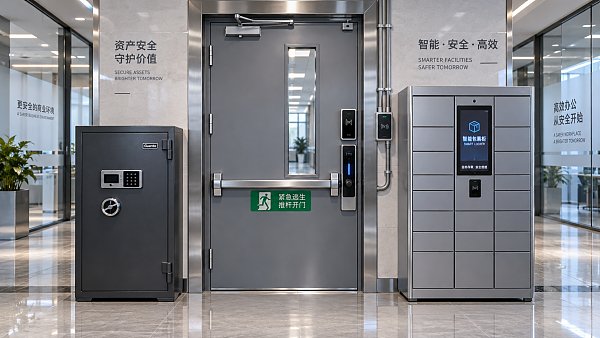
Standards That Commonly Shape Physical Security Decisions
The applicable framework depends on jurisdiction and building type, but several standards are frequently encountered in physical security projects. They should be read in full and checked against current local requirements; a standard number alone does not establish suitability.
For safes and vault systems, EN 1143-1 is often central because it classifies resistance to burglary attack under controlled test conditions. It does not mean every safe with a thick-looking body offers equivalent protection. Construction details matter: composite barriers, anti-drill materials, relocking devices, boltwork, lock protection, and anchoring provisions may all affect the intended performance. Where insurance coverage is involved, the insurer may impose separate requirements for the safe grade, cash limit, alarm connection, or installation location.
For doors, the unit of assessment matters. A cylinder with anti-picking features, such as pin-in-pin arrangements or other restricted key mechanisms, may be useful, but it cannot by itself determine the resistance of the whole entrance. Leaf, frame, hinges, strike plate, glazing, wall interface, and installation fixings create the actual attack path. If a doorset has a fire rating, substitutions to locks, closers, vision panels, access readers, or electric strikes should be reviewed carefully. Security upgrades must not compromise the door’s tested fire or smoke-control function.
Access Control: Security, Escape, and Identity Assurance
Access control compliance is frequently lost at interfaces. A controller may be listed or tested appropriately, while the connected locking device, power supply, request-to-exit device, fire alarm relay, and door hardware are selected independently. The system may then behave unpredictably during power loss, network failure, alarm activation, or an emergency evacuation.
A useful commissioning test should cover more than credential acceptance. It should confirm authorized entry, denied entry, door-held-open alerts, forced-door alerts, emergency unlocking where required, recovery after power interruption, and correct event timestamps. If the facility uses a central platform, test what happens when the server or network connection is unavailable. A secure site should not become inaccessible to authorized personnel simply because a non-critical network service has failed.
Biometric systems add another layer of review. Fingerprint, near-infrared vein recognition, and 3D facial recognition technologies have different operating characteristics and environmental sensitivities. Liveness detection may help address presentation attacks, but its effectiveness should be assessed using the supplier’s documented operating conditions rather than assumed from a feature list. Lighting, user enrollment quality, gloves, wet fingers, throughput expectations, and privacy rules can all affect deployment choices. Biometric templates and access logs may be personal data, so legal review should be built into the design stage rather than left to the installer.
Turnstiles, Speed Gates, and Parcel Lockers Need Operational Testing
Turnstiles and speed gates are often evaluated for throughput and appearance, yet the site team must also examine safety behavior. Infrared safety curtains, obstacle detection, passage logic, and anti-tailgating functions need realistic testing with the expected user population. Consider visitors carrying bags, staff moving in groups, wheelchair users, delivery personnel, and emergency egress conditions. A fast servo-driven gate can be appropriate for a busy lobby only if the sensing arrangement and control configuration are suitable for that specific passage.
Smart parcel lockers require a different compliance conversation. Their risks include unauthorized compartment access, delivery disputes, outdoor exposure, electrical reliability, network resilience, and data handling. A locker’s electronic lock should be assessed for its duty cycle, emergency opening process, tamper response, and behavior during power or connectivity loss. Where 4G, 5G, Wi-Fi, or wired networks are used, responsibility for SIM management, firmware updates, credential control, and incident logs should be written into the operating model.
Build a Verification File That Survives Handover
The strongest compliance process produces a usable evidence trail, not a folder that is opened only after an incident. For each critical asset, retain the exact model reference, applicable standard or listing, scope of certification, installation instructions, wiring diagrams, approved hardware schedule, commissioning record, maintenance intervals, and change history. Photographs of concealed fixings, cable routes, anchors, and door labels are often useful before finishes are completed.
Ask suppliers direct questions: Does the certificate cover this configuration? Is the certificate current? Which components are mandatory for the tested assembly? Are there restrictions on mounting position, door material, ambient conditions, or power supply? Can replacement parts alter the approval status? Vague answers should be treated as a review point, not as evidence of compliance.
Maintenance also belongs in the compliance plan. Mechanical cylinders can be weakened by poor key control. Door closers and electric strikes drift out of adjustment. Biometrics require enrollment governance. Turnstile sensors accumulate dust or become misaligned. Locker software and access credentials need controlled updates. Periodic inspection should test the security function and the safe-failure function, especially at doors used for escape.
A More Defensible Way to Specify Security
Good specifications describe the required outcome, the applicable standard, the evidence expected, and the installation constraints. They do not merely say “high security,” “certified lock,” or “biometric access required.” Those phrases leave too much room for substitution and make acceptance testing difficult.
For facility managers navigating safes, protective doors, smart locks, access platforms, turnstiles, and parcel locker networks, the most reliable approach is to connect engineering evidence to the real operating environment. Industry resources such as Global Smart Hardware & Physical Security Systems can help teams compare certification contexts, material and locking technologies, biometric options, and deployment risks across these categories. But the final decision should remain site-specific: verify the standard, verify the configuration, verify the installation, and verify how the system behaves when normal conditions fail.
- smart parcel lockers
- physical security systems
- access control systems
- security certification standards
- vault doors
- speed gates
- infrared safety curtains
- near-infrared vein recognition
- parcel locker networks
- physical security
- vault systems
- protective doors
- liveness detection
- EN 1143-1
- burglary-resistant safes
Have questions about this sector analysis, or seeking best practices specific to your niche? Drop us a line below and let the senior consultants at MHLS assist you.
We respect your privacy. Your information is strictly confidential.
Recommended News
 Physical Security Infrastructure Cost: Budgeting for Installation and MaintenanceUnmanned Terminal FellowUnderstand physical security infrastructure cost and build a smarter budget for installation, maintenance, and long-term ownership.
 Financial Facility Security: Choosing Vault Doors for Bank BranchesVault Structural ArchitectStrengthen financial facility security with the right bank vault door. Explore certification, installation, locking controls and maintenance before you buy.
 MACO Acquires Majority Stake in Fingerprint Access Provider ekeyProf. Elara SterlingMACO acquires a majority stake in ekey, bringing fingerprint access and door hardware closer together. Discover what the deal could mean for smart buildings.
 Physical Security System Engineering: From Risk Assessment to System DesignUnmanned Terminal FellowExplore physical security system engineering, from risk assessment to integrated design, procurement and testing. Build a safer, more resilient facility.
 Apple Home Collection Smart Lock and Other Accessories Open for Preorder November 13Biometric Auth ScientistApple Home Collection preorders open November 13, 2026. Explore the LG smart lock’s Matter and Aliro support and what buyers should verify before ordering.
 Choosing Servo-Driven Flap Barriers: Throughput, Safety and Access ControlAccess Control StrategistServo-driven flap barriers can balance throughput, safety and access control. Discover how to compare lanes, test performance and choose with confidence.
 Parcel Locker Network Pricing: Setup Costs, Fees and Contract TermsUnmanned Terminal FellowCompare parcel locker networks pricing, from setup costs and recurring fees to contract terms. Discover hidden charges and choose the right model.
 JR East Plans UWB Walk-Through Gates at 40 Stations in Spring 2028Access Control StrategistJR East plans UWB walk-through gates at 40 stations in spring 2028. Explore the rollout timeline and what suppliers should watch.
 Bank Vault Security Standards: UL and EN Ratings ExplainedVault Structural ArchitectExplore bank vault security standards and learn how UL 608 classes and EN 1143-1 grades differ, what they test, and how to verify certification before you buy.
 Mechanical Lock Hardware Prices: What Buyers Should Budget for Bulk OrdersMr. Gideon CrossMechanical lock hardware price is just the starting point. Discover what drives bulk-order costs and how to compare supplier quotes with confidence.
 IndexBox Forecasts Steady Global Security Keypad Market Growth Through 2035Dr. Valerius ThorneGlobal security keypad market growth is forecast at 3.3% annually through 2035. Explore the smart home and replacement trends shaping demand.
 Choosing an Infrared Safety Sensors Manufacturer: What Buyers Should CheckUnmanned Terminal FellowChoosing an infrared safety sensors manufacturer? Compare safety evidence, integration, environmental performance and lifecycle costs before you buy.











