
Security Product Compliance Audit Checklist: CE, FCC, Documentation and Common Gaps
Why does a security product compliance audit matter before CE or FCC submission?
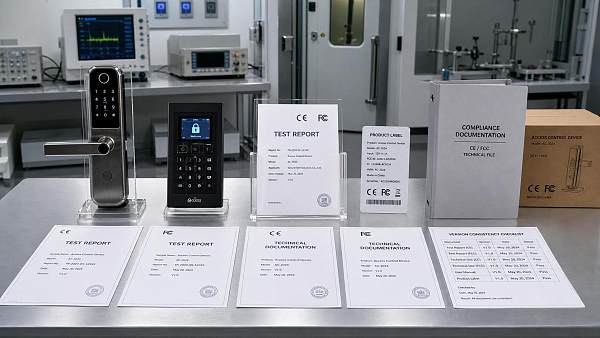
A security product compliance audit is not just a paperwork exercise. It is often the fastest way to uncover export risk before formal review starts.
In smart locks, access control devices, parcel lockers, safes, and connected security hardware, delays rarely come from one major failure alone.
More often, problems appear as small gaps. A label is incomplete. A test report is outdated. A declaration references the wrong directive.
That is why a structured security product compliance audit has become a practical checkpoint across physical security and smart hardware supply chains.
For products combining electronics, mechanics, software, and connectivity, compliance readiness depends on technical consistency, not isolated certificates.
A biometric door lock, for example, may involve EMC testing, radio functions, battery safety, firmware control, user instructions, and traceable component records.
The same logic applies to speed gates, protective doors with electronic control, and smart parcel locker networks.
In practical terms, the audit helps verify whether the product, the file, and the market claim actually match.
What should be inside the audit checklist, beyond the obvious certificates?
Many teams begin with CE marks, FCC reports, and a declaration file. That is necessary, but rarely sufficient.
A useful security product compliance audit checks the full evidence chain behind those documents.
The most reliable checklist usually covers these areas:
- Product identity consistency across model number, PCB version, firmware version, packaging, label, and reports.
- Applicable directives and standards, including EMC, RED, LVD, RoHS, or other market-specific requirements.
- Technical file completeness, including drawings, BOM, block diagrams, risk assessment, and test references.
- Labeling accuracy for marks, importer data, power ratings, warnings, frequency bands, and disposal symbols.
- User documentation quality, especially installation limits, safety instructions, maintenance notes, and intended use.
- Test report validity, sample traceability, laboratory accreditation, and report coverage against shipped configuration.
In security hardware, the technical file often needs extra attention because mechanical performance and electronic behavior interact in real use.
A turnstile may pass electrical safety checks, yet still create a compliance concern if the safety logic, sensor layout, and installation instructions are unclear.
A safe or vault accessory with electronic locking may also need tighter control over material descriptions, interface design, and operating environment claims.
Where do CE and FCC reviews usually break down in real projects?
The common assumption is that failure comes from testing. In reality, a security product compliance audit often exposes document mismatch before technical failure appears.
Some of the most frequent gaps are surprisingly routine, but they still block shipment or trigger rework.
In connected security devices, radio changes are a frequent blind spot. A new module, antenna, or enclosure material can affect prior evidence.
In mechanical-electronic products, another common gap is assuming burglary resistance or anti-picking performance automatically supports regulatory compliance. It does not.
Those performance claims may be valuable, but they must stay separate from CE or FCC obligations unless clearly tied to applicable standards.
How do you check whether the technical file is truly audit-ready?
A technical file becomes audit-ready when an external reviewer can understand the product without chasing missing links.
That means the file should explain what the product is, how it works, which rules apply, and which evidence supports the claim.
A good security product compliance audit usually asks several practical questions.
Does the file reflect the shipped version?
This sounds basic, but version drift is common. Firmware updates, supplier substitutions, and enclosure revisions often happen after testing.
If the file does not track those changes, compliance status becomes uncertain even when test reports exist.
Can the risk assessment explain actual use conditions?
For security hardware, usage conditions matter. Indoor smart locks, outdoor speed gates, and shared parcel lockers face different misuse and exposure patterns.
A useful assessment addresses power failure, forced operation, maintenance access, environmental limits, and unsafe installation scenarios.
Are the support documents connected, not isolated?
The declaration should match the standards list. The manual should match the warnings on the label. The BOM should align with the tested sample.
When these elements point in different directions, the file looks assembled rather than controlled.
Which products need a deeper compliance audit than teams first expect?
Simple-looking devices can carry layered compliance demands. That is especially true in the SHPS landscape, where physical security products increasingly include software and connectivity.
A deeper security product compliance audit is usually warranted when a product combines several functions in one platform.
- Biometric smart locks with wireless communication, mobile app pairing, and rechargeable batteries.
- Access control turnstiles using infrared protection, servo drive systems, and cloud-based monitoring.
- Smart parcel lockers with IoT gateways, multiple lock modules, touchscreens, and remote firmware updates.
- Electronic locking systems integrated into safes, vault rooms, or protective door structures.
In these categories, product safety, EMC behavior, radio performance, installation control, and user instructions intersect.
The more interfaces a product has, the more likely a compliance gap appears between engineering change and documentation control.
That is why broader audit discipline is becoming part of supplier evaluation and project risk review, not just certification preparation.
What is the most practical way to reduce common gaps before they become shipment problems?
The best approach is to treat the security product compliance audit as a repeatable control step, not a last-minute rescue task.
In actual projects, three habits usually make the biggest difference.
Build one master record for version control
Keep model, firmware, hardware revision, antenna, adapter, and manual version in one controlled source.
This reduces the chance that tested samples and shipping configurations quietly diverge.
Review labels and manuals as compliance evidence
Labels and instructions are often treated as design afterthoughts. They should be reviewed with the same discipline as test data.
Many CE and FCC delays begin there, because visible information is easy to inspect and easy to challenge.
Trigger recheck rules after any design change
Not every change requires full retesting, but every change should trigger a review decision.
New battery packs, enclosure materials, communication modules, and safety logic deserve immediate compliance screening.
A short internal decision matrix is often more effective than waiting for a problem at customs or customer acceptance.
So what should the next audit cycle focus on?
If the goal is smoother market access, focus less on collecting more files and more on checking whether existing evidence is coherent.
A strong security product compliance audit connects product identity, test scope, technical file logic, labeling details, and user-facing instructions.
That is especially relevant in security sectors where mechanical protection, biometric control, IoT connectivity, and access management now overlap.
A practical next step is to review one live product family and map every version-dependent item against the latest reports and declarations.
Then check whether the label, manual, packaging, and technical file tell the same story.
If gaps appear early, they are usually manageable. If they appear during shipment or external review, they become expensive.
That is the real value of a security product compliance audit checklist: fewer surprises, stronger accountability, and clearer readiness for CE, FCC, and cross-border deployment.
Have questions about this sector analysis, or seeking best practices specific to your niche? Drop us a line below and let the senior consultants at MHLS assist you.
We respect your privacy. Your information is strictly confidential.
Recommended News
 Physical Security Infrastructure Cost: Budgeting for Installation and MaintenanceUnmanned Terminal FellowUnderstand physical security infrastructure cost and build a smarter budget for installation, maintenance, and long-term ownership.
 Financial Facility Security: Choosing Vault Doors for Bank BranchesVault Structural ArchitectStrengthen financial facility security with the right bank vault door. Explore certification, installation, locking controls and maintenance before you buy.
 MACO Acquires Majority Stake in Fingerprint Access Provider ekeyProf. Elara SterlingMACO acquires a majority stake in ekey, bringing fingerprint access and door hardware closer together. Discover what the deal could mean for smart buildings.
 Physical Security System Engineering: From Risk Assessment to System DesignUnmanned Terminal FellowExplore physical security system engineering, from risk assessment to integrated design, procurement and testing. Build a safer, more resilient facility.
 Apple Home Collection Smart Lock and Other Accessories Open for Preorder November 13Biometric Auth ScientistApple Home Collection preorders open November 13, 2026. Explore the LG smart lock’s Matter and Aliro support and what buyers should verify before ordering.
 Choosing Servo-Driven Flap Barriers: Throughput, Safety and Access ControlAccess Control StrategistServo-driven flap barriers can balance throughput, safety and access control. Discover how to compare lanes, test performance and choose with confidence.
 Parcel Locker Network Pricing: Setup Costs, Fees and Contract TermsUnmanned Terminal FellowCompare parcel locker networks pricing, from setup costs and recurring fees to contract terms. Discover hidden charges and choose the right model.
 JR East Plans UWB Walk-Through Gates at 40 Stations in Spring 2028Access Control StrategistJR East plans UWB walk-through gates at 40 stations in spring 2028. Explore the rollout timeline and what suppliers should watch.
 Bank Vault Security Standards: UL and EN Ratings ExplainedVault Structural ArchitectExplore bank vault security standards and learn how UL 608 classes and EN 1143-1 grades differ, what they test, and how to verify certification before you buy.
 Mechanical Lock Hardware Prices: What Buyers Should Budget for Bulk OrdersMr. Gideon CrossMechanical lock hardware price is just the starting point. Discover what drives bulk-order costs and how to compare supplier quotes with confidence.
 IndexBox Forecasts Steady Global Security Keypad Market Growth Through 2035Dr. Valerius ThorneGlobal security keypad market growth is forecast at 3.3% annually through 2035. Explore the smart home and replacement trends shaping demand.
 Choosing an Infrared Safety Sensors Manufacturer: What Buyers Should CheckUnmanned Terminal FellowChoosing an infrared safety sensors manufacturer? Compare safety evidence, integration, environmental performance and lifecycle costs before you buy.











