
Security Product Compliance Standards Explained: CE, FCC, UL, and What Buyers Should Verify
Security product compliance standards shape how locks, safes, turnstiles, parcel lockers, and connected access devices enter global markets. For technical evaluation, labels such as CE, FCC, and UL are useful, but they mean different things. A marked product may meet legal entry rules, electrical safety expectations, or radio limits, yet still leave unanswered questions about burglary resistance, durability, or cybersecurity.
That distinction matters across physical security systems. A biometric smart lock, a speed gate controller, and a high-security safe do not face the same risks. Security product compliance standards help narrow risk, but the label alone rarely confirms full field suitability. What matters is understanding what each mark covers, what it does not cover, and what evidence should sit behind it.
Why compliance marks matter in security buying
In security hardware, compliance is not just a paperwork exercise. It affects import clearance, insurance acceptance, installation approval, product liability exposure, and system integration planning.
The issue becomes more complex when one product blends mechanics, electronics, biometrics, and connectivity. A smart parcel locker may include radio modules, power supplies, electromechanical locks, cloud links, and user-facing interfaces. Each layer may trigger different security product compliance standards.
The same is true for biometric door locks, vault controllers, and access control turnstiles. Market access marks answer one set of questions. Operational security and attack resistance answer another.
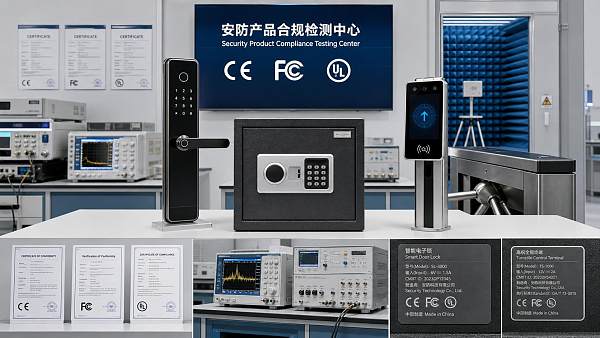
This is why professional review often starts with compliance, then moves into performance, construction, software behavior, and deployment risk.
CE, FCC, and UL do not mean the same thing
Many sourcing errors come from treating these marks as interchangeable quality signals. They are not.
CE
CE marking is mainly tied to regulatory compliance for the European Economic Area. Depending on the product, it may relate to electrical safety, electromagnetic compatibility, radio equipment, hazardous substances, or machinery requirements.
For connected locks, access terminals, or smart lockers, CE may involve EMC and RED requirements. For powered doors or automated gates, additional directives may apply.
CE is important, but it does not automatically prove anti-drill strength, anti-spoofing quality, or long-cycle mechanical endurance.
FCC
FCC compliance is primarily about radio frequency emissions and wireless device regulation in the United States. It matters for products with Wi-Fi, Bluetooth, cellular modules, RFID, or other intentional radiators.
FCC approval helps confirm that a device should not create unacceptable interference. It does not verify physical attack resistance or product safety in the broader sense.
UL
UL is associated with safety testing and certification, especially in North America. Depending on the product category, UL may address electrical hazards, fire risk, component safety, enclosure integrity, or specific security-related performance.
Some security products also rely on UL standards that go beyond basic electrical safety. Safes, alarm units, and access control equipment may be tested under category-specific standards with more meaningful operational implications.
What each mark usually tells you
A simple comparison helps prevent false assumptions during product screening.
This is the practical core of security product compliance standards: each mark is a clue, not a complete verdict.
The bigger issue: compliance versus real security performance
A compliant product can still underperform in the field. That gap appears often in physical security procurement.
For a safe or vault, the decisive question is usually resistance to attack. That may involve EN 1143-1, UL safe testing, material composition, relocking devices, and boltwork design. CE or FCC alone will not answer those points.
For a biometric lock, compliance marks may confirm electrical and wireless conformity. They do not confirm liveness detection quality, spoof resistance, false acceptance behavior, or sensor performance under moisture and contamination.
For turnstiles and speed gates, the missing questions often involve throughput, anti-tailgating logic, infrared safety response, motor endurance, and emergency egress behavior.
This is where SHPS-style analysis becomes useful. Physical security systems sit at the intersection of engineering, compliance, software logic, and deployment context. Reviewing only the logo on a label misses too much.
What buyers should verify beyond the label
When comparing security product compliance standards across suppliers, document quality matters as much as the mark itself.
- Check the exact standard number, edition, and product scope.
- Confirm whether testing covered the complete product or only a module.
- Review the name of the issuing laboratory or certification body.
- Verify whether the certificate is current, suspended, expired, or limited.
- Match the tested configuration to the shipped configuration.
- Ask for test reports when category risk is high.
- Check user manuals, declarations of conformity, and installation instructions.
- Look for region-specific gaps if the product is sold globally.
That last point is often missed. A wireless smart lock approved for one market may still require different radio, power, or safety documentation elsewhere.
How this applies across product categories
Different products call for different reading of security product compliance standards.
Smart locks and biometric devices
Review CE, FCC, and UL where relevant, then move quickly to biometric accuracy, liveness detection, encryption, offline fail behavior, and mechanical override design.
Safes and vault systems
Prioritize burglary resistance grades, fire ratings where needed, body and door construction, anti-drill materials, lock certification, and anchoring instructions. Compliance marks are secondary to attack resistance evidence.
Turnstiles and speed gates
Check electrical and EMC conformity, then verify safety curtains, sensor coverage, passage logic, emergency release, cycle testing, and integration with access control platforms.
Smart parcel lockers
Look beyond connectivity marks. Evaluate door lock reliability, compartment integrity, network resilience, remote diagnostics, power backup, and audit trail retention.
Common red flags during supplier review
Not every compliance claim is equal. Several warning signs appear repeatedly in cross-border sourcing.
- A certificate shows a family name, but not the offered model.
- The report covers a radio module, while the complete device remains unverified.
- The supplier provides logos, but no declaration or report reference.
- Mechanical security claims are described as “tested,” without naming the standard.
- The certified sample differs from the production bill of materials.
- Documentation quality drops when firmware, power input, or enclosure options change.
These issues do not always indicate fraud. Sometimes they reflect immature compliance control. Either way, they increase approval risk.
Building a better evaluation framework
The strongest reviews combine compliance evidence with scenario-based validation. That is especially useful in smart hardware and physical security systems, where environment and threat profile change the meaning of “fit for use.”
A practical framework can include four layers: market access compliance, electrical and radio safety, security performance, and deployment compatibility. Under that structure, security product compliance standards remain essential, but they become part of a wider decision system.
For many teams, the next step is not asking whether a product has CE, FCC, or UL. It is asking whether the evidence behind those marks aligns with the real installation, region, threat model, and service conditions. That approach leads to cleaner supplier comparison, fewer approval surprises, and stronger security outcomes.
- smart parcel lockers
- physical security systems
- speed gates
- access control platforms
- security product compliance
- access control turnstiles
- physical security
- vault systems
- liveness detection
- EN 1143-1
- safe testing
- UL safe testing
- biometric door locks
- security hardware
- security product compliance standards
Have questions about this sector analysis, or seeking best practices specific to your niche? Drop us a line below and let the senior consultants at MHLS assist you.
We respect your privacy. Your information is strictly confidential.
Recommended News
 Physical Security Infrastructure Cost: Budgeting for Installation and MaintenanceUnmanned Terminal FellowUnderstand physical security infrastructure cost and build a smarter budget for installation, maintenance, and long-term ownership.
 Financial Facility Security: Choosing Vault Doors for Bank BranchesVault Structural ArchitectStrengthen financial facility security with the right bank vault door. Explore certification, installation, locking controls and maintenance before you buy.
 MACO Acquires Majority Stake in Fingerprint Access Provider ekeyProf. Elara SterlingMACO acquires a majority stake in ekey, bringing fingerprint access and door hardware closer together. Discover what the deal could mean for smart buildings.
 Physical Security System Engineering: From Risk Assessment to System DesignUnmanned Terminal FellowExplore physical security system engineering, from risk assessment to integrated design, procurement and testing. Build a safer, more resilient facility.
 Apple Home Collection Smart Lock and Other Accessories Open for Preorder November 13Biometric Auth ScientistApple Home Collection preorders open November 13, 2026. Explore the LG smart lock’s Matter and Aliro support and what buyers should verify before ordering.
 Choosing Servo-Driven Flap Barriers: Throughput, Safety and Access ControlAccess Control StrategistServo-driven flap barriers can balance throughput, safety and access control. Discover how to compare lanes, test performance and choose with confidence.
 Parcel Locker Network Pricing: Setup Costs, Fees and Contract TermsUnmanned Terminal FellowCompare parcel locker networks pricing, from setup costs and recurring fees to contract terms. Discover hidden charges and choose the right model.
 JR East Plans UWB Walk-Through Gates at 40 Stations in Spring 2028Access Control StrategistJR East plans UWB walk-through gates at 40 stations in spring 2028. Explore the rollout timeline and what suppliers should watch.
 Bank Vault Security Standards: UL and EN Ratings ExplainedVault Structural ArchitectExplore bank vault security standards and learn how UL 608 classes and EN 1143-1 grades differ, what they test, and how to verify certification before you buy.
 Mechanical Lock Hardware Prices: What Buyers Should Budget for Bulk OrdersMr. Gideon CrossMechanical lock hardware price is just the starting point. Discover what drives bulk-order costs and how to compare supplier quotes with confidence.
 IndexBox Forecasts Steady Global Security Keypad Market Growth Through 2035Dr. Valerius ThorneGlobal security keypad market growth is forecast at 3.3% annually through 2035. Explore the smart home and replacement trends shaping demand.
 Choosing an Infrared Safety Sensors Manufacturer: What Buyers Should CheckUnmanned Terminal FellowChoosing an infrared safety sensors manufacturer? Compare safety evidence, integration, environmental performance and lifecycle costs before you buy.











