
Security Product Testing: Core Test Items, Failure Risks, and Reporting Basics
Why does security product testing matter before any buying or deployment decision?
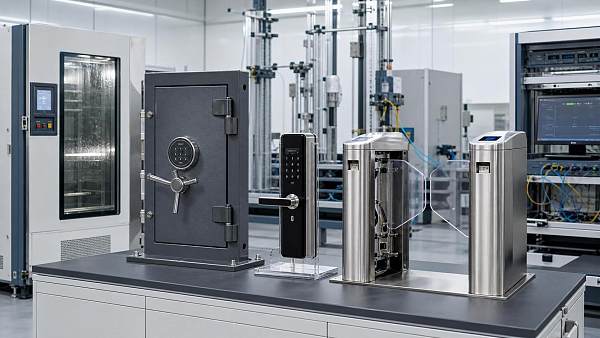
Security product testing is where technical claims meet real operating pressure.
That matters across smart hardware and physical security systems, not only in regulated projects.
A safe may look strong, yet fail under drilling or boltwork stress.
A biometric lock may unlock quickly, yet struggle with spoofing, humidity, or unstable power.
A turnstile may run smoothly in a showroom, then jam under crowd pressure.
A parcel locker may connect well indoors, then lose reliability in outdoor heat or network fluctuation.
In practical terms, security product testing helps answer one basic question.
Can this product keep working when threat, frequency, environment, and user behavior become less predictable?
That is why SHPS and similar industry resources focus on testing, compliance, materials, mechanics, electronics, and field conditions together.
The goal is not a perfect lab score alone.
The goal is a realistic view of burglary resistance, access reliability, service life, and operational risk.
What usually counts as core security product testing?
The exact test plan changes by product category, but the core logic stays consistent.
Security product testing usually combines resistance, reliability, safety, and system behavior.
For physical protection products, structural attack tests are central.
These can include drilling, cutting, prying, impact, thermal attack, and forced entry timing.
For safes, vaults, protective doors, and lock cylinders, material and mechanism performance matter as much as surface hardness.
Composite fill, relockers, bolt direction, anti-drill plates, and anti-picking geometry all affect results.
For smart locks and access devices, the test scope expands.
Now the review may include biometric false acceptance, liveness detection, credential handling, encryption, battery endurance, and electronic lock cycling.
Turnstiles and speed gates add another layer.
They need mechanical durability, anti-tailgating logic, infrared safety response, emergency release, and people-flow stability.
Parcel lockers often require door cycle testing, controller stability, lock response, network resilience, and weather exposure checks.
A useful way to read security product testing is to separate four test families.
When these four areas are missing from a report, the testing picture is usually incomplete.
How do test priorities change between safes, locks, turnstiles, and parcel lockers?
This is where many comparisons go wrong.
People often treat all security product testing as one checklist, but the threat model is different.
For safes and vault systems, resistance time and tool attack categories matter most.
Standards such as EN 1143-1 or relevant UL methods become important reference points.
For mechanical lock cylinders, anti-picking, anti-bumping, anti-drill inserts, and key control features deserve closer reading.
For biometric smart locks, testing should go beyond opening speed.
Spoof resistance, false rejection under wet fingers, offline operation, and firmware stability often reveal more than a demo video.
Turnstiles and speed gates are different again.
The key issue is not only unauthorized entry, but safe throughput during peak movement.
Servo control, infrared curtains, obstruction response, emergency mode, and housing durability all deserve testing attention.
Parcel lockers combine access control with logistics reality.
That means door alignment, electronic lock consistency, compartment management, cloud communication, and recovery after outages are all relevant.
In actual review work, the better question is not, “Has it been tested?”
It is, “Tested for which risk, under which condition, and against which expected use pattern?”
Where do security product testing failures usually come from?
Failures rarely come from one dramatic flaw alone.
More often, they appear where design assumptions and field reality no longer match.
A lock body may pass bench testing, yet fail after dust enters the mechanism.
A biometric reader may work well in ideal light, then lose consistency near strong sunlight or reflective surfaces.
A safe door may resist drilling, but hinge or anchor weakness can still reduce overall protection.
This is why failure review should look at the whole assembly, not one celebrated feature.
- Test samples are different from production units in materials, firmware, or component sources.
- The report measures isolated components, while actual use depends on assembled system behavior.
- Environmental testing is too narrow for outdoor, coastal, dusty, or high-frequency sites.
- Attack tests focus on one method, while real intrusions combine force, tools, and timing.
- Electronic recovery after low voltage, outage, or network loss is not tested deeply enough.
A second problem is overreading certifications.
A valid standard result is useful, but it does not automatically cover every installation or climate.
Security product testing reduces uncertainty.
It does not remove the need to match the product with site conditions and operational intensity.
What should a credible test report actually show?
A useful report should make performance easier to judge, not harder to decode.
If a report only gives a passing statement, it is usually not enough.
Security product testing reports become more credible when they explain the test basis and the tested sample clearly.
That includes model identity, configuration, date, standard version, lab details, and operating conditions.
The better reports also show limits.
For example, they may state whether the result applies to indoor installation only, or to a specific lock variant.
A simple screening table can help during early comparison.
When reading SHPS-style technical coverage, this kind of detail is what turns a claim into usable intelligence.
How can early-stage research turn security product testing into a better decision?
The most practical approach is to connect test evidence with the actual use case.
Start by defining the dominant risk.
Is the main issue forced attack, spoofing, misuse, heavy traffic, outdoor exposure, or service interruption?
Then look for security product testing that addresses that risk directly.
This sounds obvious, but many mistakes come from comparing unrelated metrics.
A strong anti-drill structure does not explain biometric stability.
A fast opening speed does not prove anti-tailgating performance.
A long cycle life does not confirm corrosion resistance.
A grounded review process usually includes these checks.
- Match the report date and tested version with the current offered version.
- Check whether installation method affects the stated result.
- Review both security and operational reliability, not one without the other.
- Look for field-relevant conditions, especially for connected or outdoor products.
- Treat missing data as a real decision factor, not a paperwork delay.
In the end, security product testing is less about chasing the longest report.
It is about building a clear line from threat, to test item, to evidence, to deployment confidence.
For the next step, map the application first, then compare reports against that map.
That makes it easier to spot weak coverage, question assumptions, and set a more reliable evaluation standard.
Have questions about this sector analysis, or seeking best practices specific to your niche? Drop us a line below and let the senior consultants at MHLS assist you.
We respect your privacy. Your information is strictly confidential.
Recommended News
 Financial Facility Security: Choosing Vault Doors for Bank BranchesVault Structural ArchitectStrengthen financial facility security with the right bank vault door. Explore certification, installation, locking controls and maintenance before you buy.
 MACO Acquires Majority Stake in Fingerprint Access Provider ekeyProf. Elara SterlingMACO acquires a majority stake in ekey, bringing fingerprint access and door hardware closer together. Discover what the deal could mean for smart buildings.
 Physical Security System Engineering: From Risk Assessment to System DesignUnmanned Terminal FellowExplore physical security system engineering, from risk assessment to integrated design, procurement and testing. Build a safer, more resilient facility.
 Apple Home Collection Smart Lock and Other Accessories Open for Preorder November 13Biometric Auth ScientistApple Home Collection preorders open November 13, 2026. Explore the LG smart lock’s Matter and Aliro support and what buyers should verify before ordering.
 Choosing Servo-Driven Flap Barriers: Throughput, Safety and Access ControlAccess Control StrategistServo-driven flap barriers can balance throughput, safety and access control. Discover how to compare lanes, test performance and choose with confidence.
 Parcel Locker Network Pricing: Setup Costs, Fees and Contract TermsUnmanned Terminal FellowCompare parcel locker networks pricing, from setup costs and recurring fees to contract terms. Discover hidden charges and choose the right model.
 JR East Plans UWB Walk-Through Gates at 40 Stations in Spring 2028Access Control StrategistJR East plans UWB walk-through gates at 40 stations in spring 2028. Explore the rollout timeline and what suppliers should watch.
 Bank Vault Security Standards: UL and EN Ratings ExplainedVault Structural ArchitectExplore bank vault security standards and learn how UL 608 classes and EN 1143-1 grades differ, what they test, and how to verify certification before you buy.
 Mechanical Lock Hardware Prices: What Buyers Should Budget for Bulk OrdersMr. Gideon CrossMechanical lock hardware price is just the starting point. Discover what drives bulk-order costs and how to compare supplier quotes with confidence.
 IndexBox Forecasts Steady Global Security Keypad Market Growth Through 2035Dr. Valerius ThorneGlobal security keypad market growth is forecast at 3.3% annually through 2035. Explore the smart home and replacement trends shaping demand.
 Choosing an Infrared Safety Sensors Manufacturer: What Buyers Should CheckUnmanned Terminal FellowChoosing an infrared safety sensors manufacturer? Compare safety evidence, integration, environmental performance and lifecycle costs before you buy.
 Choosing a Security Material Testing Service: What to Check for Lock and Safe MaterialsProf. Elara SterlingChoose a security material testing service with confidence. Learn what to check for lock and safe materials, from attack methods and accreditation to reliable reports.











