
Smart Building Security in the UK: Which Systems Fit Offices, Schools, and Mixed-Use Sites?
Smart building security UK: start with site function, not product lists
From office towers to schools and mixed-use developments, smart building security UK strategies must balance safety, access efficiency, compliance, and long-term operating costs.
That sounds straightforward, but project teams usually face a more complex reality.
One building may need smoother visitor flow, another needs stronger safeguarding, while another must separate residents, tenants, couriers, and contractors.
This is why smart building security UK planning should begin with operational patterns, threat exposure, and maintenance capacity.
The right system is rarely the most feature-heavy one.
It is the one that fits daily movement, local compliance, and realistic response procedures.
In practice, the strongest results come from layered security.
That means combining access control, surveillance, smart locks, barriers, and monitored entry points into one manageable framework.
For smart building security UK procurement, a useful question is simple.
Which controls reduce real risk without creating friction for users, operators, or emergency teams?
Core system blocks in a smart building security UK project
Most smart building security UK projects rely on the same building blocks, even when the site profile changes.
- Access control platforms for permissions, schedules, audit trails, and remote administration.
- Smart locks for offices, staff rooms, plant areas, apartments, delivery spaces, or restricted stores.
- CCTV and video analytics for visibility, event review, and incident verification.
- Turnstiles, speed gates, or controlled doors for entry management and anti-tailgating.
- Intercoms and visitor systems for receptionless or hybrid staffing models.
- Alarm integration for forced entry, propped doors, and out-of-hours access attempts.
The value comes from how these systems connect.
If a door alarm, camera, and access event remain isolated, response slows down and investigations become messy.
By contrast, integrated smart building security UK architecture creates a clearer operating picture.
A denied badge event can trigger video review, notify security staff, and log the incident automatically.
That reduces manual checking and improves accountability.
What fits office buildings best
Office environments usually prioritise three things: efficient entry, tenant separation, and better control over visitors and contractors.
For this reason, smart building security UK solutions for offices often centre on fast front-of-house screening.
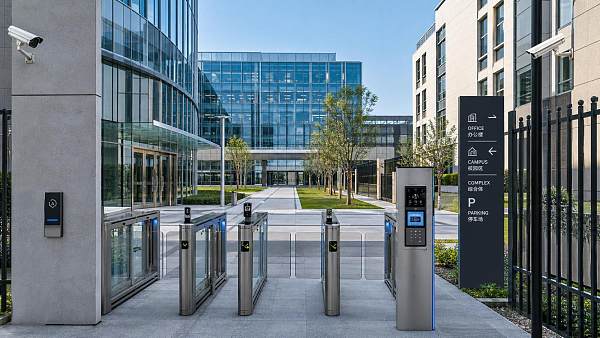
Speed gates or optical turnstiles work well in busy lobbies.
They support high throughput while discouraging tailgating, especially when paired with infrared safety and detection systems.
Beyond the lobby, smart locks and card or mobile credentials help separate floors, suites, executive spaces, and technical rooms.
Meeting rooms and shared facilities can also be included if misuse or after-hours access is a concern.
Recommended office stack
- Lobby speed gates with badge, QR, or mobile access.
- Lift destination or floor-level access controls.
- Visitor pre-registration linked to reception or remote approval.
- Smart locks on comms rooms, finance areas, and executive offices.
- CCTV covering entry points, lift lobbies, loading bays, and perimeter zones.
A common mistake is overengineering internal doors while under-securing service entrances.
In many office schemes, delivery areas, car park access, and plant corridors create the bigger exposure.
That is where smart building security UK planning should stay practical and risk-based.
What works in schools and education sites
Schools need a different balance.
The goal is not simply tighter control.
It is safer safeguarding, clear visibility, and controlled access without making the site feel hostile.
For smart building security UK deployments in schools, zoning matters more than sheer hardware volume.
Public reception, administration areas, teaching blocks, safeguarding offices, laboratories, and sports facilities should not share identical rules.
Best-fit controls for schools
- Single-point visitor entry with intercom, screening, and sign-in management.
- Electronic access control for staff-only doors and vulnerable asset rooms.
- Lockdown-capable door hardware where policy requires rapid response.
- CCTV at gates, perimeter lines, reception, and circulation hotspots.
- Remote alerts for doors held open or opened outside approved hours.
Biometric systems may suit selected staff areas, but they should be assessed carefully against policy, privacy, and operational acceptance.
In many education settings, robust credentials and good supervision deliver better value.
More importantly, smart building security UK choices in schools must support emergency egress and staff confidence.
A secure door that confuses staff under pressure is a design failure.
Mixed-use sites need layered separation
Mixed-use developments are often the hardest smart building security UK challenge.
They combine different user groups, different opening hours, and different risk tolerances inside one footprint.
A single site may include offices, apartments, retail units, back-of-house logistics, and parcel collection areas.
This makes identity management and zone separation critical.
Where mixed-use projects succeed
They define who can enter which zone, by what method, and at what time.
They also plan for exceptions, including cleaners, delivery drivers, maintenance teams, and temporary occupiers.
- Separate credentials for residents, tenants, retailers, and service contractors.
- Compartmented lift and corridor access.
- Smart parcel lockers in secure but convenient zones.
- Video coverage at entrances, shared amenities, and goods access points.
- Door and alarm integration across retail and residential boundaries.
Parcel management deserves special attention.
Uncontrolled deliveries can undermine an otherwise strong smart building security UK design.
Smart parcel lockers reduce lobby congestion, lost items, and unauthorised handoffs.
For developments with heavy courier traffic, that can materially improve both security and operations.
How to compare systems before procurement
When comparing smart building security UK options, feature lists are not enough.
A better evaluation model checks performance in daily use, under fault conditions, and during incidents.
This is often where suppliers begin to separate.
Some systems look strong in demonstrations but create complexity once multiple buildings, user groups, and exceptions appear.
A strong smart building security UK solution should remain manageable after handover, not just during commissioning.
Practical deployment advice for better outcomes
In real projects, success usually depends on coordination.
Security, MEP, fire strategy, IT, facilities, and operator workflows need alignment early.
- Map user journeys before choosing hardware positions.
- Define critical zones and response priorities clearly.
- Test visitor, delivery, and after-hours scenarios.
- Review maintenance ownership for every device type.
- Require clear reporting, event logs, and support commitments from vendors.
From a risk perspective, the best smart building security UK approach is usually the one that is consistent and understandable.
People follow systems they can interpret quickly.
That matters as much as hardware quality.
For offices, focus on throughput and tenant control.
For schools, focus on safeguarding and controlled openness.
For mixed-use sites, focus on layered permissions and clean separation.
That is the practical route to smart building security UK systems that perform well on opening day and keep working as the site evolves.
Have questions about this sector analysis, or seeking best practices specific to your niche? Drop us a line below and let the senior consultants at MHLS assist you.
We respect your privacy. Your information is strictly confidential.
Recommended News
 Parcel Locker Network Pricing: Setup Costs, Fees and Contract TermsUnmanned Terminal FellowCompare parcel locker networks pricing, from setup costs and recurring fees to contract terms. Discover hidden charges and choose the right model.
 JR East Plans UWB Walk-Through Gates at 40 Stations in Spring 2028Access Control StrategistJR East plans UWB walk-through gates at 40 stations in spring 2028. Explore the rollout timeline and what suppliers should watch.
 Bank Vault Security Standards: UL and EN Ratings ExplainedVault Structural ArchitectExplore bank vault security standards and learn how UL 608 classes and EN 1143-1 grades differ, what they test, and how to verify certification before you buy.
 Mechanical Lock Hardware Prices: What Buyers Should Budget for Bulk OrdersMr. Gideon CrossMechanical lock hardware price is just the starting point. Discover what drives bulk-order costs and how to compare supplier quotes with confidence.
 IndexBox Forecasts Steady Global Security Keypad Market Growth Through 2035Dr. Valerius ThorneGlobal security keypad market growth is forecast at 3.3% annually through 2035. Explore the smart home and replacement trends shaping demand.
 Choosing an Infrared Safety Sensors Manufacturer: What Buyers Should CheckUnmanned Terminal FellowChoosing an infrared safety sensors manufacturer? Compare safety evidence, integration, environmental performance and lifecycle costs before you buy.
 Choosing a Security Material Testing Service: What to Check for Lock and Safe MaterialsProf. Elara SterlingChoose a security material testing service with confidence. Learn what to check for lock and safe materials, from attack methods and accreditation to reliable reports.
 How Precision Anti-Pick Lock Cylinders Resist ManipulationSecurity Metallurgy ExpertDiscover how precision anti-pick lock technology resists manipulation, and learn what to check when comparing security features, test evidence, and everyday reliability.
 Dermalog Joins NIST FastCAP Program for Contactless Fingerprint TestingProf. Elara SterlingDermalog joins the NIST FastCAP program for contactless fingerprint testing. Discover what this means for biometric identification and digital identity.
 Choosing Security Export Compliance Services: What Providers Should CoverMr. Gideon CrossSecurity export compliance services can help prevent costly delays. Discover what to look for in classification, licensing, screening, and documentation.
 European Security Compliance Standards for Safes: EN 1143-1 vs EN 14450Dr. Valerius ThorneExplore security compliance standards Europe buyers need to know. Compare EN 1143-1 and EN 14450 to choose the right safe with confidence.
 HID Global Acquires inepro ID to Expand RFID and BLE Access SolutionsUnmanned Terminal FellowHID Global acquires inepro ID to expand RFID and BLE access solutions for printers, smart lockers and shared devices. Explore what the deal could mean for your organization.











