
What Security Certifications Should a Smart Parcel Locker Have?
A smart parcel locker does not have one universal “security certification.” A credible system is assessed through a combination of electrical safety approvals, radio and electromagnetic compliance, access-control testing, cybersecurity evidence, fire and building compliance, and country-specific legal requirements. The required combination depends on where the locker is installed, how it connects, whether it handles personal data or payments, and whether it becomes part of a controlled-access building.
The most important procurement distinction is between a certificate covering the complete locker and documentation covering only a component. A touchscreen may be certified, a power supply may carry a recognized safety mark, and an electronic lock may have been tested separately—while the assembled locker has never been evaluated as a system. For a networked locker installed in a residential building, retail site, campus, transport hub, or logistics facility, system-level evidence matters because wiring, enclosure construction, power distribution, remote unlocking, user authentication, and software administration interact in the finished product.
Start with the legal market-entry requirements
Electrical and radio compliance are normally the first non-negotiable layer. They do not prove that a locker is resistant to theft or cyberattack, but they establish whether it can be legally and safely placed on a regional market.
For the United States, electrical safety is often demonstrated through listing or certification by a Nationally Recognized Testing Laboratory (NRTL), such as UL, ETL, or CSA Group. The exact applicable standard depends on the equipment architecture. For lockers containing computing, displays, controllers, power supplies, and communications equipment, UL 62368-1 may be relevant. This is a hazard-based safety standard for audio/video, information, and communication technology equipment. A locker with an industrial control panel may also require the panel to be evaluated under UL 508A, where applicable.
Local authorities, insurers, landlords, and electrical inspectors may have specific expectations beyond federal rules. “UL components inside” is not equivalent to a UL-listed locker. Buyers should ask whether the listing applies to the entire assembled unit, which factory is covered, what configurations are included, and whether field-installed options can invalidate the approval.
In the European Economic Area, a smart locker generally needs CE marking based on the applicable EU legislation. Depending on its configuration, this may include:
- the Low Voltage Directive (LVD) 2014/35/EU for electrical safety;
- the Electromagnetic Compatibility Directive (EMC) 2014/30/EU for emissions and immunity;
- the Radio Equipment Directive (RED) 2014/53/EU if the locker includes Wi-Fi, Bluetooth, cellular, RFID, NFC, or other radio functions;
- the RoHS Directive for restricted hazardous substances in electrical and electronic equipment.
CE marking is not a certificate issued automatically by an EU authority. It is a manufacturer declaration supported by a conformity assessment process, technical file, risk assessment, test evidence, and an EU Declaration of Conformity. For radio-equipped lockers, RED obligations are particularly important because the radio module, antenna design, firmware configuration, and final enclosure can affect compliance.
In the United States, intentional radio transmitters also require FCC authorization, while Canada applies comparable Innovation, Science and Economic Development Canada (ISED) requirements. These approvals are often associated with the wireless module, but integration still matters. A pre-certified cellular or Wi-Fi module does not remove every responsibility from the equipment manufacturer when antenna type, power settings, enclosure effects, or additional transmitters differ from the approved conditions.
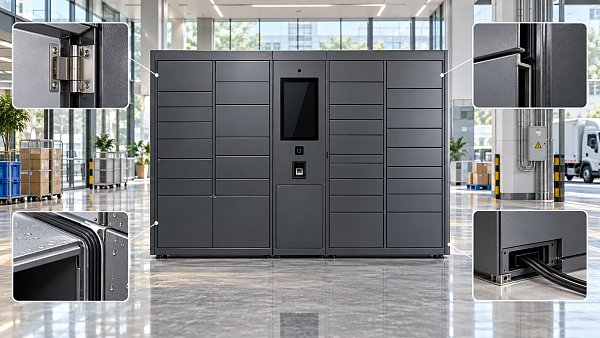
Electrical compliance is necessary, but it is not the locker’s security rating
A frequent mistake is to treat CE, FCC, or UL marking as proof that a smart parcel locker protects parcels against forced entry, unauthorized opening, or administrative misuse. These marks answer different questions. Electrical safety standards focus on hazards such as electric shock, fire, energy sources, overheating, and mechanical injury. Radio rules address spectrum use and electromagnetic behavior. Neither automatically validates the quality of the locking mechanism, the strength of the door, or the resilience of cloud access controls.
Physical security must therefore be examined separately. There is no single globally adopted burglary-resistance certification designed specifically for parcel locker cabinets. A buyer should be cautious when a supplier presents a generic “anti-theft certificate” without identifying the test method, test laboratory, attack tools, attack duration, tested configuration, and pass/fail criteria.
The more useful question is whether the critical elements have been independently assessed against relevant standards or documented test protocols. These elements include:
- electronic locking mechanisms and their resistance to forced release;
- door retention, hinge protection, latch engagement, and cabinet anchoring;
- controller behavior during power loss, network loss, and restart;
- override key control and mechanical bypass protection;
- tamper detection and event logging;
- resistance to impact, prying, drilling, and removal of accessible fasteners.
UL 294, covering access control system units, can be relevant to access-control elements used in a locker solution, especially where the system controls electrically operated locking hardware. Its applicability should be confirmed rather than assumed. UL 1034, covering burglar-resistant electric locking mechanisms, may also be relevant for particular locking devices. A supplier should identify whether the certification is for the lock, the controller, or the complete locker assembly.
For European access-control applications, EN 60839-11-1 provides system and component requirements for electronic access control systems. It can provide a useful reference where parcel lockers share infrastructure with building access control, but it does not replace an application-specific assessment of locker doors, compartments, and parcel handover procedures.
Impact and ingress ratings can add practical value, especially for outdoor banks of lockers. IEC 60529 defines IP ratings for protection against ingress of solids and water, while IEC 62262 defines IK ratings for impact resistance. An IP rating does not indicate burglary resistance; an IK rating does not confirm that a door cannot be pried open. Both should be read as narrowly as they are written. The tested enclosure, door condition, cable entry arrangement, and installation orientation matter.
Cybersecurity evidence is now part of physical parcel protection
When a locker can be opened remotely, connected to a property-management platform, administered through a web portal, or operated by a courier application, cyber weaknesses can become physical security weaknesses. An attacker does not need to break a compartment door if an exposed API, default administrator password, insecure remote command, or poorly protected service account can issue an unlock instruction.
Cybersecurity is rarely demonstrated by a single universal certification. A stronger assessment combines a recognized baseline, secure development evidence, technical test results, and contractual commitments for vulnerability management.
ETSI EN 303 645 is an important baseline for consumer Internet of Things cybersecurity. Its principles are also useful when evaluating connected lockers: no universal default passwords, a process for vulnerability disclosure, secure software updates, secure storage of sensitive parameters, protection of personal data, resilience against outages, and clear deletion procedures for user data. It is not a complete parcel-locker security specification, but it helps expose weak IoT practices that are otherwise hidden behind a polished user interface.
IEC 62443 is widely used in industrial automation and control system security. It can be relevant where locker networks are deployed as managed operational infrastructure, especially when controllers, gateways, maintenance systems, and remote service tools are integrated into broader facility systems. Its value lies less in claiming that every locker must be “IEC 62443 certified” and more in examining whether product development, account segregation, network architecture, patching, and remote support are managed with an appropriate security discipline.
Some suppliers may reference UL 2900 cybersecurity standards or independent penetration testing. Such evidence can be useful, but reports should be reviewed for scope. A short test of a mobile application does not validate the cloud platform, firmware update channel, maintenance interface, or administrator portal. Likewise, a test report from an old firmware release says little about the current product if updates are frequent and change control is unclear.
At a minimum, the security file for a connected locker should answer practical questions:
- Are all unlock commands authenticated, authorized, encrypted, and logged?
- Can the installer or service technician still use factory credentials after commissioning?
- Are firmware packages signed and verified before installation?
- Can software rollback be prevented or controlled?
- Is the locker safe when cloud connectivity, cellular service, or local network access fails?
- Are role-based permissions separated for couriers, site administrators, technical support, and platform operators?
- How long are security patches supported, and how are customers notified of critical vulnerabilities?
Where personal information is processed, data protection law also enters the decision. In the EU, the General Data Protection Regulation (GDPR) is a legal framework, not a product certificate. A locker supplier cannot simply claim to be “GDPR certified” as a substitute for proper data-processing terms, data retention controls, lawful processing arrangements, access controls, and incident response procedures. The same distinction applies to privacy requirements in other jurisdictions.
Fire, emergency access, and building integration cannot be treated as optional details
A locker located inside a building must fit the building’s fire and life-safety design. The relevant requirement may concern the equipment itself, its installation location, cable routing, wall penetration, battery system, or obstruction of evacuation routes. There is no general rule that every parcel locker needs a fire-resistance rating. However, a locker installed in a corridor, lobby, parking structure, or mixed-use development can create compliance issues if it narrows required egress, affects fire compartmentation, obstructs emergency equipment, or adds unassessed combustible materials.
Materials may be evaluated using standards such as UL 94 for flammability of plastic materials, ASTM E84 for surface burning characteristics in relevant North American building applications, or EN 13501 classifications in Europe. These are not interchangeable, and none should be used as a blanket statement that the complete installation is “fire approved.” The local building code, fire authority, and project specifications determine what is actually required.
Battery-backed lockers require additional scrutiny. Lithium battery cells and packs may be evaluated against standards such as IEC 62133-2, UL 1642, or UL 2054, depending on the battery format and market. The procurement file should identify the battery supplier, battery management approach, charging arrangement, operating temperature range, replacement procedure, and response to battery failure. A generic battery certificate that cannot be linked to the installed pack is weak evidence.
Emergency operation must also be designed deliberately. Fire alarm input, emergency release behavior, locked-door state during power loss, manual access controls, and audit trails can conflict if they are selected without a clear use case. A parcel compartment should not be made freely accessible merely because the building enters a fire condition, but emergency responders may need a controlled way to access equipment or isolate power. This is a design and code-review issue, not a feature checkbox.
Accessibility and payment functions introduce separate obligations
Where lockers are provided for public or tenant use, accessibility must be assessed as part of installation planning. In the United States, relevant requirements may arise under the Americans with Disabilities Act and applicable building codes. Reach ranges, operable force, clear floor space, display visibility, user-interface timing, and accessible compartment allocation can matter. In Europe, national accessibility rules and standards may apply; EN 301 549 can be relevant to digital accessibility aspects of software and user interfaces, although it does not solve physical installation requirements.
If the locker accepts card payments, stores payment credentials, or integrates directly with payment terminals, PCI DSS becomes relevant to the payment environment. A payment terminal’s approval does not automatically make the locker platform PCI compliant. The integration model, network segmentation, token handling, and responsibility allocation between operator, payment service provider, and software vendor must be clear.
How to evaluate certification claims without creating false assurance
The most reliable approach is to build a requirement matrix before selecting a supplier. The matrix should distinguish mandatory legal compliance, project-specific building requirements, voluntary security testing, and supplier process evidence. Each document should be connected to a defined product configuration and market.
For every claimed approval, request the certificate or declaration number, issuing body or responsible manufacturer, standard edition, test report scope, factory address, model numbers, validity status, and any conditions or exclusions. A certificate for a steel cabinet without the electronic lock, controller, display, wireless module, and power distribution does not establish compliance for the connected locker being purchased.
Configuration control is especially important in cross-border procurement. A supplier may offer a CE-marked European version, an FCC-authorized U.S. wireless version, and a locally modified version with different power supplies, cellular modules, locks, or firmware. Documentation must match the delivered configuration, not the sample demonstrated during commercial discussions.
A well-supported smart parcel locker will therefore show more than a collection of logos. It will provide market-entry compliance for the destination country, defensible safety evidence for the assembled equipment, relevant access-control and enclosure test data, documented cybersecurity controls, and installation guidance that addresses fire, accessibility, power, connectivity, and emergency operation. That combination is what turns certification from a marketing claim into a usable risk-control tool.
Have questions about this sector analysis, or seeking best practices specific to your niche? Drop us a line below and let the senior consultants at MHLS assist you.
We respect your privacy. Your information is strictly confidential.
Recommended News
 Physical Security Infrastructure Cost: Budgeting for Installation and MaintenanceUnmanned Terminal FellowUnderstand physical security infrastructure cost and build a smarter budget for installation, maintenance, and long-term ownership.
 Financial Facility Security: Choosing Vault Doors for Bank BranchesVault Structural ArchitectStrengthen financial facility security with the right bank vault door. Explore certification, installation, locking controls and maintenance before you buy.
 MACO Acquires Majority Stake in Fingerprint Access Provider ekeyProf. Elara SterlingMACO acquires a majority stake in ekey, bringing fingerprint access and door hardware closer together. Discover what the deal could mean for smart buildings.
 Physical Security System Engineering: From Risk Assessment to System DesignUnmanned Terminal FellowExplore physical security system engineering, from risk assessment to integrated design, procurement and testing. Build a safer, more resilient facility.
 Apple Home Collection Smart Lock and Other Accessories Open for Preorder November 13Biometric Auth ScientistApple Home Collection preorders open November 13, 2026. Explore the LG smart lock’s Matter and Aliro support and what buyers should verify before ordering.
 Choosing Servo-Driven Flap Barriers: Throughput, Safety and Access ControlAccess Control StrategistServo-driven flap barriers can balance throughput, safety and access control. Discover how to compare lanes, test performance and choose with confidence.
 Parcel Locker Network Pricing: Setup Costs, Fees and Contract TermsUnmanned Terminal FellowCompare parcel locker networks pricing, from setup costs and recurring fees to contract terms. Discover hidden charges and choose the right model.
 JR East Plans UWB Walk-Through Gates at 40 Stations in Spring 2028Access Control StrategistJR East plans UWB walk-through gates at 40 stations in spring 2028. Explore the rollout timeline and what suppliers should watch.
 Bank Vault Security Standards: UL and EN Ratings ExplainedVault Structural ArchitectExplore bank vault security standards and learn how UL 608 classes and EN 1143-1 grades differ, what they test, and how to verify certification before you buy.
 Mechanical Lock Hardware Prices: What Buyers Should Budget for Bulk OrdersMr. Gideon CrossMechanical lock hardware price is just the starting point. Discover what drives bulk-order costs and how to compare supplier quotes with confidence.
 IndexBox Forecasts Steady Global Security Keypad Market Growth Through 2035Dr. Valerius ThorneGlobal security keypad market growth is forecast at 3.3% annually through 2035. Explore the smart home and replacement trends shaping demand.
 Choosing an Infrared Safety Sensors Manufacturer: What Buyers Should CheckUnmanned Terminal FellowChoosing an infrared safety sensors manufacturer? Compare safety evidence, integration, environmental performance and lifecycle costs before you buy.











