
Security Export Compliance Checklist: Key Documents, ECCN Triggers, and Shipping Red Flags
Why does a security export compliance checklist matter before any shipment moves?
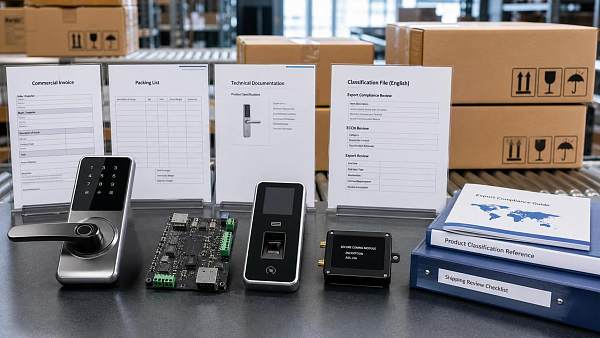
Cross-border security hardware often looks straightforward until export review starts. A biometric lock, access control board, encrypted gateway, or smart parcel locker controller may trigger documentation requests that slow the deal.
That is why a practical security export compliance checklist is more than an internal form. It helps verify whether the product can ship legally, whether the supplier understands controls, and whether the timeline is realistic.
In physical security projects, delays rarely come from one issue alone. More often, the friction appears where product specs, encryption functions, destination rules, and customs paperwork do not match cleanly.
For systems covered by SHPS, that risk is especially relevant. Smart locks, safes, vault electronics, turnstiles, locker networks, and access platforms often combine mechanics, embedded software, wireless modules, and user authentication functions.
A useful checklist should answer four basic questions early. What exactly is being exported, how is it classified, what documents support that classification, and what shipping details look inconsistent or incomplete?
What documents should appear in a serious export readiness file?
The common mistake is assuming the commercial invoice and packing list are enough. For regulated security products, that is only the visible layer of the export file.
A stronger security export compliance checklist usually includes product-level and transaction-level records. Those records should be consistent across technical, legal, and logistics teams.
- Commercial invoice with accurate model names, values, country of origin, and consignee details.
- Packing list matched to carton count, net weight, gross weight, and serial number ranges when available.
- Technical datasheet showing core functions, interfaces, wireless modules, and encryption features.
- ECCN determination, self-classification memo, or formal classification support from a qualified compliance source.
- End-use and end-user statement when the destination, site type, or integration scope raises control concerns.
- Export license, license exception rationale, or written record explaining why no license is required.
- Certificates or test references relevant to the product, such as UL, EN, radio, EMC, or safety documents.
- Software or firmware description if access control, credential management, biometrics, or secure communication is involved.
In practice, reviewers look for consistency before they look for perfection. If the invoice says “smart lock,” but the datasheet describes encrypted remote access, classification questions will follow.
The same applies to vault systems and smart locker networks. A mechanical enclosure may be simple, while the connected controller inside it creates the real export review issue.
When do ECCN triggers become a real issue for smart security hardware?
ECCN triggers matter when the product includes controlled technical features, not just because it belongs to the security sector. The review should stay tied to function, performance, and data handling.
Several SHPS-related categories deserve closer attention. Connected biometric locks, cloud-managed access controllers, encrypted smart parcel locker hubs, and advanced surveillance-linked entry devices are typical examples.
The most common trigger is encryption. If the product authenticates users, protects credentials, secures remote commands, or transmits protected data, it may require a formal export classification review.
Biometrics can also complicate assessment. Fingerprint, face, or vein recognition features do not automatically create a restriction, but they often expand the need for precise technical disclosure.
Another trigger appears when a device supports restricted-site deployment. Products intended for financial facilities, critical infrastructure, secure storage rooms, or government-linked access zones may invite deeper screening.
The table below helps separate routine documents from signs that a classification discussion should start immediately.
A good security export compliance checklist does not force an ECCN where none exists. It simply makes sure the classification decision is documented before logistics commitments become expensive.
Which shipping red flags tend to delay customs or internal approval?
Shipping red flags usually look small at first. A vague description, unusual routing instruction, or mismatch between product literature and invoice language can quickly escalate into a hold.
One frequent problem is underdescribed hardware. Terms like “electronic parts,” “security device,” or “door equipment” do not help a reviewer determine whether the shipment contains controlled functions.
Another warning sign is inconsistent consignee information. If the buyer name, installer name, and final site differ without explanation, the end-use chain becomes harder to validate.
Watch for these practical red flags:
- Invoice descriptions are generic, while brochures describe remote control, credential management, or encrypted communication.
- Declared value is unusually low for high-security safes, biometric terminals, or multi-door controller systems.
- Serial numbers are missing on premium security equipment where traceability is normally expected.
- Destination changes after approval, especially for transshipment hubs or free trade zones.
- The shipment combines mechanical items and controlled electronics under one vague line item.
- The exporter cannot explain firmware version, communication protocol, or user credential storage method.
In real projects, mixed shipments create special risk. A container may include lock cylinders, safe panels, smart controller boards, and network modules. The least sensitive item should not define the whole file.
That is where a disciplined security export compliance checklist prevents assumptions. Each product family should carry its own classification and document trail.
How can you compare suppliers when export claims sound similar?
Many suppliers say they are “export ready.” The better question is whether they can prove repeatable compliance across product updates, destinations, and shipment structures.
A reliable comparison usually comes from asking for evidence in context. One supplier may ship mechanical safes smoothly, yet struggle when the order includes biometric readers or cloud-connected locker modules.
Useful comparison points include document quality, classification discipline, and change control.
- Can the supplier provide ECCN support tied to exact models, not broad product families?
- Do technical files explain encryption use, wireless modules, and biometric functions clearly?
- Is there a process for rechecking compliance after firmware, chipset, or communication upgrades?
- Can prior exports to similar destinations be referenced without contradiction?
- Are test reports, declarations, and shipping documents aligned in naming and revision control?
This is where SHPS-style intelligence is useful. Technical differences that seem minor, such as adding liveness detection, a remote unlock path, or 4G locker connectivity, can change export review effort meaningfully.
So the stronger supplier is not the one with the shortest answer. It is the one whose compliance file stays coherent when the product becomes more advanced.
What is the best next step when the compliance picture is still unclear?
Do not wait for the booking stage. The better move is to break the review into product, destination, and shipment layers before purchase terms are fixed.
Start with the exact bill of materials. Separate purely mechanical items from connected or encrypted components. Then match each line to its technical description and classification support.
After that, verify destination sensitivity. A standard commercial building project may clear differently from a secure storage facility, border site, or financial location using the same hardware platform.
Finally, test the shipping file as a package. Product name, invoice wording, ECCN logic, end-use statement, and consignee details should tell the same story without gaps.
A workable security export compliance checklist does not remove every legal question. It does something more practical. It exposes weak points early, supports cleaner supplier comparison, and reduces preventable shipment disruption.
For the next review cycle, build a short internal matrix around documents, ECCN triggers, and shipping red flags. That simple step usually improves lead-time forecasting, sourcing confidence, and approval accuracy across security hardware projects.
Have questions about this sector analysis, or seeking best practices specific to your niche? Drop us a line below and let the senior consultants at MHLS assist you.
We respect your privacy. Your information is strictly confidential.
Recommended News
 Physical Security Infrastructure Cost: Budgeting for Installation and MaintenanceUnmanned Terminal FellowUnderstand physical security infrastructure cost and build a smarter budget for installation, maintenance, and long-term ownership.
 Financial Facility Security: Choosing Vault Doors for Bank BranchesVault Structural ArchitectStrengthen financial facility security with the right bank vault door. Explore certification, installation, locking controls and maintenance before you buy.
 MACO Acquires Majority Stake in Fingerprint Access Provider ekeyProf. Elara SterlingMACO acquires a majority stake in ekey, bringing fingerprint access and door hardware closer together. Discover what the deal could mean for smart buildings.
 Physical Security System Engineering: From Risk Assessment to System DesignUnmanned Terminal FellowExplore physical security system engineering, from risk assessment to integrated design, procurement and testing. Build a safer, more resilient facility.
 Apple Home Collection Smart Lock and Other Accessories Open for Preorder November 13Biometric Auth ScientistApple Home Collection preorders open November 13, 2026. Explore the LG smart lock’s Matter and Aliro support and what buyers should verify before ordering.
 Choosing Servo-Driven Flap Barriers: Throughput, Safety and Access ControlAccess Control StrategistServo-driven flap barriers can balance throughput, safety and access control. Discover how to compare lanes, test performance and choose with confidence.
 Parcel Locker Network Pricing: Setup Costs, Fees and Contract TermsUnmanned Terminal FellowCompare parcel locker networks pricing, from setup costs and recurring fees to contract terms. Discover hidden charges and choose the right model.
 JR East Plans UWB Walk-Through Gates at 40 Stations in Spring 2028Access Control StrategistJR East plans UWB walk-through gates at 40 stations in spring 2028. Explore the rollout timeline and what suppliers should watch.
 Bank Vault Security Standards: UL and EN Ratings ExplainedVault Structural ArchitectExplore bank vault security standards and learn how UL 608 classes and EN 1143-1 grades differ, what they test, and how to verify certification before you buy.
 Mechanical Lock Hardware Prices: What Buyers Should Budget for Bulk OrdersMr. Gideon CrossMechanical lock hardware price is just the starting point. Discover what drives bulk-order costs and how to compare supplier quotes with confidence.
 IndexBox Forecasts Steady Global Security Keypad Market Growth Through 2035Dr. Valerius ThorneGlobal security keypad market growth is forecast at 3.3% annually through 2035. Explore the smart home and replacement trends shaping demand.
 Choosing an Infrared Safety Sensors Manufacturer: What Buyers Should CheckUnmanned Terminal FellowChoosing an infrared safety sensors manufacturer? Compare safety evidence, integration, environmental performance and lifecycle costs before you buy.











