
Security Export Compliance Requirements Explained: Certifications, Documents, and Common Risks
Why do security export compliance requirements matter so much?
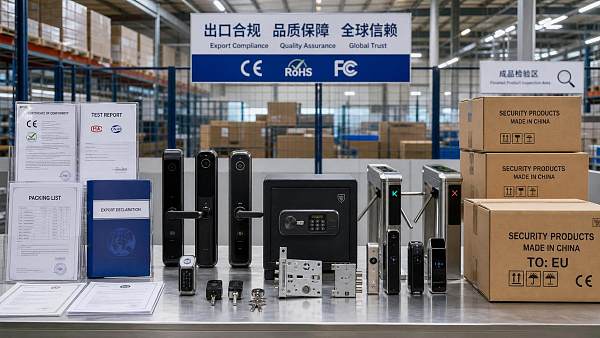
Cross-border security shipments fail for practical reasons, not abstract ones.
A biometric lock may clear performance testing, yet stop at customs because its documents are incomplete.
A safe or vault door may meet burglary-resistance claims, yet face delays when destination labeling does not match local rules.
That is why security export compliance requirements sit at the center of trade readiness.
In real projects, compliance is not only about passing one certification.
It usually combines product safety, EMC, radio approvals, restricted substances, batteries, encryption review, customs paperwork, and end-use screening.
This is especially relevant for smart security hardware.
Products such as access control turnstiles, smart parcel lockers, fingerprint locks, and connected safes often mix mechanics, electronics, software, and wireless modules.
Each layer can trigger another compliance check.
SHPS follows this overlap closely because physical security products rarely move through one standard alone.
The better question is not whether compliance matters.
It is which requirements apply, which documents prove them, and where deals usually go wrong.
What usually falls under security export compliance requirements?
Many people expect one master checklist.
More often, security export compliance requirements are built from several separate obligations.
The mix depends on product type, destination market, power source, connectivity, and claimed security level.
For example, a mechanical lock cylinder and an IoT locker terminal do not face the same review path.
- Product safety compliance, such as electrical safety for powered devices.
- EMC and radio compliance for wireless locks, access panels, and connected locker systems.
- Hazardous substance controls, including RoHS-style requirements in many regions.
- Battery transport rules for products using lithium cells or backup packs.
- Encryption and cybersecurity declarations for devices with secure communication functions.
- Performance or resistance certifications, such as burglary-resistance or access control safety testing.
- Customs classification, origin documents, invoice accuracy, and consignee screening.
A useful way to think about it is this.
Security export compliance requirements cover both the product and the transaction.
One proves the item is legal and technically acceptable.
The other proves the shipment, paperwork, and end destination are acceptable too.
Which certifications and documents are most commonly requested?
This is where many export conversations become confusing.
A buyer may ask for “certificates,” while customs needs shipping documents, and local authorities want technical evidence.
Those are related, but not identical.
For smart locks, turnstiles, safes, and parcel locker systems, the following table covers the documents most often reviewed.
A common mistake is assuming one lab report solves every market.
It rarely does.
A CE-related file may help in Europe, but another market may require local approval, local importer details, or different labeling language.
For physical security categories, performance evidence also matters commercially.
If a safe is sold with EN 1143-1 claims, or a lock promotes biometric anti-spoofing features, that proof needs to be current, consistent, and product-specific.
How do you know which rules apply to smart locks, safes, turnstiles, or lockers?
The cleanest answer starts with product architecture.
What powers the device, what data it handles, what signals it transmits, and what security claim it makes all affect compliance scope.
A mechanical product usually faces fewer layers.
A connected product almost always faces more.
In practical terms, a lock cylinder may focus on material, durability, and market labeling.
A fingerprint smart lock may add EMC, wireless approval, battery transport, privacy notices, encryption review, and app-related declarations.
The same logic applies to parcel lockers and access control systems.
A standalone cabinet is one thing.
A networked locker with 4G or 5G, remote software updates, payment links, and user authentication creates a much broader compliance footprint.
SHPS often frames this through the intersection of hardware, software, materials, and deployment setting.
That is useful because smart security hardware does not fail compliance only in the lab.
It can fail when installer instructions, nameplate details, firmware version control, or restricted component declarations are out of sync.
A fast way to screen applicability
- Does the product contain radio modules such as Wi-Fi, Bluetooth, Zigbee, or cellular?
- Does it ship with lithium batteries, backup packs, or removable power units?
- Are there formal resistance or security-grade claims in brochures or labels?
- Does the destination market require local marking, importer data, or language-specific manuals?
- Are encryption, remote access, or biometric features included?
If several answers are yes, security export compliance requirements will be broader than basic shipment paperwork.
Where do deals most often run into compliance trouble?
The biggest risks are usually small gaps, not dramatic failures.
A report may belong to an older hardware revision.
A label photo may not match the shipped unit.
A biometric feature may be marketed differently from what the test file describes.
Those mismatches are more common than outright fraud, and they still create serious exposure.
Several recurring problems deserve attention.
- Using expired or unrelated test reports for a modified product.
- Ignoring destination rules for wireless modules pre-approved elsewhere.
- Missing battery transport documents for smart locks or controller units.
- Making resistance or anti-spoofing claims without aligned technical evidence.
- Classifying a complex security system under the wrong HS code.
- Failing restricted-party or end-use screening on sensitive projects.
Another risk sits in multi-component shipments.
A turnstile project may include controllers, readers, infrared sensors, power supplies, and software licenses.
If one item lacks the right approval trail, the whole delivery can be delayed.
That is why document consistency matters as much as the certificate itself.
What is a sensible way to prepare before shipment?
The best preparation is early, product-specific, and tied to the destination market.
Waiting until cargo booking is usually too late.
A manageable process often looks like this.
- Map the exact model, firmware, radio module, battery type, and claimed features.
- Confirm destination-specific rules, not just origin-side assumptions.
- Review whether performance claims match valid reports and current configurations.
- Check labels, manuals, and declarations for consistency.
- Verify customs documents, HS codes, origin papers, and consignee screening.
- Keep a retrievable technical file for post-entry questions.
This is where disciplined information sources help.
SHPS is useful because it connects compliance with the real engineering behind safes, locks, access control, and locker systems.
That makes it easier to judge whether a claim is merely promotional or genuinely supported by design, testing, and export readiness.
In short, security export compliance requirements should be treated as part of product qualification, not a shipping afterthought.
A practical next step is to build a market-by-market checklist for each product family.
Then compare technical files, certificates, labels, and shipping documents against that list before orders are released.
That approach reduces delays, protects credibility, and gives future cross-border projects a cleaner starting point.
Have questions about this sector analysis, or seeking best practices specific to your niche? Drop us a line below and let the senior consultants at MHLS assist you.
We respect your privacy. Your information is strictly confidential.
Recommended News
 Apple Home Collection Smart Lock and Other Accessories Open for Preorder November 13Biometric Auth ScientistApple Home Collection preorders open November 13, 2026. Explore the LG smart lock’s Matter and Aliro support and what buyers should verify before ordering.
 Choosing Servo-Driven Flap Barriers: Throughput, Safety and Access ControlAccess Control StrategistServo-driven flap barriers can balance throughput, safety and access control. Discover how to compare lanes, test performance and choose with confidence.
 Parcel Locker Network Pricing: Setup Costs, Fees and Contract TermsUnmanned Terminal FellowCompare parcel locker networks pricing, from setup costs and recurring fees to contract terms. Discover hidden charges and choose the right model.
 JR East Plans UWB Walk-Through Gates at 40 Stations in Spring 2028Access Control StrategistJR East plans UWB walk-through gates at 40 stations in spring 2028. Explore the rollout timeline and what suppliers should watch.
 Bank Vault Security Standards: UL and EN Ratings ExplainedVault Structural ArchitectExplore bank vault security standards and learn how UL 608 classes and EN 1143-1 grades differ, what they test, and how to verify certification before you buy.
 Mechanical Lock Hardware Prices: What Buyers Should Budget for Bulk OrdersMr. Gideon CrossMechanical lock hardware price is just the starting point. Discover what drives bulk-order costs and how to compare supplier quotes with confidence.
 IndexBox Forecasts Steady Global Security Keypad Market Growth Through 2035Dr. Valerius ThorneGlobal security keypad market growth is forecast at 3.3% annually through 2035. Explore the smart home and replacement trends shaping demand.
 Choosing an Infrared Safety Sensors Manufacturer: What Buyers Should CheckUnmanned Terminal FellowChoosing an infrared safety sensors manufacturer? Compare safety evidence, integration, environmental performance and lifecycle costs before you buy.
 Choosing a Security Material Testing Service: What to Check for Lock and Safe MaterialsProf. Elara SterlingChoose a security material testing service with confidence. Learn what to check for lock and safe materials, from attack methods and accreditation to reliable reports.
 How Precision Anti-Pick Lock Cylinders Resist ManipulationSecurity Metallurgy ExpertDiscover how precision anti-pick lock technology resists manipulation, and learn what to check when comparing security features, test evidence, and everyday reliability.
 Dermalog Joins NIST FastCAP Program for Contactless Fingerprint TestingProf. Elara SterlingDermalog joins the NIST FastCAP program for contactless fingerprint testing. Discover what this means for biometric identification and digital identity.
 Choosing Security Export Compliance Services: What Providers Should CoverMr. Gideon CrossSecurity export compliance services can help prevent costly delays. Discover what to look for in classification, licensing, screening, and documentation.











