
3D Liveness Detection vs 2D Face Recognition: Key Differences for High-Security Entry Systems
3D Liveness Detection vs 2D Face Recognition: Key Differences for High-Security Entry Systems
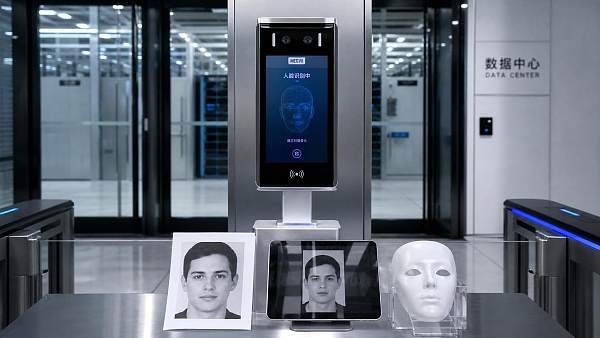
For high-security entry systems, the difference between convenience and real protection often starts at the sensor level.
2D face recognition can verify identity quickly, but it mainly analyzes flat image features.
3D liveness detection goes further. It checks whether a real, live person is present in front of the device.
That distinction matters in data centers, vault access points, executive offices, labs, and other restricted zones.
In those environments, spoof resistance is not a secondary feature. It is part of the core access control logic.
This article explains how 3D liveness detection and 2D face recognition differ in sensing, security, accuracy, and deployment risk.
Why This Comparison Matters More in High-Security Access Control
In low-risk settings, 2D face recognition may be enough for attendance, visitor registration, or basic building entry.
The risk model changes when the protected asset has financial, operational, or safety consequences.
A false accept at a server room or firearms storage area creates a very different outcome.
This is where 3D liveness detection becomes a practical evaluation issue, not just a product feature.
More buyers now ask whether a face terminal can resist photos, screen replays, masks, and presentation attacks.
That shift reflects a broader access control trend: biometric speed is useful, but trust depends on anti-spoofing depth.
What 2D Face Recognition Actually Does
2D face recognition captures a visible-light image and compares facial features against a stored template.
Typical algorithms analyze distances, contours, texture, and landmark positions such as eyes, nose, and mouth.
Its strengths are cost efficiency, simple hardware, and fast processing.
However, standard 2D face recognition does not naturally confirm physical depth or living presence.
Some vendors add software-based liveness checks, such as blink prompts or motion analysis.
Those methods improve security somewhat, but they still rely on limited visual signals.
In practice, 2D systems remain more exposed to presentation attacks using printed photos or high-resolution displays.
How 3D Liveness Detection Changes the Security Model
3D liveness detection measures real facial structure instead of depending only on a flat image.
It usually works through structured light, time-of-flight, or stereo vision sensing.
These methods build a depth map and inspect whether the target has true three-dimensional facial geometry.
That is why 3D liveness detection is much stronger against common spoofing materials.
A printed face has no depth. A phone screen has no genuine contour. A replay video has no live structure.
Advanced systems also check micro-movements, skin reflectivity, infrared response, and depth consistency.
So the decision engine is based on multiple signals, not one camera frame alone.
Core sensing methods behind 3D liveness detection
- Structured light projects a pattern and measures facial depth distortion.
- Time-of-flight calculates the travel time of emitted light.
- Stereo vision compares two image perspectives to estimate depth.
- Near-infrared support helps improve low-light capture and anti-spoof consistency.
The Biggest Technical Differences in Real Deployment
The gap between the two technologies becomes clearer during installation, testing, and field use.
2D face recognition is easier to deploy, but it has a thinner security margin.
3D liveness detection needs more specialized hardware, calibration, and environmental validation.
That added complexity usually buys stronger confidence in sensitive entry scenarios.
Security Risks That 2D Systems Struggle to Manage
The most obvious weakness is presentation attack exposure.
An attacker may use a printed image, a tablet display, or a manipulated video feed.
Good software can detect some of these attempts, but the baseline sensor still sees a flat surface.
Lighting variation is another issue. Shadows, glare, and backlight can reduce matching stability.
User posture also matters more in 2D systems, especially at uncontrolled entry points.
For perimeter gates or lobby turnstiles, this can create inconsistent outcomes during peak traffic.
That inconsistency increases help-desk burden, audit concerns, and operator overrides.
Where 3D Liveness Detection Performs Better
3D liveness detection is especially useful where the cost of a false accept is high.
Examples include banking control rooms, pharmaceutical storage, critical infrastructure, and luxury residential compounds.
It also fits executive floors, research facilities, and integrated smart lock systems with remote audit trails.
In these settings, stronger liveness validation supports both physical security and compliance evidence.
A deeper check may add hardware cost, but it often lowers operational risk over time.
That tradeoff becomes more favorable when a face terminal controls a door, mantrap, or anti-tailgating lane.
Typical use cases for 3D liveness detection
- Restricted office entry with audit requirements
- Server room and data hall access control
- High-value warehouse and logistics security
- Biometric smart lock deployment for premium sites
- Integrated turnstile and speed gate authentication
Evaluation Criteria Before Selecting a Vendor
Vendor claims around 3D liveness detection should be tested carefully.
Some products market facial recognition as secure, but provide only limited anti-spoof capability.
A serious evaluation should review hardware architecture, algorithm logic, and testing methodology together.
This is also where standards awareness becomes important.
Practical questions to ask during assessment
- Does the terminal use structured light, time-of-flight, or another true depth method?
- What spoof materials were tested, including print, replay, mask, and 3D model attacks?
- How does performance change under sunlight, side light, and low illumination?
- Can the system log liveness decisions for incident review and compliance reporting?
- How does the device integrate with doors, turnstiles, controllers, and alarm workflows?
- What is the false reject rate during high-throughput traffic periods?
Where available, ask for evidence aligned with presentation attack testing frameworks such as ISO/IEC 30107 concepts.
Even when formal certification is not required, the testing mindset should still be rigorous.
Cost, User Experience, and Long-Term Tradeoffs
2D face recognition usually wins on upfront budget and installation simplicity.
3D liveness detection usually wins on resilience, trust, and suitability for higher-risk applications.
The right choice depends on the asset being protected, not only on the device price.
In actual projects, a mixed architecture is common.
A site may use 2D face recognition at low-risk entrances and 3D liveness detection at inner restricted checkpoints.
That layered approach balances throughput, budget, and security depth more effectively.
Final Decision Guidance for High-Security Entry Systems
If the protected area can tolerate basic identity verification, 2D face recognition may remain a workable option.
If the site must resist spoofing with higher confidence, 3D liveness detection is usually the stronger choice.
The key is to evaluate the full system, not just the recognition speed on a product sheet.
Review sensor type, liveness logic, environmental tolerance, logging, integration, and attack testing evidence.
That process leads to a more defensible selection, especially for high-security doors, smart locks, turnstiles, and controlled facilities.
In short, 3D liveness detection is not just an upgraded biometric feature. It is a stronger security decision framework for critical entry control.
Have questions about this sector analysis, or seeking best practices specific to your niche? Drop us a line below and let the senior consultants at MHLS assist you.
We respect your privacy. Your information is strictly confidential.
Recommended News
 Parcel Locker Network Pricing: Setup Costs, Fees and Contract TermsUnmanned Terminal FellowCompare parcel locker networks pricing, from setup costs and recurring fees to contract terms. Discover hidden charges and choose the right model.
 JR East Plans UWB Walk-Through Gates at 40 Stations in Spring 2028Access Control StrategistJR East plans UWB walk-through gates at 40 stations in spring 2028. Explore the rollout timeline and what suppliers should watch.
 Bank Vault Security Standards: UL and EN Ratings ExplainedVault Structural ArchitectExplore bank vault security standards and learn how UL 608 classes and EN 1143-1 grades differ, what they test, and how to verify certification before you buy.
 Mechanical Lock Hardware Prices: What Buyers Should Budget for Bulk OrdersMr. Gideon CrossMechanical lock hardware price is just the starting point. Discover what drives bulk-order costs and how to compare supplier quotes with confidence.
 IndexBox Forecasts Steady Global Security Keypad Market Growth Through 2035Dr. Valerius ThorneGlobal security keypad market growth is forecast at 3.3% annually through 2035. Explore the smart home and replacement trends shaping demand.
 Choosing an Infrared Safety Sensors Manufacturer: What Buyers Should CheckUnmanned Terminal FellowChoosing an infrared safety sensors manufacturer? Compare safety evidence, integration, environmental performance and lifecycle costs before you buy.
 Choosing a Security Material Testing Service: What to Check for Lock and Safe MaterialsProf. Elara SterlingChoose a security material testing service with confidence. Learn what to check for lock and safe materials, from attack methods and accreditation to reliable reports.
 How Precision Anti-Pick Lock Cylinders Resist ManipulationSecurity Metallurgy ExpertDiscover how precision anti-pick lock technology resists manipulation, and learn what to check when comparing security features, test evidence, and everyday reliability.
 Dermalog Joins NIST FastCAP Program for Contactless Fingerprint TestingProf. Elara SterlingDermalog joins the NIST FastCAP program for contactless fingerprint testing. Discover what this means for biometric identification and digital identity.
 Choosing Security Export Compliance Services: What Providers Should CoverMr. Gideon CrossSecurity export compliance services can help prevent costly delays. Discover what to look for in classification, licensing, screening, and documentation.
 European Security Compliance Standards for Safes: EN 1143-1 vs EN 14450Dr. Valerius ThorneExplore security compliance standards Europe buyers need to know. Compare EN 1143-1 and EN 14450 to choose the right safe with confidence.
 HID Global Acquires inepro ID to Expand RFID and BLE Access SolutionsUnmanned Terminal FellowHID Global acquires inepro ID to expand RFID and BLE access solutions for printers, smart lockers and shared devices. Explore what the deal could mean for your organization.











