
3D Structured Light Access Control vs 2D Face Recognition: What Matters in Real Use
Comparing 3D structured light access control with 2D face recognition sounds simple until deployment starts. The real gap appears in spoof resistance, lighting behavior, traffic pressure, integration demands, and stability over time.
That matters across office towers, residential entrances, logistics sites, financial facilities, and controlled industrial spaces. In physical security, facial authentication is not just a convenience feature. It becomes part of risk control.
For platforms such as SHPS, which connect biometric technology with access hardware, turnstiles, smart locks, and building security infrastructure, this comparison is practical rather than theoretical. The question is not which label sounds more advanced. The question is which system performs reliably in real conditions.
Where the Difference Really Starts
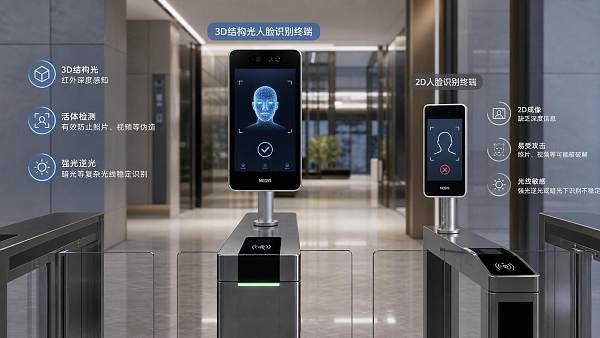
2D face recognition captures a flat image and compares visible facial features. It can work well in controlled environments, especially where cost is sensitive and the security threshold is moderate.
3D structured light access control projects an infrared pattern onto the face and maps depth information. That extra layer changes the quality of biometric evidence. The system is no longer judging appearance alone. It is measuring facial structure.
This is why 3D structured light access control is often grouped with higher-assurance entry systems. In security terms, depth data improves the system’s ability to distinguish a real person from a presentation attack.
Why the Market Pays More Attention to 3D
Interest in 3D structured light access control is rising because facial access control has moved into more demanding locations. That includes high-value buildings, mixed-use developments, data-sensitive offices, and premium residential projects.
In those environments, a false acceptance event carries operational and legal consequences. A reception terminal with weak anti-spoofing can become the weakest physical security point in an otherwise hardened system.
There is also a broader shift in procurement behavior. Buyers are asking for measurable resilience, not generic claims about AI accuracy. They want evidence under backlight, low light, mask interference, screen replay attempts, and high-throughput conditions.
That fits the wider SHPS landscape, where technologies are judged by resistance, compliance readiness, and long-term deployment value. Facial recognition is increasingly assessed like any other security component: by failure modes, not just features.
What Matters More Than Headline Accuracy
Published accuracy rates rarely describe field performance. A strong evaluation of 3D structured light access control should look at the full operating profile.
Spoof Resistance
This is the most obvious advantage of 3D structured light access control. Printed photos, mobile replays, and many image-based attacks are easier to detect when the system verifies depth.
That does not make every 3D device equally strong. The quality of liveness detection, infrared sensing, and software tuning still matters. Some products use 3D hardware well. Others use it as a marketing line.
Lighting Tolerance
2D systems can degrade sharply under harsh sunlight, dim corridors, reflective glass, or bright backlighting. Structured light systems often perform better because they rely less on visible-light image detail.
Still, outdoor and semi-outdoor use needs careful testing. Infrared interference, weather exposure, and installation angle can reduce consistency. Real site conditions matter more than lab claims.
Speed and User Flow
A slow or inconsistent biometric check creates queues, user frustration, and manual overrides. At turnstiles or speed gates, even a one-second delay can disrupt people flow.
The better 3D structured light access control systems are optimized for fast recognition at a practical stand-off distance. Poorly tuned systems can still lag, especially if the face capture window is narrow.
Template Stability Over Time
Long-term reliability often receives too little attention. Enrollment quality, database scaling, firmware updates, aging sensors, and environmental drift all affect system behavior months after installation.
A technically impressive demo is less valuable than stable performance after thousands of daily verifications.
A Practical Comparison in Real Access Control Environments
The most useful comparison is not abstract. It is contextual. Different entry points carry different risk, throughput, and management requirements.
This gap becomes clearer in sites that combine face authentication with speed gates, elevator control, visitor systems, smart building software, or restricted zone management.
Where 2D Still Makes Sense
A stronger technology does not automatically fit every project. 2D face recognition still has a place where threat levels are lower and budgets are tighter.
Examples include internal attendance terminals, low-risk office doors, temporary sites, or deployments where facial recognition is only one convenience layer among several controls.
If the environment is controlled, the user base is limited, and spoof risk is acceptable, a well-implemented 2D system may be commercially reasonable. The mistake is assuming that the same logic applies to all access points.
Where 3D Structured Light Access Control Earns Its Cost
3D structured light access control becomes more compelling when access decisions protect assets, privacy, compliance obligations, or operational continuity.
That includes premium residential lobbies, corporate headquarters, R&D spaces, finance-related facilities, logistics control rooms, and buildings where visitor identity must be managed with greater confidence.
It also fits projects using layered security design. In that model, biometric verification works alongside mechanical locks, protective doors, anti-tailgating sensors, turnstiles, and software-based access rules.
This is where SHPS-style evaluation becomes useful. The decision is not just about a terminal. It is about how the biometric device contributes to the full physical security chain.
Questions Worth Asking During Evaluation
A serious review of 3D structured light access control should move beyond brochures and sample videos. Several questions reveal whether the solution is ready for real use.
- What presentation attacks were tested, and under what conditions?
- How does recognition speed change with database size?
- What happens under direct sunlight, low lux, and reflective backgrounds?
- How does the terminal perform with glasses, partial occlusion, or varied user height?
- Can the device integrate with gates, door controllers, visitor systems, and audit logs?
- What is the maintenance path for firmware, calibration, and sensor degradation?
- Are there compliance or privacy requirements affecting biometric storage and transmission?
These questions matter because biometric performance is operational, not theoretical. Small weaknesses become visible only after people start using the entrance every day.
The Better Decision Framework
The most useful way to compare 2D and 3D is to match technology level with entry-point risk. Not every door needs the same assurance level. Not every budget should be flattened into one standard.
In practice, three filters help. Start with threat exposure. Then review environmental complexity. After that, assess integration value across the wider access ecosystem.
If spoof resistance and identity certainty are central, 3D structured light access control is usually the stronger option. If convenience and basic automation dominate, 2D may remain sufficient.
The next step is not to accept the most advanced label. It is to define the site conditions, test against realistic attack and traffic scenarios, and compare systems as part of a full physical security architecture.
That approach leads to clearer procurement choices, fewer deployment surprises, and a better fit between biometric technology and actual security objectives.
Have questions about this sector analysis, or seeking best practices specific to your niche? Drop us a line below and let the senior consultants at MHLS assist you.
We respect your privacy. Your information is strictly confidential.
Recommended News
 Parcel Locker Network Pricing: Setup Costs, Fees and Contract TermsUnmanned Terminal FellowCompare parcel locker networks pricing, from setup costs and recurring fees to contract terms. Discover hidden charges and choose the right model.
 JR East Plans UWB Walk-Through Gates at 40 Stations in Spring 2028Access Control StrategistJR East plans UWB walk-through gates at 40 stations in spring 2028. Explore the rollout timeline and what suppliers should watch.
 Bank Vault Security Standards: UL and EN Ratings ExplainedVault Structural ArchitectExplore bank vault security standards and learn how UL 608 classes and EN 1143-1 grades differ, what they test, and how to verify certification before you buy.
 Mechanical Lock Hardware Prices: What Buyers Should Budget for Bulk OrdersMr. Gideon CrossMechanical lock hardware price is just the starting point. Discover what drives bulk-order costs and how to compare supplier quotes with confidence.
 IndexBox Forecasts Steady Global Security Keypad Market Growth Through 2035Dr. Valerius ThorneGlobal security keypad market growth is forecast at 3.3% annually through 2035. Explore the smart home and replacement trends shaping demand.
 Choosing an Infrared Safety Sensors Manufacturer: What Buyers Should CheckUnmanned Terminal FellowChoosing an infrared safety sensors manufacturer? Compare safety evidence, integration, environmental performance and lifecycle costs before you buy.
 Choosing a Security Material Testing Service: What to Check for Lock and Safe MaterialsProf. Elara SterlingChoose a security material testing service with confidence. Learn what to check for lock and safe materials, from attack methods and accreditation to reliable reports.
 How Precision Anti-Pick Lock Cylinders Resist ManipulationSecurity Metallurgy ExpertDiscover how precision anti-pick lock technology resists manipulation, and learn what to check when comparing security features, test evidence, and everyday reliability.
 Dermalog Joins NIST FastCAP Program for Contactless Fingerprint TestingProf. Elara SterlingDermalog joins the NIST FastCAP program for contactless fingerprint testing. Discover what this means for biometric identification and digital identity.
 Choosing Security Export Compliance Services: What Providers Should CoverMr. Gideon CrossSecurity export compliance services can help prevent costly delays. Discover what to look for in classification, licensing, screening, and documentation.
 European Security Compliance Standards for Safes: EN 1143-1 vs EN 14450Dr. Valerius ThorneExplore security compliance standards Europe buyers need to know. Compare EN 1143-1 and EN 14450 to choose the right safe with confidence.
 HID Global Acquires inepro ID to Expand RFID and BLE Access SolutionsUnmanned Terminal FellowHID Global acquires inepro ID to expand RFID and BLE access solutions for printers, smart lockers and shared devices. Explore what the deal could mean for your organization.











