
Biometric Lock Reliability Testing: False Rejects, Wear, and Weather
Biometric Lock Reliability Testing: False Rejects, Wear, and Weather
A biometric lock that performs well in a showroom may still reject authorized users after sensor wear, repeated operation, or exposure to rain and temperature extremes. For technical evaluators, biometric lock reliability testing must connect recognition performance with mechanical durability and environmental resilience—not rely on a single accuracy figure.
The practical question is whether an authorized person can complete an access transaction, within an acceptable time, without weakening security. Answering it requires defined users, realistic installation conditions, traceable failures, and acceptance limits agreed before testing begins.
Measure the access transaction, not just the matcher
A successful biometric comparison does not necessarily open a door. Capture may fail before comparison, presentation attack detection may reject a genuine user, or the motor may receive an authorization command but fail to retract a loaded bolt. A report that combines these outcomes into “recognition accuracy” conceals the cause of unreliable access.
Separate at least three measurement layers:
- Acquisition and enrollment: whether the system captures usable biometric data and creates a usable reference.
- Biometric decision: whether genuine comparisons are rejected or non-mated comparisons are accepted at a specified threshold.
- Completed access: whether the authorized transaction results in physical unlocking within the permitted time.
Terminology matters. False non-match rate, or FNMR, describes genuine comparisons that fail to match. Operational false rejection can include a broader set of unsuccessful genuine transactions, depending on the protocol. Suppliers sometimes use FRR for either. Require the denominator, exclusions, retry policy, and treatment of acquisition failures rather than assuming two percentages are comparable.
Also distinguish first-attempt success from success after retries. A lock that usually opens on the third presentation creates a different experience from one that opens immediately, particularly at shared entrances. Report both, together with access latency and fallback use.
Build a false-rejection test that survives scrutiny
Begin with a controlled baseline using production-representative hardware and firmware. Record the sensor revision, matching threshold, presentation attack detection settings, enrollment procedure, battery condition, and connectivity state. Disable automatic software updates during comparative testing, or treat each update as a new configuration.
Participants should reflect the intended population and use conditions. Fingerprint evaluation may need to account for dry skin, worn ridge detail, and occupational hand conditions. Facial recognition requires relevant variation in user height, approach angle, eyewear, and lighting. Vein recognition still needs testing for positioning, optical interference, and the environmental conditions of its installation.
Repeated attempts by a small group are not equivalent to broad user coverage. Attempts from the same person are correlated, so a large transaction count can overstate the strength of the evidence. Report participant numbers, attempts per participant, results by relevant subgroup, and uncertainty estimates that account for repeated measurements.
For a defined operational measure, calculate the false-rejection proportion as unsuccessful genuine transactions divided by all eligible genuine transactions. State whether failure to acquire, timeout, and genuine-user rejection by liveness checks count as failures. Keep component results alongside the combined figure so engineering teams can locate the problem.
Do not improve acceptance by quietly relaxing the matching threshold. Genuine-user rejection and false acceptance must be evaluated at the same operating point. Presentation attack resistance also needs separate evidence: low false acceptance in ordinary non-mated trials does not demonstrate resistance to replicas or other attack presentations.
Wear testing must include the reader and the door
Mechanical cycle testing is necessary, but an unloaded lock on a bench does not reproduce a door installation. Strike alignment, seal compression, door sag, and installation tolerances can increase actuation load. These conditions may expose a marginal motor or power supply even when biometric recognition remains stable.
Define what constitutes one cycle: authorization, bolt movement, door opening, closing, and relocking are not interchangeable events. Specify the load, operating speed, rest intervals, permitted maintenance, and component replacement rules. An advertised cycle count means little without these details.
Sensor aging deserves its own workstream. Finger contact, cleaning, abrasion, and contamination can change an optical window or protective coating. For face and vein readers, examine window scratching, seal condition, and optical performance rather than assuming that reduced contact eliminates wear.
At planned checkpoints, repeat the baseline recognition test with the original enrolled templates. Re-enrolling everyone after aging can hide degradation. If re-enrollment restores performance, document it as a maintenance intervention, not proof that performance remained unchanged.
A useful sequence follows the complete system: baseline measurement, controlled wear, environmental exposure, and repeat access testing. Retain unaged controls and, where practical, separate specimens for isolated stress tests so failures can be attributed rather than merely observed.
Weather resistance is more than an enclosure rating
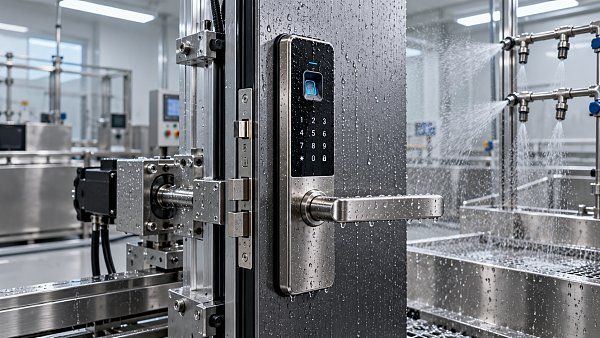
An IP classification addresses specified enclosure protection against access, solids, and water under defined tests. It does not establish fingerprint recognition with a wet finger, face capture in direct sunlight, corrosion resistance, or reliable operation after repeated condensation.
Separate exposure survival from operation during exposure. A reader may recover after drying yet remain unusable during rain. That distinction matters for an exposed entrance, even if recovery satisfies a laboratory test requirement.
Set exposure severity from the declared operating envelope and actual site risks. A sheltered internal door and a coastal parcel locker do not need identical programs. Salt exposure, ultraviolet aging, or icing may be relevant, but test selection should follow the deployment rather than a generic checklist.
Human participation introduces limits: do not expose people to unsafe chamber conditions. Use controlled procedures for genuine-user trials and distinguish those results from equipment-only environmental testing. Synthetic targets or fixtures cannot, by themselves, establish real-user rejection rates.
Use standards as evidence boundaries
ISO/IEC 19795-1 provides a framework for biometric performance testing and reporting. It supports disciplined evaluation, but it does not supply a universal acceptable rejection rate for every lock application. ISO/IEC 30107-3 addresses presentation attack detection testing and reporting; that evidence answers a different question from routine genuine-user access reliability.
IEC 60529 defines IP classifications, while the IEC 60068 series contains environmental test methods. Depending on product scope and market, EN 14846 may be relevant to electromechanically operated locks and striking plates. Confirm the applicable edition, specimen configuration, test severity, and scope before treating any reference as evidence for a finished installation.
A certificate or summary page is not a substitute for the underlying report. Check whether the tested assembly included the actual reader, lock body, seals, power supply, and firmware being offered. Where laboratory accreditation matters, verify that the relevant test is within its accredited scope.
Turn results into acceptance decisions
Agree acceptance criteria before testing. Include first-attempt access success, transaction success within the allowed retry window, latency, security operating point, mechanical completion, and recovery requirements. Set separate limits for normal operation and any explicitly permitted degraded mode; a good overall average should not conceal failure in a required weather condition.
Power and connectivity faults also belong in the plan. Test low-battery operation, restart behavior, network loss, and restoration. Verify fallback credentials and emergency access arrangements without assuming that every opening should fail safe or fail secure. Egress, fire safety, and security requirements depend on the installation and applicable rules.
For supplier comparison, request a traceable evidence package: configuration details, participant and specimen coverage, test procedures, denominators, failure logs, maintenance records, and deviations. A short site pilot can then investigate installation-specific issues that laboratory testing cannot settle.
This system-level view connects the biometric, mechanical, and compliance analysis covered by Global Smart Hardware & Physical Security Systems (SHPS). Across smart locks, access control, and parcel lockers, the useful comparison is not the largest cycle count or smallest advertised rejection figure. It is whether the evidence supports dependable, secure access under the conditions the installation will actually face.
Have questions about this sector analysis, or seeking best practices specific to your niche? Drop us a line below and let the senior consultants at MHLS assist you.
We respect your privacy. Your information is strictly confidential.
Recommended News
 Parcel Locker Network Pricing: Setup Costs, Fees and Contract TermsUnmanned Terminal FellowCompare parcel locker networks pricing, from setup costs and recurring fees to contract terms. Discover hidden charges and choose the right model.
 JR East Plans UWB Walk-Through Gates at 40 Stations in Spring 2028Access Control StrategistJR East plans UWB walk-through gates at 40 stations in spring 2028. Explore the rollout timeline and what suppliers should watch.
 Bank Vault Security Standards: UL and EN Ratings ExplainedVault Structural ArchitectExplore bank vault security standards and learn how UL 608 classes and EN 1143-1 grades differ, what they test, and how to verify certification before you buy.
 Mechanical Lock Hardware Prices: What Buyers Should Budget for Bulk OrdersMr. Gideon CrossMechanical lock hardware price is just the starting point. Discover what drives bulk-order costs and how to compare supplier quotes with confidence.
 IndexBox Forecasts Steady Global Security Keypad Market Growth Through 2035Dr. Valerius ThorneGlobal security keypad market growth is forecast at 3.3% annually through 2035. Explore the smart home and replacement trends shaping demand.
 Choosing an Infrared Safety Sensors Manufacturer: What Buyers Should CheckUnmanned Terminal FellowChoosing an infrared safety sensors manufacturer? Compare safety evidence, integration, environmental performance and lifecycle costs before you buy.
 Choosing a Security Material Testing Service: What to Check for Lock and Safe MaterialsProf. Elara SterlingChoose a security material testing service with confidence. Learn what to check for lock and safe materials, from attack methods and accreditation to reliable reports.
 How Precision Anti-Pick Lock Cylinders Resist ManipulationSecurity Metallurgy ExpertDiscover how precision anti-pick lock technology resists manipulation, and learn what to check when comparing security features, test evidence, and everyday reliability.
 Dermalog Joins NIST FastCAP Program for Contactless Fingerprint TestingProf. Elara SterlingDermalog joins the NIST FastCAP program for contactless fingerprint testing. Discover what this means for biometric identification and digital identity.
 Choosing Security Export Compliance Services: What Providers Should CoverMr. Gideon CrossSecurity export compliance services can help prevent costly delays. Discover what to look for in classification, licensing, screening, and documentation.
 European Security Compliance Standards for Safes: EN 1143-1 vs EN 14450Dr. Valerius ThorneExplore security compliance standards Europe buyers need to know. Compare EN 1143-1 and EN 14450 to choose the right safe with confidence.
 HID Global Acquires inepro ID to Expand RFID and BLE Access SolutionsUnmanned Terminal FellowHID Global acquires inepro ID to expand RFID and BLE access solutions for printers, smart lockers and shared devices. Explore what the deal could mean for your organization.











