
How to Evaluate Liveness Detection Sensors for Facial Recognition
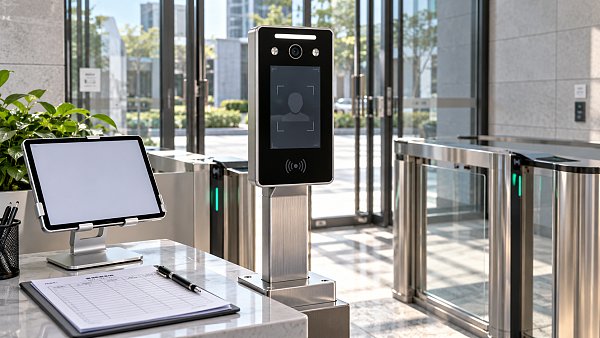
When a facial recognition terminal is installed at a building entrance, a sharp image and fast matching do not establish that the person in front of the camera is live. A display, printed image, mask, or injected video may exploit weaknesses in the capture and decision chain. Evaluate liveness detection sensors by testing the complete presentation attack detection system against relevant attacks and operating conditions, not by comparing resolution or a single advertised accuracy figure.
Start with the threat model and the intended installation. Then compare the evidence each sensor can capture, examine independent test scope, and run a controlled evaluation at the intended mounting position. A sensor that performs well at an indoor reception desk may behave differently at a sunlit turnstile or an exposed door.
Define the attack surface before comparing sensors
Separate presentation attacks from other ways of compromising the system. Presentation attacks place an artefact or characteristic in front of the capture device: examples include photographs, video replays and masks. A camera-based presentation attack detection (PAD) function is intended to assess evidence from that capture. It does not automatically protect against a substituted video stream, compromised firmware, a stolen enrollment template or an attacker holding a door open.
Document which risks the deployment must address and what happens after a failed check. A staffed lobby may permit a manual identity check; an unattended restricted entrance needs a controlled alternative that does not become an easy bypass. Consider whether attackers can approach the terminal repeatedly, observe feedback, alter lighting or reach its ports. These conditions affect both the sensor choice and the surrounding access-control design.
Also identify the genuine users and their interaction with the device. A turnstile must accommodate movement and variable approach angles, whereas a wall-mounted reader may allow a more deliberate pause. A system that requires users to stand precisely at one distance can create queues or encourage operators to disable checks.
Compare sensing methods by the evidence they provide
No sensing modality guarantees liveness on its own. The relevant question is whether its measurements, processing and integration can distinguish the expected attacks from genuine presentations under the site conditions.
A vendor may describe a device as “3D” without specifying the usable depth range, spatial coverage or how depth data contributes to the PAD decision. Ask for the sensing principle, illumination arrangement, field of view, capture distance, frame rate and minimum face size required by the deployed algorithm. Check whether all channels cover the same facial area at the actual installation angle.
Active systems may ask users to move or respond to a prompt. Passive systems attempt a decision without a deliberate challenge. An active prompt can add friction and is not automatically resistant to a prepared replay; passive operation can be convenient but still requires attack-specific evidence. Evaluate the implemented workflow rather than treating either label as a security rating.
Read test claims at the system boundary
Request a report for the actual sensor, PAD software, configuration and operating mode being considered. A test of an algorithm using another camera, an earlier firmware release or a different capture pipeline is useful background, not direct evidence for the proposed terminal. Confirm whether the tested product includes the same illumination, optics and processing path as the production unit.
ISO/IEC 30107-3 provides a framework for testing and reporting biometric presentation attack detection. A reference to that standard alone does not identify the attacks tested or prove that a product meets a particular deployment requirement. Ask for the test scope, version and configuration, attack instruments, sample sizes, conditions, decision threshold and results. Check whether an independent laboratory performed the work and whether the report applies to the product being purchased.
Two commonly reported measures need careful interpretation:
- APCER: the proportion of attack presentations, for a specified attack instrument species, incorrectly classified as bona fide. Inspect results by attack type rather than relying only on an aggregate.
- BPCER: the proportion of bona fide presentations incorrectly classified as attacks. Check this at the same operating threshold and under conditions relevant to the site.
Some presentations may produce no decision because acquisition or processing fails. Ask how these cases were counted and reported; excluding them can make a result difficult to interpret operationally. Review confidence intervals or underlying counts where available. A small set of attempts cannot establish a precise failure rate, and repeated images from the same source should not be mistaken for broad variation in attack instruments.
Keep face matching and liveness results distinct. A PAD system can reject an attack while a matching system still struggles with genuine users, or the reverse. Request end-to-end results as well as component-level measurements, with the decision order and fallback behavior clearly described.
Build an evaluation around the installation
Use the same mounting height, distance, approach path and access-control configuration planned for deployment. Fix the software version and threshold before collecting comparative results. Otherwise, a threshold change can improve attack rejection while increasing genuine-user rejection, making comparisons misleading.
- Establish a bona fide baseline. Test normal approaches across the intended capture range, including glasses and other permitted appearance variations. Record acquisition failures, PAD outcomes, matching outcomes and time to an access decision separately.
- Vary the environment. Examine expected daylight and artificial lighting, backlighting, reflections, temperature and weather exposure where applicable. Repeat at the limits of the specified operating envelope rather than only at a convenient indoor test position.
- Exercise relevant presentation attacks. Include representative print and display replays, and three-dimensional artefacts where the threat model warrants them. Vary presentation angle and distance. Document the materials and preparation sufficiently to interpret the results.
- Test operational handling. Observe behavior after failed attempts, incomplete captures and repeated retries. Verify that a retry does not silently switch to a weaker mode or grant access before all required decisions are complete.
- Review results by condition. Separate failures caused by capture, PAD, matching and downstream access control. Investigate whether a particular range, lighting condition or user interaction explains a cluster of errors.
Use consented participants and an approved evaluation protocol. Protect captured biometric data, restrict access to test artefacts and set a retention period before collection begins. The test population should reflect the users and permitted accessories expected at the site; results from a narrow sample should not be generalized without qualification.
A small site trial is valuable for finding integration and usability problems, but it cannot by itself demonstrate resistance to every attack. For high-consequence entrances, combine site testing with a suitably scoped independent evaluation and a documented review of remaining risks.
Inspect the capture chain, not just the camera module
A liveness decision is only as trustworthy as the data path feeding it. Determine where PAD processing runs, how sensor frames reach that processor, and whether the system can detect replacement or replay of captured data. Ask what protects firmware and configuration changes, whether interfaces are authenticated, and how security updates are delivered and verified.
Sensor fusion adds another dependency: visible, infrared and depth frames should correspond to the same presentation. Ask how the system handles missing, delayed or inconsistent channels. A device that falls back to visible-only processing after an infrared failure may have a materially different security posture. That transition should be explicit, logged and governed by the access policy.
Check mechanical and electrical integration as well. A protective cover can introduce reflections or attenuate infrared illumination; a recessed mounting position can restrict field of view. Outdoor housings, cabling, power interruptions and cleaning practices can affect capture quality. Validate the complete assembly rather than assuming a module-level specification will carry over unchanged.
Set acceptance criteria before selecting a supplier
Define the maximum acceptable bona fide rejection and attack acceptance for the evaluated conditions, along with acquisition time and availability requirements. These thresholds are deployment decisions, not universal numbers. A high-security door may tolerate a slower secondary check; a busy turnstile may require a different workflow and staffing arrangement.
Include evidence requirements in the purchase evaluation. Suppliers should identify the tested configuration, disclose known operating limits, describe how thresholds are managed, and explain what happens when a sensor or network component fails. Require notification and regression testing when updates change the sensor pipeline, PAD model or operating threshold.
Finally, verify the access-control outcome under fault conditions. If liveness is unavailable, decide whether the door remains locked, routes the person to an authorized alternative, or follows another documented policy consistent with applicable life-safety requirements. The selected sensor should support that decision with clear status reporting; an ambiguous “recognition failed” message is not enough to distinguish an attack from a dirty lens or failed illuminator.
Have questions about this sector analysis, or seeking best practices specific to your niche? Drop us a line below and let the senior consultants at MHLS assist you.
We respect your privacy. Your information is strictly confidential.
Recommended News
 Parcel Locker Network Pricing: Setup Costs, Fees and Contract TermsUnmanned Terminal FellowCompare parcel locker networks pricing, from setup costs and recurring fees to contract terms. Discover hidden charges and choose the right model.
 JR East Plans UWB Walk-Through Gates at 40 Stations in Spring 2028Access Control StrategistJR East plans UWB walk-through gates at 40 stations in spring 2028. Explore the rollout timeline and what suppliers should watch.
 Bank Vault Security Standards: UL and EN Ratings ExplainedVault Structural ArchitectExplore bank vault security standards and learn how UL 608 classes and EN 1143-1 grades differ, what they test, and how to verify certification before you buy.
 Mechanical Lock Hardware Prices: What Buyers Should Budget for Bulk OrdersMr. Gideon CrossMechanical lock hardware price is just the starting point. Discover what drives bulk-order costs and how to compare supplier quotes with confidence.
 IndexBox Forecasts Steady Global Security Keypad Market Growth Through 2035Dr. Valerius ThorneGlobal security keypad market growth is forecast at 3.3% annually through 2035. Explore the smart home and replacement trends shaping demand.
 Choosing an Infrared Safety Sensors Manufacturer: What Buyers Should CheckUnmanned Terminal FellowChoosing an infrared safety sensors manufacturer? Compare safety evidence, integration, environmental performance and lifecycle costs before you buy.
 Choosing a Security Material Testing Service: What to Check for Lock and Safe MaterialsProf. Elara SterlingChoose a security material testing service with confidence. Learn what to check for lock and safe materials, from attack methods and accreditation to reliable reports.
 How Precision Anti-Pick Lock Cylinders Resist ManipulationSecurity Metallurgy ExpertDiscover how precision anti-pick lock technology resists manipulation, and learn what to check when comparing security features, test evidence, and everyday reliability.
 Dermalog Joins NIST FastCAP Program for Contactless Fingerprint TestingProf. Elara SterlingDermalog joins the NIST FastCAP program for contactless fingerprint testing. Discover what this means for biometric identification and digital identity.
 Choosing Security Export Compliance Services: What Providers Should CoverMr. Gideon CrossSecurity export compliance services can help prevent costly delays. Discover what to look for in classification, licensing, screening, and documentation.
 European Security Compliance Standards for Safes: EN 1143-1 vs EN 14450Dr. Valerius ThorneExplore security compliance standards Europe buyers need to know. Compare EN 1143-1 and EN 14450 to choose the right safe with confidence.
 HID Global Acquires inepro ID to Expand RFID and BLE Access SolutionsUnmanned Terminal FellowHID Global acquires inepro ID to expand RFID and BLE access solutions for printers, smart lockers and shared devices. Explore what the deal could mean for your organization.











