
Anti-Drill Lock Cylinders: How Hardened Inserts Resist Drilling Attacks
Anti-Drill Lock Cylinders: How Hardened Inserts Resist Drilling Attacks
A lock cylinder’s resistance to drilling depends on more than the presence of a hardened insert. Material hardness, placement, retention, and surrounding construction all influence performance. An impressive-looking steel element may contribute little if it does not protect the mechanism that keeps the cylinder locked.
Understanding anti-drill lock technology for cylinders therefore means looking beyond the material label. Hardened steel and carbide can make penetration more difficult, but their effectiveness depends on how the complete assembly behaves under attack. The useful questions are practical: what remains protected, how securely is the protective material supported, and what test evidence covers the cylinder actually being supplied?
The objective is to preserve the locked condition
Drilling is a destructive attack intended to disable or defeat components that prevent unauthorized operation. Depending on the cylinder design, those components may include pin stacks, sidebars, or other locking elements. Anti-drill protection seeks to delay access to them and make destructive work less predictable.
That distinction matters when reviewing demonstrations. A visibly damaged cylinder has not necessarily failed from a security perspective if the lock remains secured. Conversely, a face that looks largely intact does not establish that the internal mechanism still resists unauthorized operation. The relevant outcome is defined by the applicable test method, not appearance alone.
“Drill-proof” is consequently an unhelpful specification. Resistance is bounded by tools, attack conditions, time, and the installed assembly. A defensible claim identifies a tested level of resistance rather than implying that penetration is impossible.
How hardened steel and carbide change the cutting process
Many cylinder bodies use machinable alloys because manufacturers must produce precise bores, keyways, and moving interfaces economically. Those materials are not selected primarily for resistance to destructive drilling. Hardened inserts introduce localized obstacles without requiring the entire cylinder to be manufactured from difficult-to-machine material.
Hardened steel: hardness needs adequate toughness
Heat-treated steel inserts resist cutting by presenting a harder working surface than the surrounding body. Suitable geometry can also make stable cutting engagement more difficult. However, “hardened steel” describes a broad material category, not a verified performance level.
Alloy selection, heat treatment, hardened depth, and toughness affect the result. A surface-hardened component and a through-hardened component may behave differently even when their surface hardness readings appear similar. Excessive brittleness can introduce fracture risk; insufficient hardness can allow the insert to be cut more readily than intended.
A hardness value is therefore useful only with context. Ask which scale and test method were used, where the measurement was taken, and whether the requirement applies to production parts. A number copied from a raw-material datasheet does not establish the condition of the finished insert.
Cemented carbide: strong wear resistance, different failure concerns
Cemented tungsten carbide combines hard carbide particles with a metallic binder. It can offer strong resistance to abrasive wear and cutting, making it useful where protective space is limited. That does not make every carbide grade interchangeable.
Grain structure and binder content influence the balance between hardness and toughness. Compared with many hardened steels, carbide is generally less forgiving of impact and poorly supported loading. Its effectiveness depends partly on whether the surrounding assembly prevents damaging movement or concentrated stress.
The better comparison is not simply “steel versus carbide.” It is a comparison between complete protective arrangements. A well-supported steel insert can be more useful than a carbide element whose mounting allows it to fracture or move out of position.
Placement and retention decide whether hardness is useful
Cylinder protection is a coverage problem as much as a materials problem. Designers may use hardened elements in the plug, cylinder body, or both. The purpose is to protect security-critical mechanisms while preserving the tolerances needed for normal key operation.
Counting inserts is a poor shortcut. Several small elements do not automatically outperform one larger component, and a prominent face insert does not establish protection deeper within the assembly. What matters is whether the protective arrangement supports the locking architecture rather than merely adding hard material.
Retention is equally important. The insert and its supporting material must be considered together: can the surrounding body deform, can the insert become loose, and does assembly variation change its position? These are legitimate design-review questions even when the manufacturer appropriately restricts detailed security drawings.
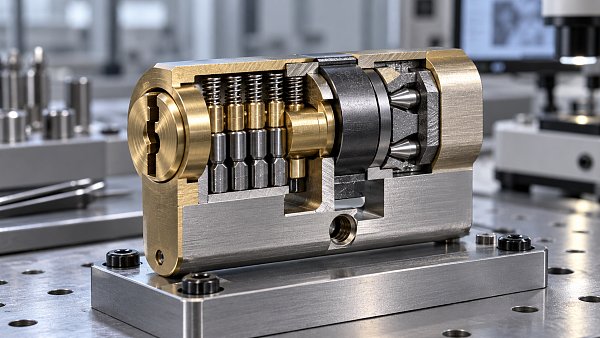
A conceptual cutaway is more informative than an exterior photograph here. It should distinguish the plug, body, protected locking components, and insert supports without revealing sensitive dimensions. For supplier evaluation, a controlled drawing review can establish coverage without circulating manufacturing details widely.
Read test evidence before accepting a security claim
Material certificates describe materials. Security test reports describe the behavior of a defined specimen under defined conditions. They answer different questions, and neither should be presented as a substitute for the other.
EN 1303 is a relevant reference for cylinders for locks in European specifications. It addresses multiple performance characteristics, including security-related requirements. Review the applicable edition and full classification rather than treating “EN 1303 compliant” as a complete description of drilling resistance. Key-related security and attack resistance are distinct considerations.
UL 437 is another relevant reference for key locks in specifications that call for it. Verify the exact product covered and its current certification status. A supplier selling one certified cylinder does not establish that every cylinder in its catalog has the same evaluated construction or scope.
UK projects may also specify TS 007 cylinder and protective-hardware ratings. Those requirements concern a broader attack-resistance context; a star rating should not be converted casually into a stand-alone drilling-time claim. Where a requirement relies on a combination of components, confirm the permitted combination.
Safe and vault standards need similar care. EN 1143-1 concerns secure storage units, not a general certification route for door cylinders. As Global Smart Hardware & Physical Security Systems (SHPS) examines both mechanical locks and secure storage, this boundary is important: anti-drill materials may appear in both, but their product classifications are not interchangeable.
What a useful evidence package contains
- Traceable product identity: model, relevant configuration, and a clear link between the tested specimen and supplied goods.
- Defined evaluation basis: standard edition, classification, laboratory identity, and the scope of any certification.
- Installation conditions: protective hardware or mounting arrangements that affect the result.
- Change control: how substitutions involving insert materials, heat treatment, geometry, or retention are reviewed.
An edited drilling video cannot supply all this information. It may illustrate behavior, but without controlled conditions and a defined pass/fail criterion it is not a reliable basis for ranking competing products. Avoid converting footage duration into a promised resistance time.
The installed door can undermine a good cylinder
Consider a cylinder selected for an apartment entrance refurbishment. Its internal protection may be credible, yet the replacement can still be unsuitable if its length leaves excessive external projection or the surrounding protective hardware is inadequate. The cylinder cannot compensate for every weakness in the door assembly.
A compatible security escutcheon or cylinder guard can restrict access and support the overall protective arrangement. Selection must account for fit, fixing strength, permitted projection, and normal operation. Do not assume that a visually similar guard reproduces the conditions used in testing.
Smart locks introduce another specification trap. Biometric authentication, encrypted credentials, and access logs do not establish the destructive-attack resistance of a mechanical override cylinder. Where an override is fitted, evaluate it as a physical entry point within the complete lock assembly.
Drill resistance also says little by itself about picking, snapping, pulling, or other attack categories. These require their own design measures and evidence. For emergency-exit or fire-rated applications, check relevant operating and assembly requirements before changing cylinders or adding protective hardware.
Specify repeatable construction, not just a successful sample
Once a design meets the required performance, procurement attention should shift to consistency. Heat-treatment variation, material substitution, dimensional drift, and changes in insert retention can alter behavior without producing an obvious external difference.
Useful supplier controls include traceable material specifications, appropriate hardness verification, dimensional inspection, and documented handling of construction changes. The inspection plan should suit the component and manufacturing process. Demanding a hardness measurement on every tiny insert is not automatically more meaningful than a technically justified sampling method.
Also check the exact cylinder configuration being ordered. A family may contain different lengths, functions, and internal arrangements. Where documentation leaves coverage unclear, obtain written confirmation rather than assuming that a shared brand name or key profile means identical protection.
A sound anti-drill specification links three things: protective construction, independently supported performance, and the intended installation. If a supplier offers only a hardness claim, ask for assembly-level evidence. If it offers only a certificate, verify product coverage. If both are credible, check the door hardware before approving the cylinder—the installation is where the specified protection must actually work.
Have questions about this sector analysis, or seeking best practices specific to your niche? Drop us a line below and let the senior consultants at MHLS assist you.
We respect your privacy. Your information is strictly confidential.
Recommended News
 Parcel Locker Network Pricing: Setup Costs, Fees and Contract TermsUnmanned Terminal FellowCompare parcel locker networks pricing, from setup costs and recurring fees to contract terms. Discover hidden charges and choose the right model.
 JR East Plans UWB Walk-Through Gates at 40 Stations in Spring 2028Access Control StrategistJR East plans UWB walk-through gates at 40 stations in spring 2028. Explore the rollout timeline and what suppliers should watch.
 Bank Vault Security Standards: UL and EN Ratings ExplainedVault Structural ArchitectExplore bank vault security standards and learn how UL 608 classes and EN 1143-1 grades differ, what they test, and how to verify certification before you buy.
 Mechanical Lock Hardware Prices: What Buyers Should Budget for Bulk OrdersMr. Gideon CrossMechanical lock hardware price is just the starting point. Discover what drives bulk-order costs and how to compare supplier quotes with confidence.
 IndexBox Forecasts Steady Global Security Keypad Market Growth Through 2035Dr. Valerius ThorneGlobal security keypad market growth is forecast at 3.3% annually through 2035. Explore the smart home and replacement trends shaping demand.
 Choosing an Infrared Safety Sensors Manufacturer: What Buyers Should CheckUnmanned Terminal FellowChoosing an infrared safety sensors manufacturer? Compare safety evidence, integration, environmental performance and lifecycle costs before you buy.
 Choosing a Security Material Testing Service: What to Check for Lock and Safe MaterialsProf. Elara SterlingChoose a security material testing service with confidence. Learn what to check for lock and safe materials, from attack methods and accreditation to reliable reports.
 How Precision Anti-Pick Lock Cylinders Resist ManipulationSecurity Metallurgy ExpertDiscover how precision anti-pick lock technology resists manipulation, and learn what to check when comparing security features, test evidence, and everyday reliability.
 Dermalog Joins NIST FastCAP Program for Contactless Fingerprint TestingProf. Elara SterlingDermalog joins the NIST FastCAP program for contactless fingerprint testing. Discover what this means for biometric identification and digital identity.
 Choosing Security Export Compliance Services: What Providers Should CoverMr. Gideon CrossSecurity export compliance services can help prevent costly delays. Discover what to look for in classification, licensing, screening, and documentation.
 European Security Compliance Standards for Safes: EN 1143-1 vs EN 14450Dr. Valerius ThorneExplore security compliance standards Europe buyers need to know. Compare EN 1143-1 and EN 14450 to choose the right safe with confidence.
 HID Global Acquires inepro ID to Expand RFID and BLE Access SolutionsUnmanned Terminal FellowHID Global acquires inepro ID to expand RFID and BLE access solutions for printers, smart lockers and shared devices. Explore what the deal could mean for your organization.











