Anti-Snap Lock Cylinder Design: How Sacrificial Sections Protect the Cam
A damaged cylinder does not necessarily mean an unlocked door. In a correctly engineered anti-snap lock cylinder design, an exposed outer section can break away while the central cam and the mechanism controlling it remain protected. The intended result is controlled damage at a designated location, rather than uncontrolled fracture through the security-critical centre.
This distinction matters when assessing cylinders for doors with exposed external hardware. A breakaway groove alone does not demonstrate protection: its position, the strength of the remaining structure, and the installed door furniture determine whether separation leaves a secure assembly or creates access to the locking mechanism. The practical evaluation question is therefore: what remains protected after the sacrificial section has gone?
The cam is the component the design must keep out of reach
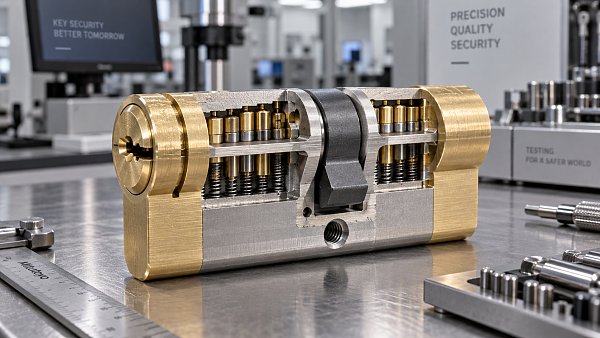
In a typical Euro-profile cylinder, the key operates a plug that transmits rotation through an internal coupling to a central cam. The cam interfaces with the lock case to move its locking components. A thumbturn version provides an alternative means of operating that transmission from the inside.
The cylinder body supports these components, but its shape includes changes in cross-section around the central fixing and cam region. Under excessive external loading, an inadequately protected cylinder can fracture in a way that compromises this area. The security issue is not simply the loss of metal; it is whether the damage exposes or releases components that control the lock.
A sacrificial section changes the intended failure path. A deliberately weakened outer region is designed to separate before damaging loads compromise the protected core. Depending on the product, reinforcement and additional internal barriers then help prevent the remaining mechanism from being accessed or operated.
This is a damage-management strategy, not a claim that the cylinder cannot break. It also does not mean the door will remain convenient to use after an attack. Security retention and continued normal operation are separate performance questions.
A breakaway groove works only as part of a load path
A groove reduces the local cross-section and creates a stress concentration. Its purpose is to make a selected region the preferred fracture location under relevant loading. However, the visible groove reveals little about whether that preference remains reliable across production tolerances, different cylinder lengths, and actual door installations.
Position determines what is sacrificed
The designated separation region must be outside the structure that needs to remain secure. Evaluators should examine its relationship to the cam, coupling, reinforcement, and installed protective furniture. A groove located farther from the centre is not automatically better: the remaining projection and surrounding hardware also affect protection after separation.
Some cylinders protect only the intended external side; others incorporate protection at both ends. An asymmetric cylinder therefore needs an unambiguous installation orientation. Reversing a product with side-specific protection can defeat the assumptions behind its tested configuration.
Reinforcement must preserve the retained structure
A hardened bridge, reinforced spine, or other structural element may support the area around the cam and fixing region. Its function differs from that of the sacrificial section: the outer portion manages where damage occurs, while the reinforcement helps keep the security-critical assembly intact.
Neither feature should be assessed in isolation. Reinforcement that changes how loads pass through the body must be compatible with the intended breakaway behaviour. Likewise, an effective sacrificial section provides limited reassurance if the remaining body, coupling, or cam protection can subsequently be compromised.
Material labels are insufficient evidence. “Hardened steel reinforcement” does not establish its dimensions, continuity, attachment, or contribution to tested performance. Request a functional description and suitable test evidence rather than treating material hardness as a substitute for assembly-level resistance.
Manufacturing variation affects controlled failure
Groove geometry, body material, heat treatment, and assembly tolerances influence fracture behaviour. A design must tolerate normal service loads without premature damage while retaining its intended failure sequence under attack. That balance needs validation; it cannot be confirmed from an exterior photograph.
For procurement, ask how the manufacturer controls security-critical dimensions and manages design changes. A revised body alloy or reinforcement arrangement may require review even when the commercial product name remains unchanged.
Assess the condition after separation, not just the fracture itself
A demonstration showing an outer section breaking cleanly proves only that separation occurred. It does not establish that the retained mechanism resisted subsequent interference. Post-snap assessment must address the complete remaining assembly.
Some designs intentionally restrict operation after damage; others aim to preserve internal operation. Neither behaviour should be inferred from the term “anti-snap.” For occupied premises, establish the consequences for escape and emergency access before specifying the product. Resistance to unauthorised entry does not by itself demonstrate suitability for an escape door.
Installation can undermine a sound cylinder design
A frequent specification problem is selecting a cylinder by overall length without checking its external and internal dimensions separately. Two cylinders with the same total length may place the cam differently relative to the door faces. That changes external projection and can put protective features in the wrong relationship to the hardware.
Measure against the finished door assembly, including its escutcheon or handle furniture. Follow the cylinder and furniture manufacturers’ permitted projection limits rather than adopting a universal dimension. Excessive exposure can increase vulnerability, while incompatible furniture can interfere with fit or operation.
A security escutcheon or protective handle can restrict access and support the cylinder, but only when correctly specified and securely attached. Decorative trim should not be assumed to provide comparable protection. Conversely, a tested cylinder should not be credited with the additional resistance of protective furniture unless that combination is supported by the applicable evidence.
For an existing door, assessment should proceed in this order:
- Identify the lock case, cylinder format, external hardware, and required internal operating function.
- Measure both cylinder sides from the fixing reference to the finished hardware surfaces.
- Confirm protection orientation and compatibility with the selected furniture.
- Check the door, lock case, and hardware fixings for damage, looseness, or distortion.
- After installation, verify normal locking and unlocking using the manufacturer’s procedure, without forcing a binding mechanism.
Do not modify a cylinder body or add a groove on site. The sacrificial geometry is an engineered feature whose behaviour depends on the surrounding construction. Unauthorised alteration can weaken the wrong area and invalidate the basis for certification or warranty.
Read certification claims at configuration level
“Anti-snap” is a descriptive claim, not a complete performance classification. A technical comparison should identify the named standard or certification scheme, its edition, the achieved classification, and the exact products covered. Different schemes address different combinations of durability, security, and attack resistance.
EN 1303 provides requirements and classifications for lock cylinders, including durability, key-related security, and attack resistance. An unqualified statement that a cylinder “meets EN 1303” does not identify its attack-resistance grade or establish a specific post-snap performance claim. Obtain the full classification and check the applicable edition.
TS 007 is commonly used in the UK for replacement cylinders and associated protective door furniture. Its star-rating approach distinguishes cylinder performance from protection supplied by hardware. A three-star cylinder and a one-star cylinder combined with suitable two-star protective furniture represent different protection routes; the rating of one component should not be attributed to another.
Sold Secure SS 312 is another cylinder assessment specification associated with attack-resistance claims, including Diamond-rated products. Verify the current listing and its scope rather than relying on a logo in a brochure. Ratings from different schemes are not automatically interchangeable.
Certification also has boundaries. Confirm whether the listed range covers the proposed lengths, double-cylinder or thumbturn format, modular construction, and any special operating features. Where public documentation is insufficient, request confirmation from the supplier or certification body. A certificate for a similar-looking model is not evidence for the proposed variant.
Separate genuine protection from reassuring terminology
Anti-drill, anti-pick, anti-bump, and anti-snap features address different failure modes. They may coexist, but one does not establish another. A cylinder with sophisticated key control or hardened drill protection can still lack adequate structural resistance around the cam.
Likewise, a visible sacrificial line does not prove a complete anti-snap system. A credible supplier should explain, without disclosing sensitive construction details, which region is intended to separate, which structure remains protected, and what independent evidence supports that outcome.
When comparing designs, resolve four uncertainties before accepting a specification:
- Failure location: Is controlled separation supported by testing, rather than inferred from an external groove?
- Residual protection: Does the assessment cover security after initial damage, not merely resistance before fracture?
- Configuration match: Are the offered size, orientation, operating format, and protective furniture within the evidence?
- Service consequences: Is post-damage internal operation documented, and is the replacement procedure defined?
After damage, retained security is not permission to keep using it
A cylinder that has performed as intended may leave the door locked while no longer providing its original resistance or reliability. The remaining structure has experienced abnormal loading, and surrounding furniture or the lock case may also be affected. Continued key operation is not proof that the assembly is undamaged.
Arrange inspection and replacement through a competent locksmith or responsible maintenance provider. For escape-route doors, establish safe temporary arrangements before returning the door to service. The replacement decision should address the complete assembly, including cylinder sizing and protective hardware, rather than simply installing another cylinder of the same nominal length.
The acceptance criterion is specific: the proposed configuration must have evidence that controlled outer-section failure does not expose or release the cam-driving mechanism within the assessed attack conditions. A breakaway feature explains the intended failure path; verified post-damage resistance establishes whether that path actually protects the lock.
Have questions about this sector analysis, or seeking best practices specific to your niche? Drop us a line below and let the senior consultants at MHLS assist you.
We respect your privacy. Your information is strictly confidential.
Recommended News
 JR East Plans UWB Walk-Through Gates at 40 Stations in Spring 2028Access Control StrategistJR East plans UWB walk-through gates at 40 stations in spring 2028. Explore the rollout timeline and what suppliers should watch.
 Bank Vault Security Standards: UL and EN Ratings ExplainedVault Structural ArchitectExplore bank vault security standards and learn how UL 608 classes and EN 1143-1 grades differ, what they test, and how to verify certification before you buy.
 Mechanical Lock Hardware Prices: What Buyers Should Budget for Bulk OrdersMr. Gideon CrossMechanical lock hardware price is just the starting point. Discover what drives bulk-order costs and how to compare supplier quotes with confidence.
 IndexBox Forecasts Steady Global Security Keypad Market Growth Through 2035Dr. Valerius ThorneGlobal security keypad market growth is forecast at 3.3% annually through 2035. Explore the smart home and replacement trends shaping demand.
 Choosing an Infrared Safety Sensors Manufacturer: What Buyers Should CheckUnmanned Terminal FellowChoosing an infrared safety sensors manufacturer? Compare safety evidence, integration, environmental performance and lifecycle costs before you buy.
 Choosing a Security Material Testing Service: What to Check for Lock and Safe MaterialsProf. Elara SterlingChoose a security material testing service with confidence. Learn what to check for lock and safe materials, from attack methods and accreditation to reliable reports.
 How Precision Anti-Pick Lock Cylinders Resist ManipulationSecurity Metallurgy ExpertDiscover how precision anti-pick lock technology resists manipulation, and learn what to check when comparing security features, test evidence, and everyday reliability.
 Dermalog Joins NIST FastCAP Program for Contactless Fingerprint TestingProf. Elara SterlingDermalog joins the NIST FastCAP program for contactless fingerprint testing. Discover what this means for biometric identification and digital identity.
 Choosing Security Export Compliance Services: What Providers Should CoverMr. Gideon CrossSecurity export compliance services can help prevent costly delays. Discover what to look for in classification, licensing, screening, and documentation.
 European Security Compliance Standards for Safes: EN 1143-1 vs EN 14450Dr. Valerius ThorneExplore security compliance standards Europe buyers need to know. Compare EN 1143-1 and EN 14450 to choose the right safe with confidence.
 HID Global Acquires inepro ID to Expand RFID and BLE Access SolutionsUnmanned Terminal FellowHID Global acquires inepro ID to expand RFID and BLE access solutions for printers, smart lockers and shared devices. Explore what the deal could mean for your organization.
 Choosing Networked Hotel Lock Systems: Connectivity, Integration and SecurityBiometric Auth ScientistCompare networked hotel lock systems by connectivity, PMS integration and security. Learn what to test before choosing a system for your property.