
How Anti-Theft Lock Technology Works: Key Mechanisms and Security Factors Explained
What anti-theft lock technology actually includes
People often use “anti-theft lock” as if it means a stronger version of an ordinary lock. In practice, anti-theft lock technology is not one mechanism but a layered security approach. It combines the geometry of the key or credential, the internal structure of the cylinder or lock body, the strength of the materials around critical attack points, and sometimes electronic verification logic. A lock may look secure from the outside yet fail quickly if its plug can be drilled, its pins can be manipulated, or the bolt throw can be bypassed through weak door hardware.
That is why technical evaluation should start with a more precise question: secure against which attack, for how long, and in what installation context? Residential entrance locks, storefront shutter locks, equipment cabinet locks, and high-frequency commercial access points do not face the same threat model. A lock that performs well against opportunistic tampering may still be a poor choice where targeted picking, destructive entry, or credential duplication is a real concern.
At the mechanical level, most anti-theft designs aim to resist four broad attack paths: picking, bumping, drilling, and forced torque or prying. In smart systems, a fifth path becomes critical: defeating authentication through spoofing, replay, poor encryption, or weak fail-safe behavior. The industry conversation around anti-theft lock technology is therefore broader than the cylinder alone. It includes the strike, escutcheon, latch or deadbolt design, mounting method, firmware behavior, and sometimes the surrounding door set.
Why cylinder design still matters most
For many applications, the lock cylinder remains the core security component because it governs whether the locking mechanism can be legitimately actuated. Basic pin tumbler systems are still widespread, but anti-theft cylinders often add features such as spool pins, serrated pins, mushroom drivers, sidebars, side pins, telescopic pin structures, magnetic elements, or angled keyways. These are not decorative complications. Each one is intended to make feedback less predictable during manipulation and to increase the difficulty of unauthorized key reproduction.
A useful distinction for evaluators is between “complexity” and “security value.” A lock can have many parts and still provide modest resistance if tolerances are loose or the mechanism can be decoded easily. Conversely, a well-manufactured cylinder with a disciplined pinning strategy and protected key control may perform better than a more elaborate but poorly executed design. This is one reason procurement teams should look beyond brochure language such as “multi-point security” or “advanced anti-pick structure” unless the supplier can explain what the mechanism is actually doing.
Key control is often underestimated. If duplicate keys can be produced without authorization, much of the benefit of a high-security cylinder disappears. In commercial and multi-user environments, anti-theft performance includes not only resistance to surreptitious opening but also control over who can copy or issue working credentials.
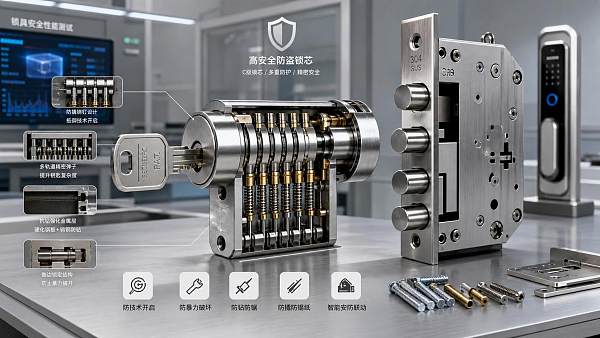
The usual attack methods and the mechanisms built to resist them
Picking resistance is the area most people know, but it is only one part of the picture. Anti-pick features usually work by creating false set conditions, reducing readable feedback, or requiring more than one locking principle to align at the same time. Sidebar systems, for example, may require both vertical pin alignment and lateral element positioning. That dual requirement increases the skill and time needed for non-destructive opening.
Bump resistance addresses a different problem. A cylinder that resists conventional picking may still be vulnerable to impact-based manipulation if its pin stack and tolerances allow kinetic transfer to momentarily set the shear line. Anti-bump designs may use modified pin shapes, spring arrangements, side locking elements, or other structural differences that disrupt that transient alignment. It is worth separating anti-pick claims from anti-bump claims because they are not interchangeable.
Drill resistance depends heavily on materials engineering. Hardened steel pins, anti-drill inserts, rotating discs, and reinforced shields are used to protect the shear line, plug face, and fixing points. Some higher-security solutions also use composite structures or hardened plates in the surrounding lock body to slow destructive access. What matters here is not simply hardness in isolation but where the protective material is placed. A lock may include hardened components but still leave a practical drilling path toward the cam or actuator.
Torque and extraction attacks target another weak point: the cylinder can be snapped, pulled, or twisted out of its housing even if the internal mechanism is strong. Anti-snap and anti-extraction measures often involve sacrificial break sections, reinforced bridges, protective escutcheons, hidden fasteners, and stronger mounting arrangements. This is where installation quality becomes inseparable from product design. A capable cylinder exposed too far beyond the door surface may underperform in the field.
Materials are part of the mechanism, not a finishing detail
In technical discussions, materials are sometimes treated as secondary to the cleverness of the locking structure. That is a mistake. Anti-theft lock technology relies on the interaction between geometry, tolerance, and material behavior under load. Hardened inserts, corrosion-resistant alloys, reinforced bolt components, wear-resistant internal elements, and protective faceplates all affect how a lock performs after repeated use and under attack.
Durability matters because a lock that degrades in alignment can become easier to manipulate or easier to force. For exterior and high-cycle environments, weather exposure, contamination, and maintenance practice can change security performance over time. Evaluators should ask whether the anti-drill and anti-pick features remain effective after long service, not only when the sample is new.
Where smart locking changes the security model
When electronic credentials, biometrics, or app-based control are added, anti-theft lock technology stops being purely mechanical. The question is no longer just whether the cylinder can be manipulated. It becomes whether the system can verify identity correctly, protect stored credentials, resist spoofing, handle power loss safely, and record access events in a usable way.
Biometric locks, for example, are often judged by convenience first and security second. A proper technical review should look at liveness detection, false acceptance risk, template protection, enrollment policy, and fallback design. If a biometric reader is paired with a weak emergency cylinder or poorly protected override path, the system may inherit the vulnerability of its least secure component. The same applies to connected locks: encryption, firmware update integrity, local attack resistance, and offline behavior are not optional details.
This does not mean smart locks are inherently weaker or stronger than mechanical ones. It means they must be assessed across a wider attack surface. In some commercial deployments, audit trail visibility and credential revocation provide security benefits that a purely mechanical system cannot. In other settings, especially where maintenance discipline is uncertain, a simpler high-security mechanical platform may be the more dependable choice.
Standards help, but they do not answer every selection question
For evaluators, standards and certification frameworks are essential because they create a common basis for comparing resistance, durability, and functional safety. The relevant standard depends on the product category and market. In Europe, lock cylinders and related door hardware may be assessed under standards such as EN 1303, while broader burglary resistance for doorsets can involve other frameworks. In North America and other markets, different testing and listing systems may apply. Smart products may also need to be reviewed against electronic security, access control, or radio compliance requirements depending on how they are deployed.
Still, a certified component is not automatically the right component. Test scope matters. A cylinder rating does not fully describe the security of the entire door assembly. A smart lock passing functional tests does not by itself confirm robust cybersecurity practice. The useful habit is to ask what exactly was tested, under which standard, and whether the field installation matches that test condition.
Common misunderstandings that distort product comparison
One recurring mistake is to compare locks by the number of locking points or the complexity of the key profile alone. More points can improve door retention, but they do not guarantee better cylinder security. Another is to assume that a heavier lock body is necessarily more secure. Mass may indicate robust construction, but without resistant internals and protected mounting, it can be misleading.
There is also a tendency to treat “anti-theft” as a binary label. In reality, lock security is graded and conditional. A product may be well suited for apartment entrances and still be inadequate for cash rooms, critical infrastructure spaces, or unattended logistics environments. Technical assessment becomes much clearer when the discussion shifts from generic labels to attack resistance, duty cycle, environmental exposure, credential management, and installation dependency.
What to check when evaluating a lock for real deployment
A practical review usually benefits from a short decision framework:
- Identify the expected attack methods: covert entry, forced entry, credential misuse, or a combination.
- Examine the whole assembly: cylinder, lock body, strike, escutcheon, fixing method, and door substrate.
- Verify whether key control or digital credential governance is part of the security requirement.
- Check relevant standards and request clarity on the exact test scope rather than relying on generic certification language.
- Consider service life, weather exposure, and maintenance, especially for high-cycle or outdoor installations.
- For smart systems, review fallback behavior, audit capability, firmware management, and resistance to spoofing or local tampering.
That framework usually reveals whether a lock is genuinely anti-theft in the application being discussed or simply marketed that way. It also explains why experienced buyers often ask detailed questions about internals, materials, keyway control, test evidence, and door integration before they compare price.
The most useful way to understand anti-theft lock technology is to see it as resistance engineering rather than a single feature. The cylinder design, protective materials, installation geometry, and authentication method all contribute to whether unauthorized entry becomes easy, noisy, time-consuming, or impractical. For technical evaluation, that is the real benchmark: not whether a lock sounds advanced, but whether its security architecture matches the attack conditions and operational demands of the site where it will actually be used.
Have questions about this sector analysis, or seeking best practices specific to your niche? Drop us a line below and let the senior consultants at MHLS assist you.
We respect your privacy. Your information is strictly confidential.
Recommended News
 Parcel Locker Network Pricing: Setup Costs, Fees and Contract TermsUnmanned Terminal FellowCompare parcel locker networks pricing, from setup costs and recurring fees to contract terms. Discover hidden charges and choose the right model.
 JR East Plans UWB Walk-Through Gates at 40 Stations in Spring 2028Access Control StrategistJR East plans UWB walk-through gates at 40 stations in spring 2028. Explore the rollout timeline and what suppliers should watch.
 Bank Vault Security Standards: UL and EN Ratings ExplainedVault Structural ArchitectExplore bank vault security standards and learn how UL 608 classes and EN 1143-1 grades differ, what they test, and how to verify certification before you buy.
 Mechanical Lock Hardware Prices: What Buyers Should Budget for Bulk OrdersMr. Gideon CrossMechanical lock hardware price is just the starting point. Discover what drives bulk-order costs and how to compare supplier quotes with confidence.
 IndexBox Forecasts Steady Global Security Keypad Market Growth Through 2035Dr. Valerius ThorneGlobal security keypad market growth is forecast at 3.3% annually through 2035. Explore the smart home and replacement trends shaping demand.
 Choosing an Infrared Safety Sensors Manufacturer: What Buyers Should CheckUnmanned Terminal FellowChoosing an infrared safety sensors manufacturer? Compare safety evidence, integration, environmental performance and lifecycle costs before you buy.
 Choosing a Security Material Testing Service: What to Check for Lock and Safe MaterialsProf. Elara SterlingChoose a security material testing service with confidence. Learn what to check for lock and safe materials, from attack methods and accreditation to reliable reports.
 How Precision Anti-Pick Lock Cylinders Resist ManipulationSecurity Metallurgy ExpertDiscover how precision anti-pick lock technology resists manipulation, and learn what to check when comparing security features, test evidence, and everyday reliability.
 Dermalog Joins NIST FastCAP Program for Contactless Fingerprint TestingProf. Elara SterlingDermalog joins the NIST FastCAP program for contactless fingerprint testing. Discover what this means for biometric identification and digital identity.
 Choosing Security Export Compliance Services: What Providers Should CoverMr. Gideon CrossSecurity export compliance services can help prevent costly delays. Discover what to look for in classification, licensing, screening, and documentation.
 European Security Compliance Standards for Safes: EN 1143-1 vs EN 14450Dr. Valerius ThorneExplore security compliance standards Europe buyers need to know. Compare EN 1143-1 and EN 14450 to choose the right safe with confidence.
 HID Global Acquires inepro ID to Expand RFID and BLE Access SolutionsUnmanned Terminal FellowHID Global acquires inepro ID to expand RFID and BLE access solutions for printers, smart lockers and shared devices. Explore what the deal could mean for your organization.











