
How Pin-Tumbler Cylinder Mechanisms Affect Picking Resistance and Key Control
How Pin-Tumbler Cylinder Mechanisms Affect Picking Resistance and Key Control
A mechanical cylinder is often treated as a small, familiar component in a much larger security system. That is a mistake. On an apartment entrance, a plant-room door, a pharmaceutical cabinet, a parcel-locker service panel, or a restricted office area, the cylinder is the point where physical access policy becomes a mechanical decision. If it can be manipulated quickly, duplicated without authorization, or poorly managed after a keyholder leaves, the quality of the door, lock case, access-control reader, or surveillance system may not matter as much as expected.
For technical evaluation, pin-tumbler lock mechanisms for cylinders should not be compared simply by pin count or by a catalogue claim such as “anti-pick.” Picking resistance comes from the interaction of pin geometry, manufacturing tolerances, plug and housing design, keyway profile, supplemental locking elements, and the way the cylinder is installed. Key control is related, but it is not the same thing. A cylinder may be difficult to manipulate yet still create a serious control problem if blanks are easy to obtain or if duplication is not governed by a credible authorization process.
The useful question is therefore not, “Does this cylinder have security pins?” It is: “What level of unauthorized-entry risk is relevant at this opening, and how does this cylinder’s mechanical design, key system, and installation address that risk over its service life?”
The shear line is simple; the engineering around it is not
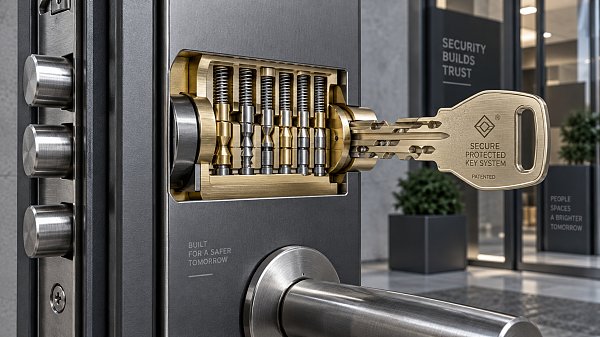
In a conventional pin-tumbler cylinder, the correct key raises a series of pin stacks so that the separation between each lower pin and upper pin aligns at the plug’s shear line. The plug can then rotate and operate the cam, tailpiece, or other connection to the lock body. That operating principle has remained widely used because it is compact, serviceable, economical, and adaptable to master-key systems.
The same basic architecture, however, offers opportunities for manipulation when the mechanism provides overly clear mechanical feedback. A basic cylinder with standard cylindrical pins, generous internal clearances, and a straightforward keyway may be adequate for a low-consequence internal door. It is not automatically suitable for a perimeter opening, a key cabinet, a utility room containing critical controls, or a site where keys circulate among contractors and temporary staff.
Manufacturers improve resistance by changing how the mechanism behaves when an incorrect pin position is reached. Common approaches include shaped driver pins, such as spool- or mushroom-type forms, serrated elements, and more complex arrangements where the pin stack does not give a simple true-or-false indication of alignment. Some higher-security cylinders add independent elements beyond the main pin line, including side pins, sliders, rotating discs, or pin-in-pin constructions. These additions can make unauthorized manipulation more demanding because more than one locking condition must be satisfied.
There is an important procurement caveat here: the presence of a security feature is not proof of a security outcome. A single shaped pin may offer limited practical benefit in a low-precision design. Conversely, a well-made conventional pin system can be more consistent in daily operation than a feature-heavy cylinder produced with poor control over materials, finishing, or assembly. Evaluators should look at the full architecture rather than count named features.
Pin geometry changes feedback, but tolerances shape the real result
Security pin profiles are intended to create false positions or misleading rotational behavior when the plug is moved without the correct key. This can increase the time, skill, and uncertainty required for manipulation. Yet the effectiveness of those profiles depends heavily on dimensional relationships inside the cylinder: pin diameter, chamber alignment, plug-to-housing fit, spring behavior, surface finish, and the consistency of parts across production batches.
Tight tolerances are often presented as an unqualified advantage. In reality, they involve a trade-off. They may reduce unintended movement and support more predictable security behavior, but the cylinder must still tolerate dust, wear particles, insufficient lubrication, moisture, temperature change, and imperfect keys. A cylinder that performs neatly in a controlled test setting but becomes rough after routine use can prompt users to force keys, apply unsuitable lubricants, or leave doors unsecured. Security hardware must be judged as an operating component, not as a cutaway display model.
This is especially relevant in mixed-use buildings and distributed infrastructure. Parcel locker banks, for example, may be exposed to frequent service access, outdoor contaminants, and different maintenance habits across sites. Service doors in a data room or healthcare environment may see less traffic but carry higher consequences if key control fails. The optimum cylinder specification can differ sharply even where the door hardware appears similar.
More pins do not automatically mean more resistance
A longer pin line can increase the number of possible key combinations and may add complexity to manipulation. It can also support more flexible master-key planning. But pin quantity alone is a poor basis for selection. Additional chambers can introduce longer keys, more opportunity for accumulated tolerance variation, and greater complexity in key cutting and rekeying. In a master-keyed system, the use of additional pin segments to support different change keys can also affect the mechanism’s resistance profile.
Technical reviewers should distinguish between key differs and effective security. Key differs describes the number of possible unique key combinations in a theoretical system. Effective security includes whether those combinations are realistically controlled, whether the keyway is protected, whether master-keying has introduced compromise points, and whether the cylinder resists the relevant forms of physical attack.
Keyway design is part of key control, not just a shape
A restricted or proprietary keyway can be useful because it limits who can lawfully source the correct blank and cut a duplicate. But “restricted” needs clarification. Some restrictions are based on contractual distribution arrangements. Others may rely on registered design rights, patents, or controlled blank supply. The duration and enforceability of those protections vary by jurisdiction and by supplier arrangement. A purchaser should not assume that a branded key automatically provides permanent duplication protection.
A credible key-control program usually has both mechanical and administrative layers. Mechanically, it may use controlled blanks, distinctive key profiles, coded cylinders, or supplemental elements. Administratively, it should define who approves copies, how identity is checked, where key records are retained, how lost keys are handled, and whether the system can be rekeyed in a practical time frame. In a large portfolio, the administration may matter more than a marginal difference in pin geometry.
This becomes visible during turnover events. When a tenant changes, a contractor’s work concludes, or an employee with broad access departs, the site needs a clear answer: recover keys, rekey affected doors, or accept residual risk. If the master-key plan is undocumented or replacement cylinders are difficult to obtain, a relatively inexpensive cylinder choice can create a costly operational problem later.
Master-keying is an access-management decision with mechanical consequences
Master-key systems are valuable where people need different levels of physical access: individual office users, cleaners, maintenance teams, security staff, facilities managers, and emergency responders may each require a different key scope. The danger is not master-keying itself. The danger is allowing convenience to drive the hierarchy until a very broad key opens too many doors and too many copies are in circulation.
In pin-tumbler systems, master-key capability commonly requires additional pinning conditions within chambers. That is a legitimate engineering approach, but it should prompt closer review in sensitive openings. Critical areas may justify a separate high-security key section, a different cylinder technology, or electronic access control with audit capability. There is no universal rule; the right split depends on the consequences of compromise, user volume, emergency requirements, and the operator’s ability to manage credentials.
For facilities combining mechanical and electronic protection, a sensible approach is often layered rather than ideological. A biometric smart lock or card reader may govern normal access, while a mechanical cylinder provides override access under controlled procedures. The override key should not quietly become the easiest route into the space. Its issuance, storage, and duplication status deserve the same scrutiny as the electronic credential database.
Do not evaluate picking resistance in isolation
A cylinder can have sophisticated pin-tumbler features and still be the weak point of a door assembly. Installation length, projecting cylinder position, escutcheon design, fixing method, lock-case compatibility, and the door’s resistance to forced attack all affect the practical result. A protected cylinder should be specified with the door, handle or protective furniture, strike arrangement, and surrounding frame condition in mind.
Where standards are relevant, technical teams should verify exactly what the stated standard covers. Cylinder standards, door-set standards, and burglary-resistance classifications may address different products, attack methods, and test conditions. A test claim for one component should not be treated as proof that the completed opening performs to the same level. Documentation should identify the tested configuration, applicable market requirements, and any conditions on installation.
This broader systems view is central to physical security planning. The same discipline used to assess anti-drill materials in a safe body, liveness detection in a biometric lock, or infrared safety sensing in a speed gate also applies to cylinders: understand the threat, inspect the component interfaces, and confirm what has actually been tested or controlled.
A practical review path before specifying a cylinder
Before approving a cylinder family, request more than a feature list. Review the intended application, available test documentation, material and attack-protection details, master-keying capability, key blank supply model, duplication authorization process, expected maintenance method, and lead time for replacement or expansion. If the project spans multiple countries, confirm that key-cutting support and controlled supply arrangements work in each relevant market rather than only in the supplier’s home region.
It is also worth handling sample cylinders as a user would. Check key insertion, rotation, removal, operation with likely door furniture, and behavior with multiple authorized keys. Ask how the supplier manages system records and what information is required to order additional keys or cylinders. Those routine questions often expose whether key control is a real process or merely a label in a brochure.
The strongest specification is rarely the one with the longest list of anti-pick terms. It is the one that makes a defensible match between cylinder mechanism, key-control model, door assembly, operational workflow, and the consequences of failure. For security hardware evaluators, that is the point at which a pin-tumbler cylinder becomes not just a lock component, but a managed part of the site’s physical security infrastructure.
Have questions about this sector analysis, or seeking best practices specific to your niche? Drop us a line below and let the senior consultants at MHLS assist you.
We respect your privacy. Your information is strictly confidential.
Recommended News
 Financial Facility Security: Choosing Vault Doors for Bank BranchesVault Structural ArchitectStrengthen financial facility security with the right bank vault door. Explore certification, installation, locking controls and maintenance before you buy.
 MACO Acquires Majority Stake in Fingerprint Access Provider ekeyProf. Elara SterlingMACO acquires a majority stake in ekey, bringing fingerprint access and door hardware closer together. Discover what the deal could mean for smart buildings.
 Physical Security System Engineering: From Risk Assessment to System DesignUnmanned Terminal FellowExplore physical security system engineering, from risk assessment to integrated design, procurement and testing. Build a safer, more resilient facility.
 Apple Home Collection Smart Lock and Other Accessories Open for Preorder November 13Biometric Auth ScientistApple Home Collection preorders open November 13, 2026. Explore the LG smart lock’s Matter and Aliro support and what buyers should verify before ordering.
 Choosing Servo-Driven Flap Barriers: Throughput, Safety and Access ControlAccess Control StrategistServo-driven flap barriers can balance throughput, safety and access control. Discover how to compare lanes, test performance and choose with confidence.
 Parcel Locker Network Pricing: Setup Costs, Fees and Contract TermsUnmanned Terminal FellowCompare parcel locker networks pricing, from setup costs and recurring fees to contract terms. Discover hidden charges and choose the right model.
 JR East Plans UWB Walk-Through Gates at 40 Stations in Spring 2028Access Control StrategistJR East plans UWB walk-through gates at 40 stations in spring 2028. Explore the rollout timeline and what suppliers should watch.
 Bank Vault Security Standards: UL and EN Ratings ExplainedVault Structural ArchitectExplore bank vault security standards and learn how UL 608 classes and EN 1143-1 grades differ, what they test, and how to verify certification before you buy.
 Mechanical Lock Hardware Prices: What Buyers Should Budget for Bulk OrdersMr. Gideon CrossMechanical lock hardware price is just the starting point. Discover what drives bulk-order costs and how to compare supplier quotes with confidence.
 IndexBox Forecasts Steady Global Security Keypad Market Growth Through 2035Dr. Valerius ThorneGlobal security keypad market growth is forecast at 3.3% annually through 2035. Explore the smart home and replacement trends shaping demand.
 Choosing an Infrared Safety Sensors Manufacturer: What Buyers Should CheckUnmanned Terminal FellowChoosing an infrared safety sensors manufacturer? Compare safety evidence, integration, environmental performance and lifecycle costs before you buy.
 Choosing a Security Material Testing Service: What to Check for Lock and Safe MaterialsProf. Elara SterlingChoose a security material testing service with confidence. Learn what to check for lock and safe materials, from attack methods and accreditation to reliable reports.











