
How to Evaluate a Pin in Pin Cylinder Manufacturer for High-Security Lock Projects
How to Evaluate a Pin in Pin Cylinder Manufacturer for High-Security Lock Projects
Choosing the right pin in pin cylinder manufacturer can directly affect the security, durability, and compliance of your lock project.
For high-security applications, price is only one layer of the decision.
The harder question is whether a supplier can deliver precise machining, stable anti-picking performance, reliable materials, and repeatable quality at scale.
This is where a careful evaluation of a pin in pin cylinder manufacturer becomes essential.
Why Manufacturer Evaluation Matters First
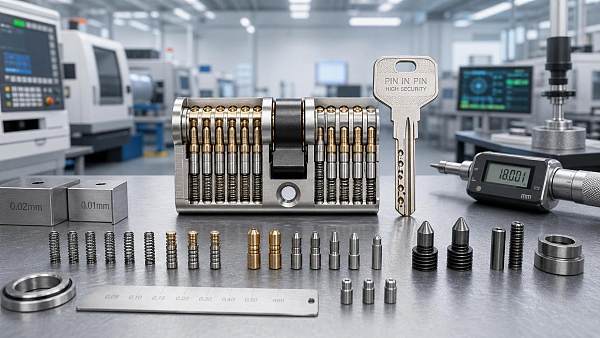
A lock cylinder may look similar across catalogs.
In real projects, internal tolerances, pin geometry, spring consistency, and core material quality create major differences.
That difference becomes visible in critical environments.
Examples include commercial entrances, master key systems, secure storage, utility cabinets, institutional buildings, and restricted access areas.
A weak pin in pin cylinder manufacturer may still offer attractive samples.
The problem often appears later through unstable key operation, accelerated wear, poor key differ, or inconsistent anti-pick behavior.
That also means supplier evaluation should begin before commercial negotiation becomes the main focus.
Understand the Pin in Pin Cylinder Design
Before comparing factories, understand what makes this cylinder structure different.
A pin in pin cylinder uses nested pin elements to increase picking complexity and key control depth.
When engineered well, it can improve resistance to manipulation and support more advanced key profiles.
However, the same design also demands higher production accuracy.
Small errors in drilling, pin length sorting, spring force, or plug finishing can affect the entire mechanism.
This is why evaluating a pin in pin cylinder manufacturer is not the same as sourcing a standard cylinder supplier.
You are assessing precision security manufacturing, not just general metal hardware production.
Check Precision and Machining Capability
The first technical checkpoint is machining control.
Ask the pin in pin cylinder manufacturer how it controls tolerances in plug drilling, chamber spacing, pin sizing, and keyway finishing.
A serious supplier should explain this clearly.
Useful signals include CNC process stability, in-process inspection points, gauge usage, and final functional testing methods.
It is worth asking for dimensional consistency data across batches.
In practice, batch-to-batch stability matters more than one polished prototype.
If the supplier avoids process detail, that is usually a warning sign.
For high-security lock projects, precision errors often become service complaints and replacement costs later.
Review Anti-Picking and Attack Resistance
A qualified pin in pin cylinder manufacturer should discuss attack scenarios, not only product features.
Ask how the cylinder performs against picking, bumping, impressioning, drilling, and plug extraction.
The answer should include structure, materials, and test evidence.
Security pins, hardened inserts, anti-drill rods, and protected key profiles may all be relevant.
Still, features on paper are not enough.
Look for third-party testing, internal verification procedures, and evidence from comparable applications.
From recent market shifts, more buyers are also checking how cylinders perform after prolonged use.
Attack resistance that weakens after wear is a practical risk, especially in high-cycle environments.
Assess Materials, Surface Treatment, and Durability
Material selection tells you a great deal about a pin in pin cylinder manufacturer.
Ask what is used for the body, plug, pins, springs, and reinforcement elements.
Common choices may include brass, nickel silver, stainless steel, and hardened steel inserts.
The right choice depends on the project environment.
Outdoor exposure, coastal humidity, high traffic, and chemical contact can change the decision quickly.
Surface treatment matters as well.
Plating quality affects corrosion resistance, visual consistency, and long-term operation.
When possible, request salt spray data, cycle test results, and material traceability records.
A dependable pin in pin cylinder manufacturer should connect materials directly to service life and use conditions.
Verify Standards, Certification, and Test Discipline
Compliance is often where sourcing decisions become clearer.
If your market requires EN, UL, or regional security standards, confirm whether the pin in pin cylinder manufacturer has real experience with them.
Do not rely on broad claims like “tested to international standards.”
Ask for certificate numbers, issuing bodies, report scope, and product coverage.
Also check whether the tested configuration matches the actual product you plan to buy.
This detail is easy to miss.
Some suppliers certify one version, then quote another version with lower security content.
A disciplined pin in pin cylinder manufacturer should also run internal lifecycle, torque, and failure analysis tests routinely.
Examine Key Control and System Design Support
For many projects, the cylinder is only part of the security system.
The stronger question is whether the pin in pin cylinder manufacturer can support controlled key duplication and scalable key management.
This matters in property management, institutions, infrastructure, and commercial campuses.
Ask about patent protection, restricted key blanks, master key planning, and key coding control.
A capable supplier should also understand hierarchy design.
That includes change keys, master keys, grand master structures, and expansion logic for future sites.
If that support is weak, operational risk rises after installation.
A pin in pin cylinder manufacturer with strong system design capability usually adds more long-term value than a low-cost producer.
Audit Production Consistency and Supply Reliability
A secure design still fails commercially if supply is unstable.
Ask the pin in pin cylinder manufacturer about monthly capacity, tooling control, lead times, and lot traceability.
Then go deeper into quality management.
Useful points include incoming material inspection, assembly verification, defect response, and final outgoing checks.
For larger programs, ask how engineering changes are documented and approved.
This becomes important when key profiles, finishes, or anti-drill components are modified.
In actual sourcing work, delayed response to quality issues is often more damaging than the defect itself.
A reliable pin in pin cylinder manufacturer should show both production order and accountability.
Questions That Help Shortlist Suppliers
- What tolerance range is controlled for pin chambers and plug machining?
- Which attack resistance tests has the pin in pin cylinder manufacturer completed?
- What materials are used for anti-drill protection and wear-critical components?
- Can the supplier support restricted key systems and master key architecture?
- How are lot traceability and nonconformance reports handled?
- Which certifications apply to the exact quoted model?
- What is the average production lead time for repeat orders?
- What cycle life data is available for the proposed cylinder?
A Practical Comparison Framework
Final Decision: Look Beyond Unit Cost
The best pin in pin cylinder manufacturer is rarely the one with the lowest quotation.
A better choice is the supplier that can prove security engineering, stable quality, and dependable execution.
That becomes even more important in high-security lock projects where failure costs exceed purchase savings.
A structured evaluation process helps reduce that risk.
Start with design understanding, then verify machining, materials, resistance testing, compliance, and supply discipline.
From there, compare suppliers using evidence rather than broad claims.
That approach makes conversations with each pin in pin cylinder manufacturer more efficient and much easier to defend internally.
When the project is security-critical, disciplined supplier selection is part of the protection strategy itself.
Have questions about this sector analysis, or seeking best practices specific to your niche? Drop us a line below and let the senior consultants at MHLS assist you.
We respect your privacy. Your information is strictly confidential.
Recommended News
 Choosing Servo-Driven Flap Barriers: Throughput, Safety and Access ControlAccess Control StrategistServo-driven flap barriers can balance throughput, safety and access control. Discover how to compare lanes, test performance and choose with confidence.
 Parcel Locker Network Pricing: Setup Costs, Fees and Contract TermsUnmanned Terminal FellowCompare parcel locker networks pricing, from setup costs and recurring fees to contract terms. Discover hidden charges and choose the right model.
 JR East Plans UWB Walk-Through Gates at 40 Stations in Spring 2028Access Control StrategistJR East plans UWB walk-through gates at 40 stations in spring 2028. Explore the rollout timeline and what suppliers should watch.
 Bank Vault Security Standards: UL and EN Ratings ExplainedVault Structural ArchitectExplore bank vault security standards and learn how UL 608 classes and EN 1143-1 grades differ, what they test, and how to verify certification before you buy.
 Mechanical Lock Hardware Prices: What Buyers Should Budget for Bulk OrdersMr. Gideon CrossMechanical lock hardware price is just the starting point. Discover what drives bulk-order costs and how to compare supplier quotes with confidence.
 IndexBox Forecasts Steady Global Security Keypad Market Growth Through 2035Dr. Valerius ThorneGlobal security keypad market growth is forecast at 3.3% annually through 2035. Explore the smart home and replacement trends shaping demand.
 Choosing an Infrared Safety Sensors Manufacturer: What Buyers Should CheckUnmanned Terminal FellowChoosing an infrared safety sensors manufacturer? Compare safety evidence, integration, environmental performance and lifecycle costs before you buy.
 Choosing a Security Material Testing Service: What to Check for Lock and Safe MaterialsProf. Elara SterlingChoose a security material testing service with confidence. Learn what to check for lock and safe materials, from attack methods and accreditation to reliable reports.
 How Precision Anti-Pick Lock Cylinders Resist ManipulationSecurity Metallurgy ExpertDiscover how precision anti-pick lock technology resists manipulation, and learn what to check when comparing security features, test evidence, and everyday reliability.
 Dermalog Joins NIST FastCAP Program for Contactless Fingerprint TestingProf. Elara SterlingDermalog joins the NIST FastCAP program for contactless fingerprint testing. Discover what this means for biometric identification and digital identity.
 Choosing Security Export Compliance Services: What Providers Should CoverMr. Gideon CrossSecurity export compliance services can help prevent costly delays. Discover what to look for in classification, licensing, screening, and documentation.
 European Security Compliance Standards for Safes: EN 1143-1 vs EN 14450Dr. Valerius ThorneExplore security compliance standards Europe buyers need to know. Compare EN 1143-1 and EN 14450 to choose the right safe with confidence.











