
How to Evaluate an Anti-Pick Cylinder Lock Manufacturer for High-Security Projects
How to Evaluate an Anti-Pick Cylinder Lock Manufacturer for High-Security Projects
Selecting an anti-pick cylinder lock manufacturer is not a routine hardware purchase when the project involves restricted rooms, multi-tenant commercial buildings, critical-access areas, high-value storage, or exposed exterior doors. A cylinder may look like a small component beside a steel door, access controller, or biometric reader, but it often remains the most direct mechanical path into the space.
Procurement teams are frequently presented with similar claims: “anti-pick,” “anti-drill,” “high-security,” or “patented key system.” Those labels are useful only when the manufacturer can explain the locking architecture, provide relevant test evidence, maintain repeatable production quality, and support the key-management model after installation. A low unit price can quickly lose its appeal if cylinders require rework, keys cannot be controlled, or replacement parts arrive too late during a security incident.
The practical task is to distinguish a supplier that assembles visually convincing cylinders from an anti-pick cylinder lock manufacturer capable of supporting a real security specification. That requires examining both the product and the factory behind it.
Start with the attack model, not the catalogue
“High security” means different things in different projects. A residential developer may be trying to reduce opportunistic picking and unauthorized key copying. A facility manager may be more concerned about contractors retaining keys after handover. A data room, pharmaceutical store, cash-handling area, or utility site may face more deliberate manipulation, drilling, pulling, or forced entry attempts. These situations do not call for exactly the same cylinder.
Before requesting quotations, define the door set and its likely weak points. Confirm whether the cylinder will be installed in a mortise lock, rim lock, panic-door hardware, fire-rated door assembly, security escutcheon, or an electronic access-control environment. A well-designed cylinder can still be compromised if it protrudes too far beyond the door fitting, is paired with a weak lock case, or is installed in a door with inadequate reinforcement.
A useful procurement brief should describe the intended application, cylinder profile and dimensions, keying hierarchy, expected service life, quantity split by location, and whether the project requires resistance against picking, drilling, bumping, snapping, extraction, or unauthorized duplication. This prevents a manufacturer from quoting its closest-looking standard item while leaving critical risks outside the scope.
Ask what makes the cylinder resistant to picking
An anti-pick claim should lead to a technical conversation, not a marketing brochure. Pin-tumbler cylinders may use spool pins, serrated pins, mushroom pins, side pins, pin-in-pin arrangements, telescopic elements, sliders, rotating discs, magnetic elements, or other mechanisms intended to make manipulation more difficult. None of these features should be judged in isolation. The question is how the complete design reacts to common manipulation methods and whether the manufacturing tolerances are controlled well enough for the design to work consistently.
For example, a cylinder with multiple security pins may create a convincing false set during manipulation. Yet if pin chambers, springs, plugs, and key cuts are produced inconsistently, the actual resistance can vary from one batch to another. Conversely, a mechanically simpler cylinder may be appropriate for a lower-risk interior application if the buyer does not mistake it for a high-security solution.
Ask the manufacturer to identify the mechanism used, the number of active locking elements, the role of sidebars or secondary locking lines where applicable, and the key profile controls. Request cutaway samples or technical drawings where confidentiality arrangements allow. A credible supplier does not need to reveal every protected detail, but should be able to explain the security principle in enough depth for engineering and security teams to assess it.
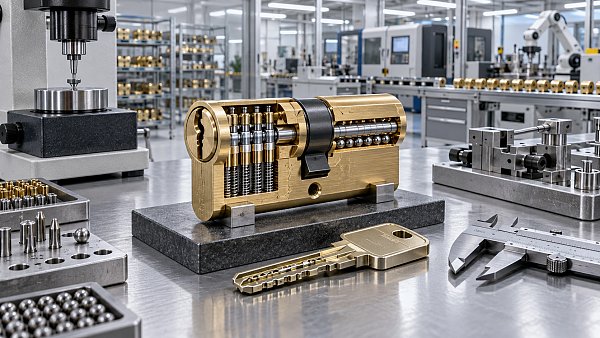
Do not treat anti-pick performance as separate from key control. In many buildings, unauthorized duplication creates a more realistic threat than skilled lock picking. A restricted keyway, controlled blank distribution, registration process, or documented authorization route for duplicate keys may matter as much as the internal pin configuration. The appropriate level of control depends on the project. It should also be enforceable across the countries where the building or portfolio operates.
Evaluate resistance beyond manipulation
High-security cylinders encounter more than picks. Attack resistance may involve drilling, plug pulling, twisting, snapping, impressioning, bumping, or destructive removal. A manufacturer should be able to state which threats its cylinder is designed to address and which depend on companion hardware such as an anti-drill escutcheon, reinforced door plate, or protected handle set.
Material choices deserve close attention. Hardened inserts, anti-drill pins, steel bars, reinforced plugs, and robust cam or tailpiece designs can improve resistance to specific attacks. However, buyers should look beyond broad terms such as “brass body” or “steel protection.” Ask where the hardened elements are positioned, whether they protect the keyway and plug area, and whether the cylinder’s external geometry creates exposure once installed.
Cylinder snapping is a good example of why installation details matter. In markets where euro-profile cylinders are common, a break-off or sacrificial design may be relevant. But its performance depends on correct cylinder length, fitting depth, and the protective escutcheon. Ordering the wrong length to save inventory complexity can leave too much cylinder exposed. That is a specification error, not simply a product failure.
Verify tests, standards, and the exact product configuration
Test reports and certifications can help reduce uncertainty, but only when reviewed carefully. The buyer should confirm the issuing body, report date, scope, product model, cylinder length, key type, optional protection features, and the standard or test method used. A certificate for one configuration does not automatically cover every cam type, finish, double-cylinder version, thumbturn option, or customized keying arrangement.
Relevant requirements vary by market and project. In Europe, buyers may encounter standards such as EN 1303 for building hardware cylinders, while project specifications may also reference national schemes or door-set requirements. Other regions may follow different testing and approval routes. The important procurement discipline is not memorizing standard numbers; it is matching the evidence to the project’s contractual, insurance, fire-door, and security requirements.
Be cautious with phrases such as “tested to” or “designed according to.” Ask whether the offered model was independently tested, whether the report is still valid, and whether the supplier can provide the applicable documentation before the purchase order is released. If the cylinder is part of a protected door assembly, check compatibility with the door manufacturer rather than assuming component-level compliance is enough.
Inspect manufacturing discipline, not just samples
A sample can open smoothly and still tell you very little about batch consistency. Cylinder locks depend on small tolerances across plugs, chambers, pins, springs, keys, cams, housings, and assembly processes. Poor control may result in rough operation, premature key wear, mismatched keying, intermittent jamming, or uneven resistance characteristics between lots.
When evaluating an anti-pick cylinder lock manufacturer, ask how it controls incoming materials, machining, key cutting, assembly, functional testing, and traceability. The answers do not need to be theatrical. What matters is whether the factory can identify production lots, isolate defective material, verify key-cylinder function, and manage changes to tooling or subcomponents.
For sizeable or sensitive projects, a factory audit or a third-party inspection can be sensible. If an on-site visit is not practical, request a structured quality questionnaire, process photos or live walkthroughs where possible, sample test records, and details of final inspection. This is especially relevant where keyed-alike and master-keyed systems are involved. One incorrectly keyed cylinder can create a handover problem far larger than the cost of the component itself.
Questions worth putting into the RFQ
- What anti-pick mechanism is used, and what attack methods is it intended to resist?
- Which protection features are integrated into the cylinder, and which require separate door hardware?
- Can the quoted configuration be linked to current test reports or approval documents?
- What key-control process applies to duplicate keys, master keys, and restricted key blanks?
- How are keyed-alike groups and master-key charts checked before shipment?
- What are the minimum order quantity, normal lead time, emergency replacement process, and spare-key policy?
- Can the supplier maintain compatible production for future project phases or replacement needs?
Treat keying architecture as an operational security issue
Mechanical key systems are often priced as a list of cylinders and keys, but the real value lies in the hierarchy. A simple keyed-different arrangement is easier to manage but can burden staff with large key rings. Keyed-alike groups offer convenience, while master-key systems create controlled access across floors, departments, buildings, or service zones. Each added layer of access logic introduces more design and verification work.
Buyers should decide early who owns the key schedule, who may authorize changes, how lost keys are recorded, and whether the system must integrate with electronic credentials or smart-lock retrofits later. In mixed estates, a cylinder manufacturer’s ability to support mechanical locks alongside biometric locks, access control, protected doors, and emergency egress hardware can reduce coordination risk. It does not mean one supplier must provide everything; it means interfaces should be planned rather than discovered during installation.
For complex sites, retain a controlled key chart with revision history. Avoid distributing complete master-key information broadly through email attachments or unprotected spreadsheets. Physical security tends to fail at administrative seams: an unreturned contractor key, an undocumented replacement cylinder, or an urgent duplicate request approved without a clear authority chain.
Compare total cost, including the cost of being locked into a supplier
The lowest cylinder price is rarely the lowest project cost. Procurement should compare the full landed and lifecycle picture: tooling or setup charges, master-key system design, keys, installation accessories, inspection, freight, customs exposure, spare stock, replacement lead time, warranty handling, and future expansion.
Supplier dependency is often overlooked. A proprietary key platform may offer strong control, but the buyer should understand what happens if the local distributor changes, the project expands into another region, or an emergency replacement is needed years later. Clarify whether cylinders can be supplied from more than one approved channel, how key authorization survives ownership changes, and whether the manufacturer retains production capability for discontinued lines.
A practical comparison table should therefore score more than technical features. Include documentation quality, key-system flexibility, production capacity, delivery reliability, after-sales response, and compatibility with the specified door hardware. The manufacturer with the most features is not automatically the best choice if its service model cannot support the operating life of the building.
Run a controlled pre-award review
Before final award, obtain representative samples in the exact profile, length, cam or tailpiece arrangement, finish, and keying concept required for the project. Have installers assess fitment and operation with the actual lock body, escutcheon, door thickness, and handing. Security personnel should also review the key hierarchy and duplicate-key process. This small pre-award exercise can reveal issues that no catalogue comparison will show.
For projects involving wider physical security infrastructure, the cylinder decision should sit beside the broader protection plan: protective doors, access control, turnstiles, safes, parcel locker compartments, and digital credential systems all create different access points and maintenance obligations. Platforms such as Global Smart Hardware & Physical Security Systems help procurement teams place mechanical cylinder decisions within that wider security environment rather than treating a lock as an isolated commodity.
The right manufacturer is the one that can show how its cylinder works, where its protection begins and ends, how it is tested, and how it will be supported after the building is occupied. If those answers remain vague before purchase, they are unlikely to become clearer when a replacement key, failed cylinder, or security investigation makes the details urgent.
Have questions about this sector analysis, or seeking best practices specific to your niche? Drop us a line below and let the senior consultants at MHLS assist you.
We respect your privacy. Your information is strictly confidential.
Recommended News
 Physical Security Infrastructure Cost: Budgeting for Installation and MaintenanceUnmanned Terminal FellowUnderstand physical security infrastructure cost and build a smarter budget for installation, maintenance, and long-term ownership.
 Financial Facility Security: Choosing Vault Doors for Bank BranchesVault Structural ArchitectStrengthen financial facility security with the right bank vault door. Explore certification, installation, locking controls and maintenance before you buy.
 MACO Acquires Majority Stake in Fingerprint Access Provider ekeyProf. Elara SterlingMACO acquires a majority stake in ekey, bringing fingerprint access and door hardware closer together. Discover what the deal could mean for smart buildings.
 Physical Security System Engineering: From Risk Assessment to System DesignUnmanned Terminal FellowExplore physical security system engineering, from risk assessment to integrated design, procurement and testing. Build a safer, more resilient facility.
 Apple Home Collection Smart Lock and Other Accessories Open for Preorder November 13Biometric Auth ScientistApple Home Collection preorders open November 13, 2026. Explore the LG smart lock’s Matter and Aliro support and what buyers should verify before ordering.
 Choosing Servo-Driven Flap Barriers: Throughput, Safety and Access ControlAccess Control StrategistServo-driven flap barriers can balance throughput, safety and access control. Discover how to compare lanes, test performance and choose with confidence.
 Parcel Locker Network Pricing: Setup Costs, Fees and Contract TermsUnmanned Terminal FellowCompare parcel locker networks pricing, from setup costs and recurring fees to contract terms. Discover hidden charges and choose the right model.
 JR East Plans UWB Walk-Through Gates at 40 Stations in Spring 2028Access Control StrategistJR East plans UWB walk-through gates at 40 stations in spring 2028. Explore the rollout timeline and what suppliers should watch.
 Bank Vault Security Standards: UL and EN Ratings ExplainedVault Structural ArchitectExplore bank vault security standards and learn how UL 608 classes and EN 1143-1 grades differ, what they test, and how to verify certification before you buy.
 Mechanical Lock Hardware Prices: What Buyers Should Budget for Bulk OrdersMr. Gideon CrossMechanical lock hardware price is just the starting point. Discover what drives bulk-order costs and how to compare supplier quotes with confidence.
 IndexBox Forecasts Steady Global Security Keypad Market Growth Through 2035Dr. Valerius ThorneGlobal security keypad market growth is forecast at 3.3% annually through 2035. Explore the smart home and replacement trends shaping demand.
 Choosing an Infrared Safety Sensors Manufacturer: What Buyers Should CheckUnmanned Terminal FellowChoosing an infrared safety sensors manufacturer? Compare safety evidence, integration, environmental performance and lifecycle costs before you buy.











