
How to Evaluate an Anti-Theft Lock Cylinder Design Manufacturer for Security Projects
Why does the anti-theft lock cylinder design manufacturer matter so much?
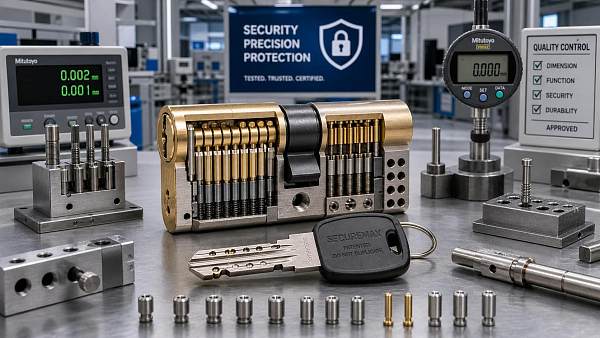
An anti-theft lock cylinder is a small component with a large security impact.
In real projects, cylinder failure does not only mean replacement cost. It can trigger intrusion risk, warranty claims, certification delays, and damaged brand trust.
That is why an anti-theft lock cylinder design manufacturer should be reviewed as an engineering partner, not just a price source.
The more security-critical the application is, the more this decision affects long-term performance.
Residential locks, protective doors, parcel locker systems, restricted commercial entries, and integrated access hardware all depend on cylinder consistency.
A weak cylinder design can compromise a strong lock body. A strong design, by contrast, can improve anti-picking resistance, anti-drill endurance, and service life.
Within the SHPS security intelligence landscape, mechanical lock cylinders sit beside safes, vaults, smart locks, access control, and protective infrastructure.
That broader context matters. Security hardware is rarely evaluated in isolation anymore.
More common questions today involve compliance readiness, export suitability, attack resistance, and how mechanical security fits into wider physical protection systems.
When comparing suppliers, what should be checked before discussing price?
A useful starting point is to separate visual claims from measurable capability.
Many suppliers can show polished drawings or attractive finishes. Fewer can explain how their anti-theft lock cylinder design performs under real attack conditions.
The first review usually needs five areas.
- Design architecture: pin-in-pin structure, side bar system, blade displacement, key profile complexity, and anti-bump features.
- Material selection: brass grades, hardened inserts, anti-drill steel elements, spring durability, and corrosion resistance.
- Manufacturing control: machining precision, tolerance management, plating stability, and assembly repeatability.
- Testing evidence: internal attack simulation, cycle testing, salt spray data, and third-party certification records.
- Project support: customization speed, sampling discipline, drawing confirmation, and change control.
This is where a capable anti-theft lock cylinder design manufacturer starts to stand out.
The stronger suppliers can explain why a structure resists picking, how a material improves drill resistance, and what tolerance range protects key operation stability.
They can also discuss application fit. A cylinder for a residential smart lock may require different priorities than one for a parcel locker or a protective door.
Before pricing, it helps to ask for a technical data pack, a sample validation path, and any available standard references.
A quick evaluation table for early screening
Early screening works better when requirements are visible and comparable.
How can you tell whether the manufacturer really understands security design?
A serious anti-theft lock cylinder design manufacturer talks about attack methods, not only features.
That difference is important. Security design begins with understanding how the cylinder may be picked, bumped, drilled, snapped, decoded, or worn into failure.
Good technical discussions usually include details such as false gates, mushroom pins, side pins, reinforced front sections, and keyway complexity.
Stronger engineering teams also explain trade-offs. For example, a more complex key system may improve resistance but affect machining cost, assembly time, and key duplication control.
In practical applications, design maturity also shows up in compatibility.
Can the cylinder fit different lock bodies? Can it work with electronic overlays or smart lock modules? Can key management be adapted for multi-site projects?
This matters across the wider SHPS ecosystem, where mechanical locking often works alongside biometric access, smart control, and building security integration.
A supplier with cross-category awareness usually gives better answers about system-level risk.
One useful test is to present a project scenario and ask what should change in the cylinder design.
If the answer changes intelligently by application, the supplier probably has real design depth.
Which standards, tests, and documents should be requested?
Not every project needs the same compliance package, but every project needs evidence.
For an anti-theft lock cylinder design manufacturer, the most useful documents often include test reports, material declarations, dimensional drawings, cycle life data, plating or corrosion reports, and quality inspection records.
Where export or high-security applications are involved, ask whether the supplier has experience supporting market-specific standards.
Even if the cylinder itself is one component, its performance may affect the full lockset’s certification path.
Needle-like claims such as “tested” or “certified material” are not enough.
More reliable documentation answers three questions clearly: what was tested, under which method, and on which design version.
It is also worth checking whether sample versions and mass production versions are controlled under the same revision standard.
This is a common blind spot. Some projects pass sample review but lose consistency during scale-up.
A disciplined supplier should provide revision tracking, critical dimension control points, and a clear nonconformance process.
Is the lowest quote ever the right choice for an anti-theft lock cylinder design manufacturer?
Usually not, especially when the project has security exposure or warranty sensitivity.
The quoted piece price is only one layer of cost.
A low-cost cylinder may create hidden expenses through field failures, key mismatch, plating defects, inconsistent torque, delayed approvals, or shortened replacement cycles.
A better cost review looks at total landed risk.
- Tooling or customization cost for profile changes
- Sampling time and engineering revision cycles
- Certification retest risk if designs change
- Reject rate during incoming inspection
- After-sales replacement and service disruption
- Lead-time instability during demand spikes
In many cases, the right anti-theft lock cylinder design manufacturer is not the cheapest one.
It is the supplier that keeps performance, quality, and delivery within predictable limits.
That predictability is valuable when the lock cylinder sits inside larger security programs, from mechanical door systems to smart property access infrastructure.
What mistakes appear most often during supplier selection?
One frequent mistake is judging security by key appearance alone.
A complicated key shape may look advanced while the internal resistance remains ordinary.
Another mistake is treating all anti-theft lock cylinder design manufacturers as interchangeable machining vendors.
Design logic, materials, assembly skill, and process control vary more than many buyers expect.
There is also a common timing issue. Security validation is often left too late, after drawings, finish, and pricing are already fixed.
That creates rework and slows launch schedules.
Another weak practice is ignoring ecosystem compatibility.
If the cylinder must fit smart lock housings, protective doors, parcel locker compartments, or restricted facility hardware, tolerance mismatch becomes expensive quickly.
Finally, some teams ask for samples but not for production evidence.
A sample can prove concept. It cannot prove manufacturing stability on its own.
A practical shortlist before final approval
Before confirming a supplier, these checkpoints usually reduce avoidable risk.
- Confirm the attack-resistance structure and not just the product label.
- Match cylinder design to the actual door, lock body, or access application.
- Review sample results against documented production controls.
- Check whether testing evidence matches the exact design revision.
- Compare total project cost, not unit price only.
- Ask how the supplier handles engineering change, defect response, and delivery fluctuation.
So how should the final decision be made?
The final decision should come from fit, evidence, and control.
Fit means the anti-theft lock cylinder design manufacturer understands the intended application and threat level.
Evidence means test data, material clarity, sample validation, and relevant project history are available.
Control means the supplier can reproduce the approved design consistently at scale.
That is the point where supplier evaluation becomes more than a sourcing exercise.
It becomes part of physical security risk management.
For teams working across the SHPS environment, that broader view is increasingly useful because mechanical security now intersects with compliance, smart access, and integrated infrastructure planning.
A sensible next step is to define the threat level, lock architecture, required test evidence, and acceptable lead time before comparing quotations.
Once those points are fixed, supplier comparison becomes clearer, faster, and far less vulnerable to misleading price signals.
Have questions about this sector analysis, or seeking best practices specific to your niche? Drop us a line below and let the senior consultants at MHLS assist you.
We respect your privacy. Your information is strictly confidential.
Recommended News
 Physical Security System Engineering: From Risk Assessment to System DesignUnmanned Terminal FellowExplore physical security system engineering, from risk assessment to integrated design, procurement and testing. Build a safer, more resilient facility.
 Apple Home Collection Smart Lock and Other Accessories Open for Preorder November 13Biometric Auth ScientistApple Home Collection preorders open November 13, 2026. Explore the LG smart lock’s Matter and Aliro support and what buyers should verify before ordering.
 Choosing Servo-Driven Flap Barriers: Throughput, Safety and Access ControlAccess Control StrategistServo-driven flap barriers can balance throughput, safety and access control. Discover how to compare lanes, test performance and choose with confidence.
 Parcel Locker Network Pricing: Setup Costs, Fees and Contract TermsUnmanned Terminal FellowCompare parcel locker networks pricing, from setup costs and recurring fees to contract terms. Discover hidden charges and choose the right model.
 JR East Plans UWB Walk-Through Gates at 40 Stations in Spring 2028Access Control StrategistJR East plans UWB walk-through gates at 40 stations in spring 2028. Explore the rollout timeline and what suppliers should watch.
 Bank Vault Security Standards: UL and EN Ratings ExplainedVault Structural ArchitectExplore bank vault security standards and learn how UL 608 classes and EN 1143-1 grades differ, what they test, and how to verify certification before you buy.
 Mechanical Lock Hardware Prices: What Buyers Should Budget for Bulk OrdersMr. Gideon CrossMechanical lock hardware price is just the starting point. Discover what drives bulk-order costs and how to compare supplier quotes with confidence.
 IndexBox Forecasts Steady Global Security Keypad Market Growth Through 2035Dr. Valerius ThorneGlobal security keypad market growth is forecast at 3.3% annually through 2035. Explore the smart home and replacement trends shaping demand.
 Choosing an Infrared Safety Sensors Manufacturer: What Buyers Should CheckUnmanned Terminal FellowChoosing an infrared safety sensors manufacturer? Compare safety evidence, integration, environmental performance and lifecycle costs before you buy.
 Choosing a Security Material Testing Service: What to Check for Lock and Safe MaterialsProf. Elara SterlingChoose a security material testing service with confidence. Learn what to check for lock and safe materials, from attack methods and accreditation to reliable reports.
 How Precision Anti-Pick Lock Cylinders Resist ManipulationSecurity Metallurgy ExpertDiscover how precision anti-pick lock technology resists manipulation, and learn what to check when comparing security features, test evidence, and everyday reliability.
 Dermalog Joins NIST FastCAP Program for Contactless Fingerprint TestingProf. Elara SterlingDermalog joins the NIST FastCAP program for contactless fingerprint testing. Discover what this means for biometric identification and digital identity.











