Mechanical Lock Cylinders for Commercial Buildings: Key Grades, Finishes, and Retrofit Factors
Mechanical Lock Cylinders for Commercial Buildings: Key Grades, Finishes, and Retrofit Factors

Selecting mechanical lock cylinders for commercial buildings is rarely a simple hardware choice.
It influences key control, maintenance cycles, replacement cost, and how smoothly future upgrades can happen.
That matters even more in offices, mixed-use towers, schools, healthcare sites, and logistics facilities.
In practice, mechanical lock cylinders for commercial buildings sit inside a broader security and lifecycle decision.
The wrong cylinder may still lock a door, yet create long-term problems with rekeying, finish durability, or hardware compatibility.
The better approach is to compare three things together: grade, finish, and retrofit limits.
Once those are clear, procurement becomes more defensible and deployment risk drops.
Why cylinder selection changes building risk
Commercial doors face heavier use than residential doors, and that alone changes the selection logic.
Open-close cycles are higher, user groups are larger, and master key hierarchies are usually more complex.
A cylinder also has to work with exit devices, mortise locks, lever sets, and access control interfaces.
Because of that, mechanical lock cylinders for commercial buildings must be judged beyond basic anti-pick claims.
The real questions are more operational.
- How well does the key system resist unauthorized duplication?
- Can the cylinder survive corrosion, cleaning chemicals, and frequent use?
- Will it fit existing door prep and lock body dimensions?
- Can future rekeying happen without replacing the full lockset?
These questions shape total ownership cost more than the initial cylinder price.
Understanding key grades and security tiers
Key grade discussions often get confused because regional standards and marketing language vary.
Some suppliers focus on ANSI or BHMA performance classes.
Others emphasize EN classifications, patent protection, or high-security pin architectures.
For commercial projects, it helps to separate grade from security features.
1. Performance grade
This usually refers to durability, cycle testing, torque resistance, and overall mechanical endurance.
Higher grades generally suit main entrances, shared tenant areas, and high-traffic service corridors.
2. Key control grade
This concerns restricted keyways, patent protection, and how tightly duplication can be managed.
For many buildings, this matters more than adding another visible anti-pick feature.
3. Attack resistance tier
Here the focus is picking, bumping, drilling, plug pulling, and destructive entry attempts.
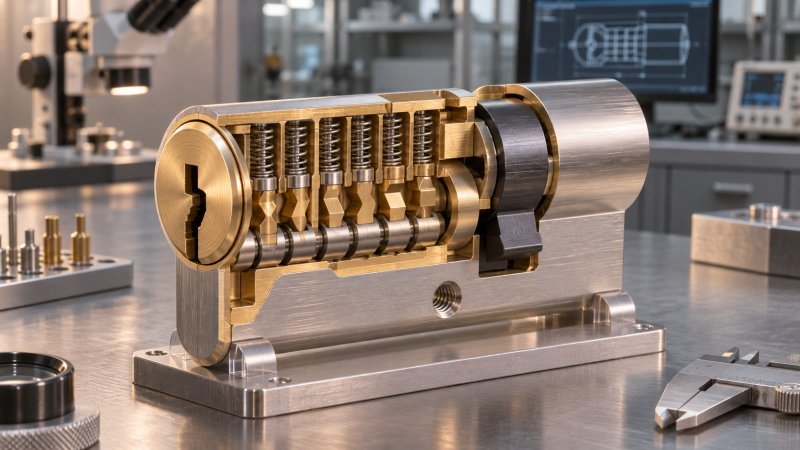
Features may include hardened inserts, spool pins, sidebars, pin-in-pin structures, and reinforced front sections.
When evaluating mechanical lock cylinders for commercial buildings, all three layers should be reviewed together.
A cylinder can score well on durability yet still leave weak key duplication control.
That gap becomes expensive when staff turnover, contractors, or multi-tenant access are involved.
Which cylinder formats are common in commercial projects
Format choice is just as important as grade.
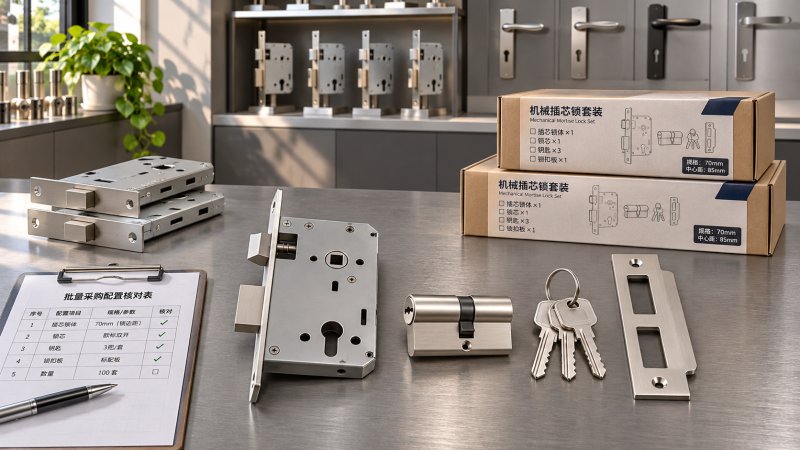
Common options include mortise cylinders, rim cylinders, euro profile cylinders, oval cylinders, and interchangeable core systems.
Each affects retrofit effort and maintenance workflow.
This is where many retrofit mistakes happen.
A strong cylinder still fails the project if cam geometry, tailpiece length, or backset relationships are overlooked.
How finishes affect durability and visual consistency
Finish selection is often treated as cosmetic, but that is too narrow.
For mechanical lock cylinders for commercial buildings, finish affects corrosion behavior, cleaning tolerance, and visual aging.
It also matters when matching lever hardware, escutcheons, and door closers across a project.
Popular commercial finishes
- Satin chrome: practical, neutral, and good at hiding wear.
- Stainless-look finishes: preferred for healthcare, transport, and harsh-use areas.
- Oil-rubbed or dark finishes: attractive, but scratches may show faster.
- Brass tones: suitable for heritage or hospitality projects, yet maintenance expectations rise.
Exterior doors need extra attention.
Moisture, salt air, UV exposure, and aggressive cleaners accelerate finish breakdown and can affect moving parts over time.
In real projects, the best finish is usually the one that stays acceptable after years of service, not the one that looks best on day one.
Retrofit factors that decide project success
Retrofit work is where technical selection meets field reality.
Even experienced teams run into avoidable issues when existing hardware records are incomplete.
Before ordering mechanical lock cylinders for commercial buildings, verify these points on site.
- Door thickness and cylinder length.
- Lock body brand, model, and handing.
- Cam type, tailpiece shape, and rotation angle.
- Fire door rating and code-related constraints.
- Master key structure and future expansion needs.
- Access control overlap with electronic credentials.
This last point is increasingly important.
Many buildings now combine mechanical backup with electronic access at selected doors.
That means cylinder choices should support a hybrid security plan rather than a standalone door view.
Procurement risks to watch before specification freeze
Several risks show up late because they are missed during submittal review.
- Restricted keyway claims without enforceable duplication policy.
- Imported cylinders with inconsistent dimensional tolerances.
- Finish mismatch across visible door hardware sets.
- No spare core, no service key plan, and no phased rekey strategy.
- Security features specified without evidence of testing or certification relevance.
A good specification asks for measurable performance and verified compatibility.
It should also define key management responsibilities after handover.
Without that, even high-grade mechanical lock cylinders for commercial buildings can lose practical security value.
A practical selection framework
A useful decision path keeps the evaluation grounded.
- Define door groups by risk, traffic, and user count.
- Match each group to a cylinder format and performance grade.
- Set the key control level based on turnover and access sensitivity.
- Choose finishes by environment, cleaning regime, and hardware palette.
- Confirm retrofit dimensions through field survey, not assumptions.
- Require sample approval or pilot installation for critical door sets.
This process keeps discussions practical and reduces late-site improvisation.
It also creates better alignment between security intent, procurement control, and maintenance planning.
Final takeaway
Choosing mechanical lock cylinders for commercial buildings is really about fit, not just strength.
The right answer combines tested durability, disciplined key control, appropriate finishes, and realistic retrofit planning.
When those factors are reviewed together, the specification becomes easier to defend and easier to maintain.
Before final approval, verify the existing hardware conditions, demand dimensional clarity, and align the cylinder system with long-term building access strategy.
That is usually the difference between a smooth retrofit and a costly correction cycle.
Have questions about this sector analysis, or seeking best practices specific to your niche? Drop us a line below and let the senior consultants at MHLS assist you.
We respect your privacy. Your information is strictly confidential.
Recommended News
 JR East Plans UWB Walk-Through Gates at 40 Stations in Spring 2028Access Control StrategistJR East plans UWB walk-through gates at 40 stations in spring 2028. Explore the rollout timeline and what suppliers should watch.
 Bank Vault Security Standards: UL and EN Ratings ExplainedVault Structural ArchitectExplore bank vault security standards and learn how UL 608 classes and EN 1143-1 grades differ, what they test, and how to verify certification before you buy.
 Mechanical Lock Hardware Prices: What Buyers Should Budget for Bulk OrdersMr. Gideon CrossMechanical lock hardware price is just the starting point. Discover what drives bulk-order costs and how to compare supplier quotes with confidence.
 IndexBox Forecasts Steady Global Security Keypad Market Growth Through 2035Dr. Valerius ThorneGlobal security keypad market growth is forecast at 3.3% annually through 2035. Explore the smart home and replacement trends shaping demand.
 Choosing an Infrared Safety Sensors Manufacturer: What Buyers Should CheckUnmanned Terminal FellowChoosing an infrared safety sensors manufacturer? Compare safety evidence, integration, environmental performance and lifecycle costs before you buy.
 Choosing a Security Material Testing Service: What to Check for Lock and Safe MaterialsProf. Elara SterlingChoose a security material testing service with confidence. Learn what to check for lock and safe materials, from attack methods and accreditation to reliable reports.
 How Precision Anti-Pick Lock Cylinders Resist ManipulationSecurity Metallurgy ExpertDiscover how precision anti-pick lock technology resists manipulation, and learn what to check when comparing security features, test evidence, and everyday reliability.
 Dermalog Joins NIST FastCAP Program for Contactless Fingerprint TestingProf. Elara SterlingDermalog joins the NIST FastCAP program for contactless fingerprint testing. Discover what this means for biometric identification and digital identity.
 Choosing Security Export Compliance Services: What Providers Should CoverMr. Gideon CrossSecurity export compliance services can help prevent costly delays. Discover what to look for in classification, licensing, screening, and documentation.
 European Security Compliance Standards for Safes: EN 1143-1 vs EN 14450Dr. Valerius ThorneExplore security compliance standards Europe buyers need to know. Compare EN 1143-1 and EN 14450 to choose the right safe with confidence.
 HID Global Acquires inepro ID to Expand RFID and BLE Access SolutionsUnmanned Terminal FellowHID Global acquires inepro ID to expand RFID and BLE access solutions for printers, smart lockers and shared devices. Explore what the deal could mean for your organization.
 Choosing Networked Hotel Lock Systems: Connectivity, Integration and SecurityBiometric Auth ScientistCompare networked hotel lock systems by connectivity, PMS integration and security. Learn what to test before choosing a system for your property.