
Pin Tumbler Lock Cylinders vs Dimple Cylinders: Security Differences and Buying Tips
When evaluating door security hardware, the difference between pin tumbler lock cylinders and dimple cylinders is more than a matter of key shape. It affects picking resistance, product positioning, installation compatibility, and long-term value across residential, commercial, and mixed-use projects.
For companies working across the physical security supply chain, this comparison matters because cylinder choice often sits at the intersection of risk control, budget discipline, and market demand. In many projects, pin tumbler lock cylinders remain the baseline. In others, dimple cylinders create a stronger argument around upgraded protection and key management.
The practical question is not which type is universally better. The real question is which cylinder structure fits the threat level, service environment, compliance target, and sales strategy behind a given opening.
Why this comparison matters in today’s security market
Mechanical cylinders still play a critical role, even as biometric locks, access control devices, and connected systems gain visibility. Many security openings still depend on durable mechanical cores, especially in retrofit projects and cost-sensitive installations.
Within the SHPS landscape, mechanical lock cylinders are not isolated products. They connect with protective doors, smart lock bodies, access control hardware, parcel locker systems, and broader physical security infrastructure.
That makes cylinder selection a commercial issue as well as a technical one. The right product can simplify stocking decisions, support project bidding, and reduce disputes over performance expectations.
A side-by-side visual often helps frame the discussion.
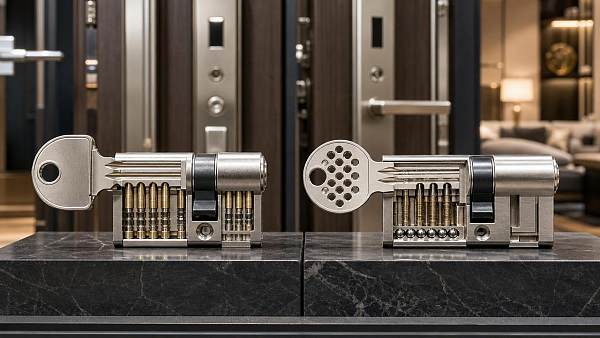
More importantly, end users increasingly ask about anti-picking features, anti-drill protection, and key duplication control. That is where the gap between standard pin tumbler lock cylinders and well-designed dimple systems becomes commercially relevant.
Understanding the two cylinder structures
Pin tumbler lock cylinders use a familiar mechanism. Spring-loaded top pins and bottom pins align at the shear line when the correct key is inserted. This basic architecture is widely used across global door hardware.
Dimple cylinders also rely on pin alignment, but the key usually features drilled dimples rather than edge cuts. Pins may be arranged vertically, horizontally, or on multiple axes, depending on the design.
In simple terms, both are pin-based systems. The difference is in key geometry, pin arrangement, tolerances, and the complexity of the locking interaction.
That distinction matters because a cylinder’s security level is rarely defined by one label alone. A low-grade dimple cylinder can underperform. A well-engineered pin tumbler lock cylinder with spool pins, hardened inserts, and restricted keyways can perform far above entry-level products.
Where the market often gets confused
Many buyers assume dimple always means high security. That is not automatically true. The actual outcome depends on manufacturing precision, internal pin design, anti-drill elements, material hardness, and key control policy.
Likewise, many assume pin tumbler lock cylinders are only basic products. In reality, the category ranges from low-cost residential cylinders to advanced pin-in-pin formats with strong anti-manipulation performance.
Security differences that deserve closer attention
From a sales and sourcing perspective, security differences should be judged by attack method, not by appearance. The most common concerns are picking, bumping, drilling, unauthorized key copying, and wear over time.
Picking resistance
Standard pin tumbler lock cylinders can be vulnerable if they use simple pins and loose tolerances. However, security pins, sidebars, paracentric keyways, and tighter machining significantly improve resistance.
Dimple cylinders often make picking more difficult because of multi-directional pin placement and more complex key profiles. Still, the advantage depends on the internal design, not the dimple key alone.
Bump resistance
Conventional pin tumbler lock cylinders may face greater bumping risk unless they include dedicated countermeasures. Enhanced spring systems and special pin formats can reduce that exposure.
Many dimple cylinders perform better here, especially those with side elements or non-standard pin geometry. But low-cost versions should never be assumed bump-proof without test evidence.
Drilling and physical attack
Both types can include hardened steel pins, anti-drill plates, and reinforced plugs. In physical security applications, these features often matter more than whether the cylinder is pin tumbler or dimple.
This is especially relevant for doors paired with burglary-resistant frames, security escutcheons, or higher-grade lock bodies. A good cylinder should not become the weakest point in an otherwise upgraded assembly.
Key control
This is where dimple cylinders often create stronger differentiation. Restricted key blanks, patented profiles, and controlled duplication systems are more common in premium dimple platforms.
Pin tumbler lock cylinders can also offer restricted keyways, but many standard formats are easier to duplicate in open retail markets. For projects where key authorization matters, this becomes a decisive factor.
How application context changes the answer
The better choice depends heavily on where the cylinder will be used. A residential retrofit, a property management portfolio, a logistics locker system, and a commercial perimeter door do not carry the same risk profile.
Pin tumbler lock cylinders often make sense when compatibility, service simplicity, and cost control are priorities. They are well suited to standard doors, broad inventory programs, and replacement cycles that require easy interchangeability.
Dimple cylinders usually fit better where unauthorized duplication, master key control, or perceived security upgrade is central to the offer. They are often favored in multi-tenant properties, offices, restricted areas, and upgraded entrance systems.
In integrated SHPS environments, cylinder selection may also influence the value of adjacent hardware. A premium lock body, protective door, or smart access layer can lose credibility if the mechanical core remains too easy to manipulate.
Typical use directions
- Standard residential doors often accept upgraded pin tumbler lock cylinders without major system changes.
- Apartment common areas may benefit from dimple cylinders with stronger key hierarchy control.
- Retail and light commercial openings usually need a balance between serviceability and tamper resistance.
- Higher-risk internal spaces may justify premium dimple platforms or advanced pin tumbler lock cylinders with restricted systems.
Buying tips that go beyond the catalog sheet
Catalog descriptions can hide major differences in real performance. A stronger buying approach is to evaluate cylinder families through technical evidence, service demands, and long-term supply reliability.
Check the internal security features
Ask whether the cylinder uses security pins, sidebars, anti-drill inserts, reinforced cam structures, or snap resistance features. For pin tumbler lock cylinders, these details often separate commodity products from credible security hardware.
Look at certification and test alignment
Where relevant, review cylinder performance against applicable local or export-market standards. Test data, durability cycles, and documented attack resistance are more useful than broad marketing claims.
Review key control policy carefully
A restricted system only creates value if duplication control is enforceable. Confirm how replacement keys are issued, who holds authorization, and whether the profile is truly protected in the target market.
Assess service and stocking practicality
Pin tumbler lock cylinders often win on stocking breadth and replacement speed. Dimple cylinders may require more deliberate inventory planning, especially when keyed systems and proprietary blanks are involved.
Match the cylinder to the full opening set
A cylinder should be judged together with the lock body, handle set, escutcheon, door material, and traffic level. Isolated comparison can lead to overbuying in low-risk sites or underprotecting important openings.
A practical way to make the final decision
A useful selection method is to sort opportunities into three layers: standard protection, controlled access, and elevated risk. This quickly shows whether basic pin tumbler lock cylinders are sufficient or whether a dimple platform adds justified value.
If the main goal is dependable replacement business, broad compatibility, and flexible pricing, upgraded pin tumbler lock cylinders can be a strong core offering. If the goal is stronger key discipline and clearer security differentiation, dimple cylinders often deserve a larger role.
The most reliable next step is to compare several cylinder families against the same checklist: attack resistance, key control, service model, certification status, and fit with the complete door solution. That framework makes future product decisions more consistent and easier to defend.
Have questions about this sector analysis, or seeking best practices specific to your niche? Drop us a line below and let the senior consultants at MHLS assist you.
We respect your privacy. Your information is strictly confidential.
Recommended News
 Parcel Locker Network Pricing: Setup Costs, Fees and Contract TermsUnmanned Terminal FellowCompare parcel locker networks pricing, from setup costs and recurring fees to contract terms. Discover hidden charges and choose the right model.
 JR East Plans UWB Walk-Through Gates at 40 Stations in Spring 2028Access Control StrategistJR East plans UWB walk-through gates at 40 stations in spring 2028. Explore the rollout timeline and what suppliers should watch.
 Bank Vault Security Standards: UL and EN Ratings ExplainedVault Structural ArchitectExplore bank vault security standards and learn how UL 608 classes and EN 1143-1 grades differ, what they test, and how to verify certification before you buy.
 Mechanical Lock Hardware Prices: What Buyers Should Budget for Bulk OrdersMr. Gideon CrossMechanical lock hardware price is just the starting point. Discover what drives bulk-order costs and how to compare supplier quotes with confidence.
 IndexBox Forecasts Steady Global Security Keypad Market Growth Through 2035Dr. Valerius ThorneGlobal security keypad market growth is forecast at 3.3% annually through 2035. Explore the smart home and replacement trends shaping demand.
 Choosing an Infrared Safety Sensors Manufacturer: What Buyers Should CheckUnmanned Terminal FellowChoosing an infrared safety sensors manufacturer? Compare safety evidence, integration, environmental performance and lifecycle costs before you buy.
 Choosing a Security Material Testing Service: What to Check for Lock and Safe MaterialsProf. Elara SterlingChoose a security material testing service with confidence. Learn what to check for lock and safe materials, from attack methods and accreditation to reliable reports.
 How Precision Anti-Pick Lock Cylinders Resist ManipulationSecurity Metallurgy ExpertDiscover how precision anti-pick lock technology resists manipulation, and learn what to check when comparing security features, test evidence, and everyday reliability.
 Dermalog Joins NIST FastCAP Program for Contactless Fingerprint TestingProf. Elara SterlingDermalog joins the NIST FastCAP program for contactless fingerprint testing. Discover what this means for biometric identification and digital identity.
 Choosing Security Export Compliance Services: What Providers Should CoverMr. Gideon CrossSecurity export compliance services can help prevent costly delays. Discover what to look for in classification, licensing, screening, and documentation.
 European Security Compliance Standards for Safes: EN 1143-1 vs EN 14450Dr. Valerius ThorneExplore security compliance standards Europe buyers need to know. Compare EN 1143-1 and EN 14450 to choose the right safe with confidence.
 HID Global Acquires inepro ID to Expand RFID and BLE Access SolutionsUnmanned Terminal FellowHID Global acquires inepro ID to expand RFID and BLE access solutions for printers, smart lockers and shared devices. Explore what the deal could mean for your organization.











