
Pin-in-Pin Lock Manufacturer Selection Guide: Security Features, Testing, and Compliance
Choosing a pin-in-pin lock manufacturer is less about catalog breadth and more about security credibility. In commercial doors, parcel locker systems, protective enclosures, and restricted access points, the cylinder is often a small component with outsized risk impact.
That is why technical review usually goes beyond key profiles and finish options. What matters is how the pin-in-pin structure resists manipulation, how consistently it is produced, how it performs after repeated cycles, and whether test evidence aligns with the application.
Within the broader SHPS landscape, pin-in-pin cylinders sit at the intersection of mechanical security, material engineering, compliance testing, and deployment reliability. They are relevant wherever physical access control must remain dependable even when digital layers fail or are not present.
Why Pin-in-Pin Designs Draw Attention
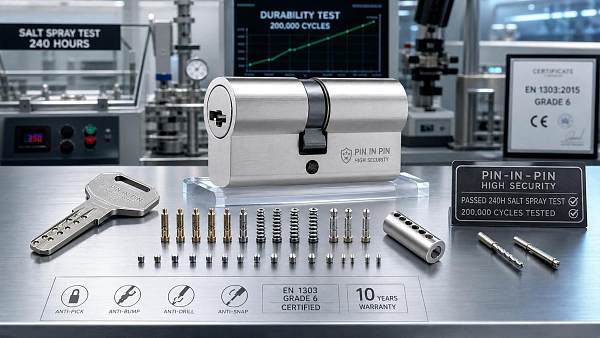
A pin-in-pin cylinder uses stacked or nested pin elements to create more complex key interaction. In practical terms, that added complexity can improve resistance to picking, impressioning, and unauthorized key duplication when the design is executed well.
The phrase “when executed well” matters. A weak pin-in-pin lock manufacturer can turn an advanced concept into a marketing label. Tolerances, spring behavior, chamber finishing, plug hardness, and keyway discipline determine whether the design performs in the field.
This is also why the segment appears frequently in discussions around high-security cylinders, anti-picking hardware, and layered physical protection. It supports doors, cabinets, key switches, lockers, and integrated security hardware where attack delay is commercially meaningful.
What a Serious Evaluation Should Cover
A capable pin-in-pin lock manufacturer should be judged on structure, not claims. Security performance begins with the internal architecture and extends through manufacturing control, testing discipline, and documentation quality.
Core security features
- Multi-element pin geometry that complicates conventional picking feedback.
- Restricted keyway control and controlled blank distribution.
- Hardened inserts or anti-drill components in the plug and housing.
- Balanced spring design to reduce manipulation predictability.
- Tight machining tolerances across chambers, pins, and key cuts.
It is useful to ask which features are standard and which are optional. Some suppliers show advanced anti-drill pins or patent-oriented key control in premium series only, while standard models remain closer to conventional cylinders.
Manufacturing consistency
Consistency is where many supplier comparisons become clearer. One batch may pass a bench test, yet field failure appears later through burrs, spring fatigue, plug drag, rough key insertion, or uneven shear-line behavior.
A reliable pin-in-pin lock manufacturer should be able to explain material grades, heat treatment practice, plating control, lubrication approach, and dimensional inspection methods. If that information is vague, long-term performance is harder to trust.
Testing Evidence Matters More Than Product Language
In physical security, test language can sound impressive without saying much. “High security,” “anti-theft,” and “tamper resistant” are too broad on their own. A technical review needs defined methods, limits, and traceable results.
For a pin-in-pin lock manufacturer, useful evidence often includes cycle testing, attack resistance assessment, corrosion performance, key duplication control, and dimensional repeatability records. Third-party reports carry more weight than internal summaries alone.
Practical test questions
- How many operating cycles were completed, and under what load conditions?
- Was picking resistance tested by an accredited body or only in-house?
- Were drill attacks evaluated with hardened plates, inserts, or bare cylinders?
- What corrosion standard was used for coastal or humid deployment?
- Were failures analyzed by lot number and corrective action records?
This level of detail is especially important for export projects, public infrastructure, financial environments, and multi-site commercial deployment. A cylinder chosen for appearance or price can become expensive if maintenance calls, rekeying events, or forced-entry exposure rise later.
Reading Compliance in Context
Compliance should not be reduced to a logo on a datasheet. The useful question is whether the tested configuration matches the delivered cylinder, hardware set, and installation environment.
Depending on market and application, evaluation may reference EN standards for cylinders and building hardware, fire door compatibility requirements, corrosion classifications, or project-specific buyer specifications. In some cases, insurance expectations also shape the required evidence.
SHPS often frames this correctly across adjacent categories such as safes, protective doors, and access control equipment: certification readiness is not abstract. It affects market entry, tender eligibility, warranty exposure, and system credibility.
Where Supplier Differences Become Visible
Two suppliers may both present a pin-in-pin platform, yet their business suitability can be very different. The gap often appears in engineering responsiveness, customization boundaries, and project discipline rather than in headline specifications.
For example, protective doors and commercial access points may require cylinder integration with escutcheons, panic hardware, master key planning, weather resistance, and fire-rated assemblies. Smart parcel lockers may demand compact formats, frequent cycles, and reliable serviceability.
A strong pin-in-pin lock manufacturer usually understands those interfaces. It can discuss cam options, tailpiece variations, modular length solutions, keying hierarchy, and packaging for international distribution without treating each request as an exception.
Common deployment contexts
- Commercial buildings needing durable keyed access with moderate to high attack concern.
- Restricted rooms where mechanical backup remains critical.
- Parcel locker networks requiring repeatable cycle endurance and service control.
- Protective doors and equipment housings exposed to tampering risk.
- Regional export programs needing documentation, consistency, and scalable supply.
Questions That Improve Selection Quality
A productive review meeting is rarely about broad claims. It is about whether the pin-in-pin lock manufacturer can answer precise questions with stable evidence.
Useful questions include batch traceability, key blank control, patent or exclusivity arrangements, compatibility with master key systems, and lead times for replacement cylinders. These details affect operational risk just as much as the internal pin design.
It is also worth checking whether samples reflect regular production. Hand-selected engineering samples may feel excellent, while volume output tells a different story. Independent sample pulls, teardown review, and small pilot deployment can reveal that gap early.
A practical short list
- Request attack and durability evidence for the exact cylinder family.
- Confirm whether compliance applies to the delivered configuration.
- Review key control policy, not just key profile drawings.
- Inspect machining quality on random samples, not presentation units.
- Compare support for rekeying, spare parts, and field replacement.
What to Do Next
A good pin-in-pin lock manufacturer should fit the risk profile, operating environment, and documentation needs of the project. That means aligning security features, service life expectations, compliance scope, and supply discipline before price becomes the final filter.
For a sharper comparison, start with an application map. Define attack risk, cycle volume, environmental exposure, key control sensitivity, and regional compliance needs. Then compare suppliers against those conditions rather than against generic product language.
In the SHPS context, that approach is usually the most reliable one. Mechanical lock cylinders are not isolated products. They sit inside a larger physical security system, and the right selection depends on how well the manufacturer can support that wider security logic.
Have questions about this sector analysis, or seeking best practices specific to your niche? Drop us a line below and let the senior consultants at MHLS assist you.
We respect your privacy. Your information is strictly confidential.
Recommended News
 Physical Security System Engineering: From Risk Assessment to System DesignUnmanned Terminal FellowExplore physical security system engineering, from risk assessment to integrated design, procurement and testing. Build a safer, more resilient facility.
 Apple Home Collection Smart Lock and Other Accessories Open for Preorder November 13Biometric Auth ScientistApple Home Collection preorders open November 13, 2026. Explore the LG smart lock’s Matter and Aliro support and what buyers should verify before ordering.
 Choosing Servo-Driven Flap Barriers: Throughput, Safety and Access ControlAccess Control StrategistServo-driven flap barriers can balance throughput, safety and access control. Discover how to compare lanes, test performance and choose with confidence.
 Parcel Locker Network Pricing: Setup Costs, Fees and Contract TermsUnmanned Terminal FellowCompare parcel locker networks pricing, from setup costs and recurring fees to contract terms. Discover hidden charges and choose the right model.
 JR East Plans UWB Walk-Through Gates at 40 Stations in Spring 2028Access Control StrategistJR East plans UWB walk-through gates at 40 stations in spring 2028. Explore the rollout timeline and what suppliers should watch.
 Bank Vault Security Standards: UL and EN Ratings ExplainedVault Structural ArchitectExplore bank vault security standards and learn how UL 608 classes and EN 1143-1 grades differ, what they test, and how to verify certification before you buy.
 Mechanical Lock Hardware Prices: What Buyers Should Budget for Bulk OrdersMr. Gideon CrossMechanical lock hardware price is just the starting point. Discover what drives bulk-order costs and how to compare supplier quotes with confidence.
 IndexBox Forecasts Steady Global Security Keypad Market Growth Through 2035Dr. Valerius ThorneGlobal security keypad market growth is forecast at 3.3% annually through 2035. Explore the smart home and replacement trends shaping demand.
 Choosing an Infrared Safety Sensors Manufacturer: What Buyers Should CheckUnmanned Terminal FellowChoosing an infrared safety sensors manufacturer? Compare safety evidence, integration, environmental performance and lifecycle costs before you buy.
 Choosing a Security Material Testing Service: What to Check for Lock and Safe MaterialsProf. Elara SterlingChoose a security material testing service with confidence. Learn what to check for lock and safe materials, from attack methods and accreditation to reliable reports.
 How Precision Anti-Pick Lock Cylinders Resist ManipulationSecurity Metallurgy ExpertDiscover how precision anti-pick lock technology resists manipulation, and learn what to check when comparing security features, test evidence, and everyday reliability.
 Dermalog Joins NIST FastCAP Program for Contactless Fingerprint TestingProf. Elara SterlingDermalog joins the NIST FastCAP program for contactless fingerprint testing. Discover what this means for biometric identification and digital identity.











