
How to Choose Security Door Hardware for Commercial Buildings by Traffic and Risk Level
How to Choose Security Door Hardware for Commercial Buildings by Traffic and Risk Level
Choosing security door hardware for commercial buildings is not just about locks and closers.
It starts with how people move, what assets need protection, and how much risk each entry point carries.
A busy office lobby needs different hardware than a data room, cash office, or restricted back-of-house corridor.
That is why security door hardware for commercial buildings should be selected through a traffic-and-risk framework, not by price alone.
The right choice improves safety, supports compliance, reduces downtime, and lowers replacement costs over time.
Start with Traffic Patterns and Entry Behavior
Before comparing products, map how each door is used during a normal day.
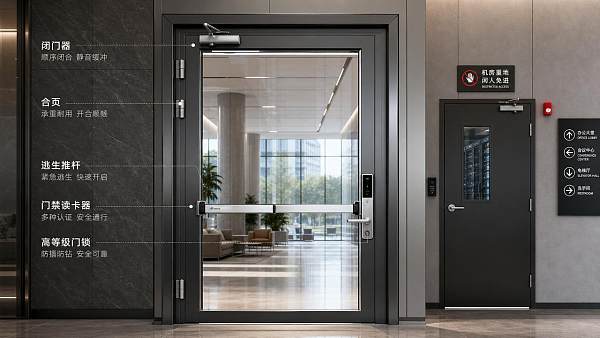
Look at opening frequency, peak-hour congestion, user type, delivery access, after-hours activity, and emergency egress requirements.
In practical terms, traffic affects wear, closing force, latch performance, and lock reliability.
High-cycle doors usually fail earlier when standard-grade hardware is used in demanding environments.
This is where many projects go wrong.
They buy one specification for the whole building, even though traffic conditions vary sharply from one area to another.
Three common traffic categories
- Low traffic: storage rooms, private offices, utility spaces, and internal management areas.
- Medium traffic: staff entrances, tenant corridors, meeting floors, and shared service doors.
- High traffic: main entrances, retail access points, healthcare corridors, and loading-adjacent passages.
Once this baseline is clear, security door hardware for commercial buildings becomes easier to specify with confidence.
Assess Risk Level Before Choosing Hardware Grade
Traffic tells you how hard the hardware will work.
Risk level tells you how strong the hardware must be.
A low-traffic door can still need high-security hardware if it protects sensitive records, pharmaceuticals, cash, or network infrastructure.
For that reason, commercial door hardware selection should include both operational and threat analysis.
Questions that define risk
- What assets sit behind the door?
- How attractive is the area to forced entry or unauthorized access?
- Does the site operate late at night or with reduced staffing?
- Will the door connect to public zones, parking, or delivery routes?
- Are there insurance, fire, life-safety, or access control requirements?
A simple risk framework
Low-risk openings often focus on durability and code compliance.
Medium-risk openings need stronger cylinders, better strike reinforcement, and controlled access capability.
High-risk openings need multi-layer protection, tighter credential control, and resistance to attack, abuse, and manipulation.
This is the point where security door hardware for commercial buildings shifts from a maintenance item to a security investment.
Match Hardware Types to Traffic and Risk
Different components solve different problems.
A good specification balances mechanical strength, access control, user convenience, and service life.
Locks and cylinders
For lower-risk areas, a quality commercial mortise or cylindrical lock may be enough.
For higher-risk zones, look for anti-pick, anti-drill, and key-control features in the cylinder system.
Where audit trails matter, electronic locks or smart credentials become more practical than traditional key hierarchies.
Door closers and hinges
High-traffic openings need heavy-duty closers designed for frequent cycling and predictable latch control.
Weak closers cause slam issues, incomplete latching, and accelerated wear on locks and frames.
Hinges also matter more than many buyers expect.
Load-bearing performance directly affects alignment, seal integrity, and long-term hardware reliability.
Exit devices and panic hardware
For assembly spaces, schools, healthcare sites, and many public-facing buildings, panic hardware is often essential.
Here, security door hardware for commercial buildings must support fast egress without creating uncontrolled entry.
Electrified exit devices can help balance both needs when integrated correctly with access control.
Readers, credentials, and monitoring
In medium- and high-risk environments, mechanical hardware alone rarely covers the full requirement.
Credential readers, door position sensors, request-to-exit devices, and alarm reporting add visibility and control.
This becomes especially valuable in multi-tenant buildings, logistics sites, and facilities with shift-based access.
Use a Practical Selection Matrix
A simple matrix helps procurement teams avoid overbuying in low-risk areas and underprotecting sensitive doors.
This kind of matrix turns broad discussion into a clearer buying decision.
It also helps suppliers propose security door hardware for commercial buildings with better alignment to actual use conditions.
Check Compliance, Lifecycle Cost, and Integration
Product selection should not stop at performance claims.
Verify fire rating compatibility, life-safety rules, local code requirements, and door-frame-hardware coordination.
Many hardware failures come from poor system matching, not weak parts alone.
For example, a strong lock cannot perform well on a weak frame or misaligned door leaf.
What buyers should compare
- Cycle testing and durability rating
- Resistance to picking, drilling, or forced entry
- Compatibility with access control platforms
- Maintenance intervals and spare-part availability
- Total installed cost, not unit price only
From a long-term cost perspective, reliable security door hardware for commercial buildings often wins through fewer failures and less disruption.
That matters even more in hospitals, office towers, campuses, and mixed-use developments where downtime creates operational friction.
Common Procurement Mistakes to Avoid
Several mistakes appear again and again in commercial projects.
- Using the same hardware package for every opening.
- Choosing by upfront price instead of service life.
- Ignoring after-hours threat exposure.
- Overlooking frame reinforcement and installation quality.
- Adding smart access without checking mechanical backup strategy.
Avoiding these mistakes usually does not require a bigger budget.
It requires better classification, better supplier questions, and a more realistic view of daily use.
A Smarter Way to Specify Security Door Hardware for Commercial Buildings
The best approach is straightforward.
List every opening, group it by traffic level, score its risk, and then match hardware to function and threat profile.
That process creates more accurate budgets and fewer surprises after installation.
It also leads to stronger physical security outcomes because each door gets the protection it actually needs.
When security door hardware for commercial buildings is chosen through traffic, risk, compliance, and lifecycle cost, procurement becomes more disciplined and far more effective.
If the next purchase decision involves mixed-use property, office space, retail access, or restricted infrastructure, start with the opening profile first, then buy hardware that fits the reality of the site.
Have questions about this sector analysis, or seeking best practices specific to your niche? Drop us a line below and let the senior consultants at MHLS assist you.
We respect your privacy. Your information is strictly confidential.
Recommended News
 Physical Security Infrastructure Cost: Budgeting for Installation and MaintenanceUnmanned Terminal FellowUnderstand physical security infrastructure cost and build a smarter budget for installation, maintenance, and long-term ownership.
 Financial Facility Security: Choosing Vault Doors for Bank BranchesVault Structural ArchitectStrengthen financial facility security with the right bank vault door. Explore certification, installation, locking controls and maintenance before you buy.
 MACO Acquires Majority Stake in Fingerprint Access Provider ekeyProf. Elara SterlingMACO acquires a majority stake in ekey, bringing fingerprint access and door hardware closer together. Discover what the deal could mean for smart buildings.
 Physical Security System Engineering: From Risk Assessment to System DesignUnmanned Terminal FellowExplore physical security system engineering, from risk assessment to integrated design, procurement and testing. Build a safer, more resilient facility.
 Apple Home Collection Smart Lock and Other Accessories Open for Preorder November 13Biometric Auth ScientistApple Home Collection preorders open November 13, 2026. Explore the LG smart lock’s Matter and Aliro support and what buyers should verify before ordering.
 Choosing Servo-Driven Flap Barriers: Throughput, Safety and Access ControlAccess Control StrategistServo-driven flap barriers can balance throughput, safety and access control. Discover how to compare lanes, test performance and choose with confidence.
 Parcel Locker Network Pricing: Setup Costs, Fees and Contract TermsUnmanned Terminal FellowCompare parcel locker networks pricing, from setup costs and recurring fees to contract terms. Discover hidden charges and choose the right model.
 JR East Plans UWB Walk-Through Gates at 40 Stations in Spring 2028Access Control StrategistJR East plans UWB walk-through gates at 40 stations in spring 2028. Explore the rollout timeline and what suppliers should watch.
 Bank Vault Security Standards: UL and EN Ratings ExplainedVault Structural ArchitectExplore bank vault security standards and learn how UL 608 classes and EN 1143-1 grades differ, what they test, and how to verify certification before you buy.
 Mechanical Lock Hardware Prices: What Buyers Should Budget for Bulk OrdersMr. Gideon CrossMechanical lock hardware price is just the starting point. Discover what drives bulk-order costs and how to compare supplier quotes with confidence.
 IndexBox Forecasts Steady Global Security Keypad Market Growth Through 2035Dr. Valerius ThorneGlobal security keypad market growth is forecast at 3.3% annually through 2035. Explore the smart home and replacement trends shaping demand.
 Choosing an Infrared Safety Sensors Manufacturer: What Buyers Should CheckUnmanned Terminal FellowChoosing an infrared safety sensors manufacturer? Compare safety evidence, integration, environmental performance and lifecycle costs before you buy.











