
How to Select Server Room Turnstiles Without Disrupting Emergency Egress
How to Select Server Room Turnstiles Without Disrupting Emergency Egress
Selecting server room turnstiles is primarily a life-safety and integration decision, not simply an access-control purchase. The barrier must secure critical infrastructure while remaining unobstructed during an emergency.
For technical evaluators, the central question is straightforward: can every authorized person leave immediately when alarms activate, power fails, or conditions become unsafe inside the facility?
A well-specified system combines anti-tailgating performance, reliable credential validation, fire-alarm interfaces, emergency release logic, safe lane geometry, and documented commissioning procedures. Missing any one element can create unacceptable operational risk.
Server rooms require tighter access control than typical offices, but their occupants still depend on the building's approved egress strategy. Security controls must never override that strategy.
Start With the Emergency Egress Design, Not the Turnstile Catalog
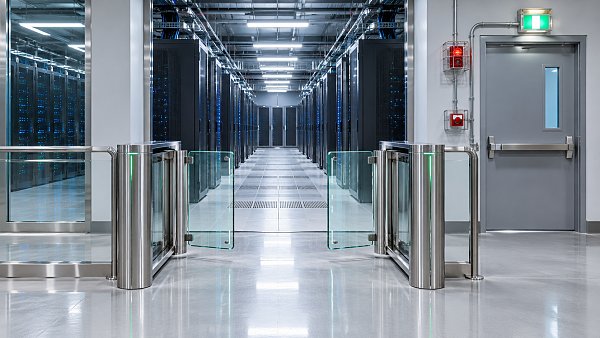
Before comparing server room turnstiles, obtain the approved fire and life-safety drawings, occupancy assumptions, emergency routes, and authority requirements for the specific building and room location.
Technical teams should confirm whether the turnstile is located inside the server room, at a data-hall entrance, within a corridor, or at a larger restricted-area perimeter.
These locations have different implications for exit capacity, travel distance, door hardware, evacuation routing, smoke compartments, and the way building occupants will respond under pressure.
A turnstile should not become the sole required exit path unless the local code, fire engineer, building authority, and approved egress design explicitly permit that arrangement.
In many deployments, the practical approach is a controlled turnstile entry lane paired with a separate, clearly identified emergency egress door using approved panic hardware.
This arrangement allows strong identity verification on entry without depending on access-control electronics, reader availability, or barrier motion for life-safety exit performance.
Where a turnstile lane is part of an exit route, evaluators must establish exactly how it opens, who commands release, and whether its released position provides sufficient clear width.
Do not assume that an advertised “emergency mode” satisfies local requirements. Request the manufacturer’s wiring documentation, physical-clearance drawings, test evidence, and application-specific reference installations.
Verify Fail-Safe Behavior During Power Loss and Alarm Events
Fail-safe behavior means the barrier moves or remains in a position that permits egress when normal electrical control is unavailable. This is normally the baseline expectation for emergency routes.
However, fail-safe is not a universal product setting. Different server room turnstiles may use retracting wings, dropping arms, unlocked swing barriers, or mechanically free passage after release.
Ask suppliers to describe the exact state after mains loss, controller failure, network loss, fire-panel alarm, emergency push-button activation, and loss of auxiliary battery power.
These events should be treated separately. A turnstile may remain operational during a network outage while still releasing properly after a hardwired fire alarm or complete electrical failure.
Fire alarm activation should generally be hardwired through supervised interfaces rather than dependent on cloud services, access-control software, or a network command reaching the lane controller.
Technical evaluators should also determine whether release is latched. A briefly triggered relay output may be insufficient if the fire alarm remains active and the barrier attempts to resecure.
The preferred emergency state must remain stable for the duration required by the building’s emergency procedures. Restoration should require a deliberate reset after personnel confirm conditions are safe.
Battery backup can maintain controlled operation during short outages, but it should not be used to justify a design that traps occupants when batteries degrade or fail.
Require a documented power-failure test with normal loads removed. Observe the barrier physically, rather than accepting only a control-panel status message or supplier demonstration video.
Assess Lane Geometry and Clear Passage Under Real Evacuation Conditions
Turnstile security is often optimized around narrow, controlled lanes. Emergency egress requires the opposite perspective: predictable movement, clear passage, and minimal hesitation for people leaving quickly.
Evaluate the available opening after emergency release, not only the nominal lane width shown in product brochures. Moving panels, cabinets, posts, and adjacent walls can reduce usable clearance.
Consider whether an operator carrying tools, a laptop bag, protective equipment, or a small equipment case can pass without becoming delayed or striking the barrier structure.
Data center and server-room personnel may include contractors, maintenance specialists, security responders, and visitors who are less familiar with the layout than permanent staff.
That makes intuitive route design important. A released barrier must visibly communicate that passage is available, even in low lighting, alarm noise, or a stressful evacuation.
For high-density technical spaces, calculate egress capacity using the building design basis rather than everyday headcount. Incident response, maintenance work, and adjacent-area evacuations can increase demand.
Also assess the physical route beyond the turnstile. A wide released lane provides little benefit if it leads immediately to a locked door, equipment obstruction, narrow corridor, or dead-end path.
When a separate emergency door is present, its placement must be obvious and reachable without requiring users to understand the turnstile’s release mode or access-control workflow.
Choose Anti-Tailgating Features That Do Not Create Unsafe Entrapment Risk
Anti-tailgating is a valid requirement for server room access, especially where racks, network hardware, backup media, and privileged administrative systems are protected behind the barrier.
Yet aggressive tailgating detection can create problems if the system responds by closing rapidly, alarming excessively, or trying to isolate a person during an emergency release condition.
Evaluate detection technologies such as infrared sensor arrays, stereo vision, time-of-flight sensing, weight analysis, and passage-sequencing logic according to the actual threat model.
For most server-room entrances, the goal is to detect and document unauthorized following, then alert security or deny entry. Physical containment should not compromise safe exit.
Ask vendors how the lane responds when two people attempt passage from opposite directions. Bidirectional movement can occur during incidents, especially when responders enter as occupants leave.
The system should distinguish ordinary access violations from emergency conditions. Fire-alarm release must take precedence over anti-tailgating logic, local alarms, credential checks, and access-control schedules.
Sensor coverage should also protect against contact with retracting or swinging elements. Safety sensors need to detect people, not merely confirm that a credential transaction occurred.
During acceptance testing, run realistic scenarios involving close following, reverse movement, stopped users, dropped items, mobility aids, and responders entering against normal traffic direction.
Integrate Fire Alarm, Access Control, and Local Emergency Controls Correctly
Emergency egress depends on interfaces between separate systems. A reliable turnstile installation must coordinate the lane controller, access-control panel, fire alarm system, emergency buttons, and facility procedures.
Define the release signal source, electrical supervision method, relay polarity, cable pathway, and fault behavior in the design specification. Ambiguity here frequently appears during commissioning.
Fire alarm integration should be designed and approved by qualified fire-life-safety professionals. Security integrators should not independently reinterpret fire-alarm requirements to fit a preferred turnstile model.
Local emergency release devices may be required near the controlled area. Their location, labeling, accessibility, reset method, and protective cover requirements should match the approved emergency design.
A manual release device must be useful when the access-control server, building network, or central monitoring platform is unavailable. Avoid designs requiring a remote operator to unlock the lane.
Confirm whether the turnstile controller monitors the release circuit for open circuits, short circuits, or communication faults. A supervised connection improves fault visibility before an emergency occurs.
Integration testing should include the real fire panel and final wiring. Bench testing with a generic relay does not prove that the installed system releases properly under all programmed alarm states.
Document cause-and-effect matrices showing what happens after each alarm input. This gives security, facilities, and compliance teams a shared basis for future modifications and incident investigations.
Match the Turnstile Type to the Server Room Risk Profile
Not every restricted technical area needs the same barrier. Selecting server room turnstiles should begin with asset criticality, visitor volume, staffing patterns, and the consequences of unauthorized entry.
Optical speed gates can provide a professional appearance and fast authorized passage, but their suitability depends on lane width, tailgating detection performance, and emergency wing-release behavior.
Full-height turnstiles offer stronger physical deterrence in some perimeter applications, but they are rarely appropriate as the only egress arrangement for occupied interior server areas.
Waist-high tripod turnstiles are economical, yet they can restrict evacuation flow and may be unsuitable where tool bags, equipment transport, accessibility requirements, or emergency routes are involved.
Retractable flap barriers are commonly considered for corporate data halls because they can support credential workflows while opening a wider passage during configured emergency release events.
For highly sensitive rooms, combine the turnstile with a secure door, mantrap, interlock vestibule, video verification, or staffed security process rather than overloading one lane with every function.
Biometric authentication may improve identity assurance, but it should be evaluated separately from egress. A biometric reader may control entry while exit remains free and immediately available.
Technical specifications should distinguish anti-passback, anti-tailgating, identity verification, intrusion alarm, and emergency release. Treating them as one feature creates incomplete procurement requirements.
Build Emergency Testing Into Procurement and Site Acceptance
A supplier quotation is not evidence that a turnstile will work safely in the completed facility. Emergency performance must be verified through factory review, installation checks, and site acceptance tests.
Include measurable emergency-release requirements in the request for proposal. Specify the required released state, maximum release time, clear opening, alarm inputs, and restoration procedure.
Require suppliers to identify dependencies such as controller firmware, optional emergency boards, external power supplies, mechanical overrides, or particular access-control interface modules needed for compliance.
At site acceptance, test normal access first, then test emergency release from every required source. Record the time from alarm initiation to unobstructed passage for each installed lane.
Test with the final barrier configuration, including cabinets, readers, card pedestals, visitor gates, signage, and any nearby doors. Small layout changes can alter actual egress usability.
Involve facilities, security, IT, the fire-safety representative, installers, and operational users. Each team sees different failure modes that may be missed by a product-focused inspection.
Create a periodic inspection program after handover. Check fire-alarm interfaces, emergency buttons, battery condition, sensor alignment, mechanical movement, signage, and reset procedures on a defined schedule.
Changes to access-control software, fire-alarm programming, room layouts, or turnstile firmware should trigger regression testing. Emergency release behavior is a system-level outcome, not a static product attribute.
Use a Practical Technical Evaluation Checklist
Technical evaluators can reduce procurement risk by requiring a concise, evidence-based checklist rather than relying on broad claims about compliance, intelligent security, or emergency functionality.
First, confirm whether the planned turnstile location is part of a required emergency exit route. Obtain written confirmation from the responsible building and life-safety authorities.
Second, define the barrier’s exact fail-safe state after power loss and every emergency signal. Include released width, barrier position, reset method, and behavior during persistent alarms.
Third, verify that fire alarm release is hardwired, correctly supervised where required, and independent of network availability. Confirm that emergency release overrides normal security logic.
Fourth, assess clear passage with realistic user conditions, equipment, adjacent circulation, and accessibility needs. Drawings should show the complete route, not only the turnstile lane dimensions.
Fifth, review anti-tailgating settings and sensor behavior. Confirm that security responses cannot close, block, or confuse occupants during an alarm-driven evacuation event.
Sixth, require factory documentation, interface schematics, maintenance instructions, and site test records. Retain these documents with the facility’s life-safety and security system records.
Finally, assign ownership after installation. Security may manage authorization, but facilities and life-safety teams need clear responsibility for testing emergency release and approving system changes.
Conclusion: Secure Entry Must Never Delay a Safe Exit
The best server room turnstiles balance restricted access with dependable emergency egress. Their value comes from correctly engineered release behavior, not simply from high throughput or sophisticated credentials.
Technical evaluators should begin with the approved egress design, then select a barrier whose mechanical configuration and control interfaces support that design without exceptions or hidden dependencies.
A separate compliant exit door is often the clearest solution, while turnstiles protect controlled entry. Where barriers affect an exit route, rigorous engineering review and testing are essential.
By verifying fail-safe operation, fire-alarm integration, lane clearance, sensor behavior, and acceptance testing, organizations can protect critical server infrastructure without creating an avoidable emergency egress hazard.
Have questions about this sector analysis, or seeking best practices specific to your niche? Drop us a line below and let the senior consultants at MHLS assist you.
We respect your privacy. Your information is strictly confidential.
Recommended News
 Financial Facility Security: Choosing Vault Doors for Bank BranchesVault Structural ArchitectStrengthen financial facility security with the right bank vault door. Explore certification, installation, locking controls and maintenance before you buy.
 MACO Acquires Majority Stake in Fingerprint Access Provider ekeyProf. Elara SterlingMACO acquires a majority stake in ekey, bringing fingerprint access and door hardware closer together. Discover what the deal could mean for smart buildings.
 Physical Security System Engineering: From Risk Assessment to System DesignUnmanned Terminal FellowExplore physical security system engineering, from risk assessment to integrated design, procurement and testing. Build a safer, more resilient facility.
 Apple Home Collection Smart Lock and Other Accessories Open for Preorder November 13Biometric Auth ScientistApple Home Collection preorders open November 13, 2026. Explore the LG smart lock’s Matter and Aliro support and what buyers should verify before ordering.
 Choosing Servo-Driven Flap Barriers: Throughput, Safety and Access ControlAccess Control StrategistServo-driven flap barriers can balance throughput, safety and access control. Discover how to compare lanes, test performance and choose with confidence.
 Parcel Locker Network Pricing: Setup Costs, Fees and Contract TermsUnmanned Terminal FellowCompare parcel locker networks pricing, from setup costs and recurring fees to contract terms. Discover hidden charges and choose the right model.
 JR East Plans UWB Walk-Through Gates at 40 Stations in Spring 2028Access Control StrategistJR East plans UWB walk-through gates at 40 stations in spring 2028. Explore the rollout timeline and what suppliers should watch.
 Bank Vault Security Standards: UL and EN Ratings ExplainedVault Structural ArchitectExplore bank vault security standards and learn how UL 608 classes and EN 1143-1 grades differ, what they test, and how to verify certification before you buy.
 Mechanical Lock Hardware Prices: What Buyers Should Budget for Bulk OrdersMr. Gideon CrossMechanical lock hardware price is just the starting point. Discover what drives bulk-order costs and how to compare supplier quotes with confidence.
 IndexBox Forecasts Steady Global Security Keypad Market Growth Through 2035Dr. Valerius ThorneGlobal security keypad market growth is forecast at 3.3% annually through 2035. Explore the smart home and replacement trends shaping demand.
 Choosing an Infrared Safety Sensors Manufacturer: What Buyers Should CheckUnmanned Terminal FellowChoosing an infrared safety sensors manufacturer? Compare safety evidence, integration, environmental performance and lifecycle costs before you buy.
 Choosing a Security Material Testing Service: What to Check for Lock and Safe MaterialsProf. Elara SterlingChoose a security material testing service with confidence. Learn what to check for lock and safe materials, from attack methods and accreditation to reliable reports.











