
Protective Doors and Turnstiles for High-Security Entrances: How to Compare Options
High-security entrances are no longer judged by strength alone. The real comparison now sits between resistance, throughput, user control, system integration, and the cost of operating those layers together.
That is why protective doors and turnstiles deserve closer attention. A poor match can slow traffic, weaken compliance, create safety conflicts, or leave expensive gaps between physical barriers and digital access control.
Across finance, logistics, data infrastructure, public buildings, and restricted industrial sites, entrance design has become a practical risk decision. It connects materials science, locking hardware, anti-tailgating logic, and deployment planning.
Within the wider SHPS landscape, this topic sits beside smart locks, protective structures, biometric verification, and access control platforms. The entrance is often the point where those technologies must perform as one system.
What protective doors and turnstiles actually do
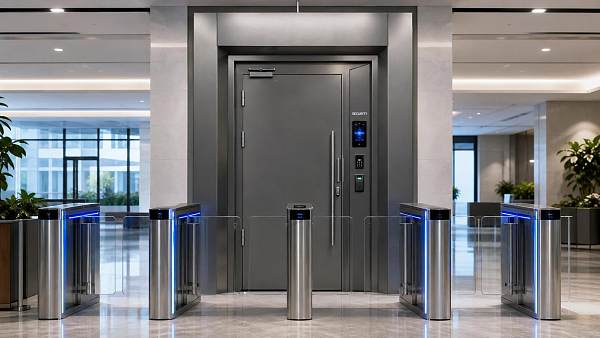
Protective doors and turnstiles are often grouped together, but they solve different parts of the same problem. One controls forced entry resistance. The other controls passage behavior.
Protective doors are built to delay or resist attack. Their value depends on door leaf construction, frame reinforcement, locking points, hinges, core materials, and certified resistance performance.
Turnstiles manage how people move through controlled zones. Their value comes from lane logic, anti-tailgating sensors, safety response, direction control, and the ability to connect with credentials or biometrics.
Simple comparisons miss the interaction between them. A very strong door can still create a weak entrance if adjacent pedestrian lanes allow piggybacking or if visitor flow bypasses verification.
In practice, protective doors and turnstiles should be read as part of a full entrance sequence. That sequence may include vestibules, guard supervision, access readers, infrared detection, and emergency egress rules.
Why comparison has become more complex
The market has moved beyond choosing between “stronger” and “faster.” Most projects now require layered performance under real operating conditions, not just isolated product claims.
A financial facility may prioritize attack delay and mantrap logic. A headquarters lobby may need elegant throughput with controlled visitor handling. A logistics site may care more about shift changes and rugged uptime.
At the same time, compliance expectations are rising. Buyers increasingly ask how entrance systems align with life safety rules, building codes, insurance expectations, and local testing or certification requirements.
Technology convergence adds another layer. Biometric readers, mobile credentials, remote monitoring, and building management integration can improve control, but only if the entrance hardware supports stable interoperability.
This is where SHPS-style analysis matters. Entrance evaluation now touches mechanical design, anti-drill or anti-pry concepts, sensing accuracy, software connection, and long-term serviceability.
The most useful comparison dimensions
A sound review starts with measurable criteria. It helps separate appearance-driven decisions from entrance performance that will hold up under traffic, audit scrutiny, and evolving threat conditions.
These dimensions apply differently depending on the entrance type. The goal is not to maximize every parameter. The goal is to align the entrance with a specific threat model and operating rhythm.
Reading the door side of the decision
Protective doors are often evaluated too narrowly by steel thickness or visible mass. That approach ignores how attack resistance is distributed across the whole assembly.
More useful questions include whether the frame is reinforced, how the lock case behaves under drilling, whether hinges remain stable under load, and whether glazing creates an exposed weakness.
For some sites, ballistic or blast concerns may matter. For others, burglary delay and anti-pry performance are the dominant issues. The correct door specification depends on the expected attack path.
It is also worth checking how the door interacts with credentialing. A strong leaf paired with a weak reader position, exposed cabling, or poorly protected electric strike can undermine the whole entrance design.
Where verification sensitivity is high, a layered approach works better. Mechanical resistance, monitored locking, and biometric validation should reinforce each other rather than operate as separate add-ons.
Questions that clarify real door performance
- Which resistance standard or test evidence supports the door set?
- Are frame, leaf, lock, hinges, and hardware certified as a complete assembly?
- What tools and attack durations was the system designed to resist?
- How are cable routes, readers, and emergency release points protected?
- What maintenance is required to preserve rated performance over time?
Reading the turnstile side of the decision
Turnstiles are not just traffic devices. In high-security entrances, they are behavior filters that determine how reliably one authorization equals one passage.
Tripod units may fit lower-risk controlled circulation. Full-height turnstiles suit perimeter control. Speed gates are common where aesthetics, fast movement, and integration depth all matter.
The strongest difference often comes from sensor logic. Infrared arrays, tailgating algorithms, direction monitoring, and object detection determine whether the system can distinguish normal flow from abuse.
Door-like gate leaves can look secure, yet the real test is lane intelligence. Detection accuracy during peak flow matters more than brochure claims about opening speed.
Servo-driven systems usually offer smoother motion and better control. Even so, evaluators should check motor durability, recovery behavior after obstruction, and how alarms are escalated to site security.
Typical trade-offs in turnstile selection
- Higher throughput can reduce verification time if lane logic is weak.
- Elegant speed gates may require more careful calibration than rugged perimeter units.
- Wider accessible lanes improve inclusion, but they also raise anti-tailgating demands.
- Fail-safe opening supports life safety, yet it must be matched with emergency response planning.
Matching the entrance to the site
Protective doors and turnstiles should be compared within the operating context, not in isolation. The same product can be suitable in one facility and inefficient in another.
A data center may combine protective doors with mantrap logic and biometric verification. A corporate tower may combine speed gates with visitor management and elevator destination control.
At transport or public utility sites, weather resistance, vandal resistance, and service continuity may outweigh premium finishes. In pharmaceutical or laboratory spaces, traceability and contamination-sensitive circulation may be more important.
That is why application fit should be documented early. Entrance risk, expected volume, credential type, staffing model, and emergency requirements all change the right comparison outcome.
Where many evaluations go wrong
One common mistake is mixing perimeter logic with inner-zone logic. A full-height turnstile that works outdoors may be unacceptable in a lobby. A polished speed gate may be too light for exposed perimeter use.
Another error is treating certifications as interchangeable. Test scope, assembly conditions, and local acceptance vary. A label alone does not prove site suitability.
Some projects also underestimate commissioning. Protective doors and turnstiles depend on proper alignment, sensor tuning, software rules, and emergency integration. Weak commissioning can erase strong hardware value.
Finally, lifecycle issues are often left for later. Spare parts lead times, service access, and upgrade compatibility deserve attention during selection, not after deployment problems appear.
A practical way to move the evaluation forward
A useful next step is to compare protective doors and turnstiles as an entrance package rather than as separate catalog items. That creates a clearer view of risk, flow, and ownership cost.
Start with the site’s actual threat assumptions. Then map daily traffic, emergency behavior, user categories, and system integration needs. Only after that should product-level comparison begin.
It also helps to request evidence in three forms: certified performance, installed case references, and maintenance expectations. Together, those show whether a solution is credible beyond the sales presentation.
For organizations tracking the wider smart hardware market, SHPS-style research can support that process by connecting barrier design, biometrics, access control, and compliance context into one decision framework.
In the end, the best protective doors and turnstiles are not the most complex ones. They are the options that fit the threat, support movement, integrate cleanly, and remain dependable long after handover.
Have questions about this sector analysis, or seeking best practices specific to your niche? Drop us a line below and let the senior consultants at MHLS assist you.
We respect your privacy. Your information is strictly confidential.
Recommended News
 Parcel Locker Network Pricing: Setup Costs, Fees and Contract TermsUnmanned Terminal FellowCompare parcel locker networks pricing, from setup costs and recurring fees to contract terms. Discover hidden charges and choose the right model.
 JR East Plans UWB Walk-Through Gates at 40 Stations in Spring 2028Access Control StrategistJR East plans UWB walk-through gates at 40 stations in spring 2028. Explore the rollout timeline and what suppliers should watch.
 Bank Vault Security Standards: UL and EN Ratings ExplainedVault Structural ArchitectExplore bank vault security standards and learn how UL 608 classes and EN 1143-1 grades differ, what they test, and how to verify certification before you buy.
 Mechanical Lock Hardware Prices: What Buyers Should Budget for Bulk OrdersMr. Gideon CrossMechanical lock hardware price is just the starting point. Discover what drives bulk-order costs and how to compare supplier quotes with confidence.
 IndexBox Forecasts Steady Global Security Keypad Market Growth Through 2035Dr. Valerius ThorneGlobal security keypad market growth is forecast at 3.3% annually through 2035. Explore the smart home and replacement trends shaping demand.
 Choosing an Infrared Safety Sensors Manufacturer: What Buyers Should CheckUnmanned Terminal FellowChoosing an infrared safety sensors manufacturer? Compare safety evidence, integration, environmental performance and lifecycle costs before you buy.
 Choosing a Security Material Testing Service: What to Check for Lock and Safe MaterialsProf. Elara SterlingChoose a security material testing service with confidence. Learn what to check for lock and safe materials, from attack methods and accreditation to reliable reports.
 How Precision Anti-Pick Lock Cylinders Resist ManipulationSecurity Metallurgy ExpertDiscover how precision anti-pick lock technology resists manipulation, and learn what to check when comparing security features, test evidence, and everyday reliability.
 Dermalog Joins NIST FastCAP Program for Contactless Fingerprint TestingProf. Elara SterlingDermalog joins the NIST FastCAP program for contactless fingerprint testing. Discover what this means for biometric identification and digital identity.
 Choosing Security Export Compliance Services: What Providers Should CoverMr. Gideon CrossSecurity export compliance services can help prevent costly delays. Discover what to look for in classification, licensing, screening, and documentation.
 European Security Compliance Standards for Safes: EN 1143-1 vs EN 14450Dr. Valerius ThorneExplore security compliance standards Europe buyers need to know. Compare EN 1143-1 and EN 14450 to choose the right safe with confidence.
 HID Global Acquires inepro ID to Expand RFID and BLE Access SolutionsUnmanned Terminal FellowHID Global acquires inepro ID to expand RFID and BLE access solutions for printers, smart lockers and shared devices. Explore what the deal could mean for your organization.











