
Smart Building Security for Offices: How to Reduce Tailgating Risks
An office entrance can accept a valid credential and still admit an unauthorized person. When someone follows an employee through an open door or gate, the access-control system may record a successful transaction without recognizing that two people entered. Reducing tailgating therefore requires control over the passage itself, supported by a practical response when that control fails.
Effective smart building security for offices starts with the exposure at each entrance. A staffed reception door may need better visitor routing, door monitoring, and employee procedures. An unstaffed entrance serving sensitive areas may justify monitored speed gates or a more controlled passage system. The appropriate solution should reduce unauthorized entry while preserving safe movement, accessibility, and emergency egress.
Find where one authorization can become two entries
Begin by walking the routes an unauthorized person could use to reach occupied offices or restricted rooms. Include the main lobby, parking connections, delivery entrances, shared lift lobbies, and doors used by contractors. A prominent lobby gate provides limited protection if another route reaches the same space with fewer controls.
At each entrance, distinguish between deliberate following and everyday behavior that creates an opportunity. Employees may hold doors for someone carrying equipment, assume a visitor has already checked in, or admit a familiar contractor whose authorization has expired. These situations require different responses, even though all can result in an unverified entry.
Observe the entrance during busy arrivals, quieter periods, deliveries, and departures. Check whether people queue outside the controlled boundary, whether visitors can join an employee lane, and whether a door remains open after the authorized user has passed. Review how cleaners, maintenance personnel, and employees with bulky items enter. Exceptions that occur every day belong in the entrance design.
Record the protected destination as well as the entry point. In a shared building, landlord-controlled lobby access may establish permission to enter the building but say little about permission to enter an individual tenant’s office. Tenant entrances and sensitive internal zones may need their own controls. Conversely, applying the strongest barrier to every internal doorway can create unnecessary delays without materially improving protection.
A useful assessment connects three questions: what can someone reach after passing this entrance, how easily can they follow another person, and who would notice or respond? An unattended doorway leading directly to confidential work areas deserves a different treatment from a reception entrance where visitors remain visible and must pass another controlled boundary.
Choose hardware around the passage you need to control
A credential reader establishes whether an access request is authorized. It does not, by itself, establish how many people use the opening. Biometric authentication can strengthen identity checks at the reader, but a second person can still follow the authenticated user. Upgrading authentication alone leaves that physical gap unresolved.
For a conventional office door, first check the door assembly and operating sequence. The closer should return the door reliably, the latch should engage, and the monitoring contact should report its position correctly. Review release duration and door-held-open handling under realistic use. Shortening the release interval indiscriminately may inconvenience users while leaving the door physically open long enough for someone to follow.
Door contacts help identify an opening that remains open, but they do not count people passing through it. Where the risk warrants person-counting or passage detection, confirm how the additional sensors associate movement with an authorization. Detection must also lead to an actionable event; an alert that nobody receives has little operational value.
Speed gates can provide a more defined passage because they combine a controlled lane, moving barriers, and sensors. Their suitability depends on lane geometry, sensing coverage, barrier behavior, and supervision. A gate that detects two people may sound an alarm, inhibit a subsequent authorization, or use another programmed response. Buyers should establish exactly what happens when the second person is already inside the lane.
Safety detection and anti-tailgating detection serve different purposes. Sensors used to prevent a barrier from striking an occupant do not automatically establish that only one authorized person passed. Ask suppliers to demonstrate both functions, including how the system behaves when safe barrier movement conflicts with an attempt to stop unauthorized passage.
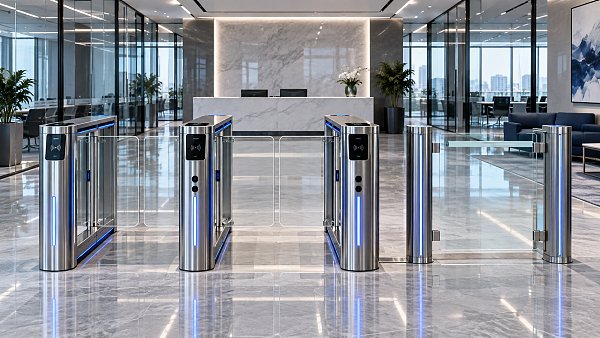
The layout around the lanes matters as much as the equipment. Reception queues, furniture, adjacent doors, and open gaps can create routes around the controlled boundary. Accessible lanes need the same attention to authorization and supervision as other lanes, with geometry and settings appropriate to their intended users. An unattended side gate opened for convenience can undermine the entire entrance arrangement.
Where consequences are high and traffic is limited, an interlocked entrance or security portal may offer greater control over passage. It also introduces space, throughput, assistance, and emergency-operation questions. Specify how occupancy is assessed, how legitimate users with mobility aids pass, and how staff resolve an interrupted transaction. Such systems require evaluation against the building’s applicable accessibility and life-safety requirements.
For a busy office lobby, the decision often turns on how reliably the entrance can support ordinary movement. Require demonstrations with closely spaced users, luggage, wheelchairs, walking aids, and visitors awaiting assistance. Published throughput figures have limited value unless the test conditions resemble the planned operation.
Make detection lead to a clear, safe response
An anti-tailgating event needs an owner. During staffed hours, reception or security may be able to verify the individuals involved and redirect an unregistered visitor. After hours, responsibility may shift to a remote monitoring team or an on-site responder. Define these arrangements before commissioning; otherwise, the system can produce accurate alerts without changing access outcomes.
Separate routine passage errors from events requiring intervention. A user who hesitates, reverses direction, or carries an awkward item may trigger a sensor event. An unidentified person continuing into a restricted area presents a different problem. The response procedure should explain how staff verify authorization, when they request assistance, and what they record.
Employees also need a socially workable way to avoid admitting unknown people. Asking everyone to confront a stranger physically is an unsuitable operating model. A clear instruction such as “Please check in at reception; they will help you through” provides a usable alternative to holding the door. Staff should know how to report a concern without pursuing or blocking someone.
Visitor handling should remove pressure to bypass controls. Registration, host notification, temporary credentials, and escort requirements must match the office’s access policy. If a visitor is expected to remain escorted, the entrance procedure should support that arrangement explicitly. Delivery workers and contractors need defined routes and access windows rather than informal permission to follow employees.
Integration should preserve enough context to investigate an event. Useful records may include the entrance, authorization time, passage event, alarm type, and operator action. Where video is used, synchronize system clocks so reviewers can connect the alert to the correct footage. Set access permissions and retention arrangements according to applicable privacy requirements and the organization’s policy.
Emergency behavior must be designed separately from normal access enforcement. Establish how the entrance responds to fire-system signals, power loss, controller failure, and network interruption with qualified life-safety professionals. Security settings must not obstruct required escape routes. Test the approved sequence, including restoration to normal operation, rather than assuming that a single “fail-safe” setting resolves every failure condition.
Validate the entrance under realistic operating conditions
Quality-control teams should convert the intended behavior into an acceptance plan before choosing equipment. A statement such as “includes anti-tailgating sensors” is too vague to verify. The specification should identify the passage scenarios to be detected, the expected response, the conditions under which the claim applies, and the records needed to demonstrate performance.
Begin with ordinary authorized passage, then introduce controlled variations. Include users walking closely together, a second person entering before the barrier closes, hesitation inside the lane, reverse movement, and consecutive valid authorizations. Use representative bags, trolleys, and mobility aids. Coordinate these tests with the supplier and building team so participants remain safe and other occupants are not disrupted.
For each scenario, record several outcomes separately:
- Detection: Did the system identify the intended event and classify it correctly?
- Passage outcome: Did an unauthorized person cross the protected boundary, even if an alarm sounded?
- Safety and usability: Could legitimate users complete the passage without hazardous movement or unreasonable assistance?
- Response: Did the responsible operator receive enough information and act according to the procedure?
This separation prevents a misleading acceptance result. A system may detect a follower while allowing that person to proceed. That capability can still support a supervised entrance, but it should not be represented as physical prevention. Equally, a barrier that interrupts passage frequently may drive staff to leave a bypass open, weakening the protection it was intended to provide.
Set performance targets around the site’s risk and traffic conditions. Track missed detections in controlled tests, nuisance alarms during legitimate use, unauthorized crossings, operator response times, and queue formation during peak arrivals. State the denominator for each measure. An alarm count alone cannot show whether performance has improved if traffic volume or operating hours have changed.
Results also need context. A quiet demonstration with widely spaced users does not establish performance during a crowded morning arrival. Record the tested configuration, including sensor settings, firmware, lane dimensions, authorization timing, and relevant environmental conditions. When a setting changes to reduce nuisance alarms, repeat the affected security scenarios to check that the adjustment has not increased missed detections.
Commissioning should include fault and maintenance conditions. Check how the entrance reports a sensor fault, loses connectivity, handles an authorized override, and returns to service. Verify who can change settings and whether changes are logged. An entrance that operates well on installation day can become unreliable if a damaged sensor, misaligned door, or persistent override goes unnoticed.
After handover, review incidents and exceptions together. Repeated alerts at one lane may point to a configuration issue, a confusing approach route, or a user group whose needs were overlooked. Frequent use of a side entrance may reveal that the main route cannot accommodate deliveries or accessibility requirements. Correcting these causes can reduce both security exposure and pressure on staff.
The next decision should follow the weakest part of the entrance. If doors fail to close, repair and verify them before investing in more sophisticated authentication. If a staffed lobby detects following but nobody intervenes, fix the response procedure. If an unattended entrance must prevent unauthorized passage into a sensitive area, evaluate a stronger physical boundary and validate its behavior on site. Each improvement should close an observed gap and remain usable enough to stay in operation.
Have questions about this sector analysis, or seeking best practices specific to your niche? Drop us a line below and let the senior consultants at MHLS assist you.
We respect your privacy. Your information is strictly confidential.
Recommended News
 Physical Security System Engineering: From Risk Assessment to System DesignUnmanned Terminal FellowExplore physical security system engineering, from risk assessment to integrated design, procurement and testing. Build a safer, more resilient facility.
 Apple Home Collection Smart Lock and Other Accessories Open for Preorder November 13Biometric Auth ScientistApple Home Collection preorders open November 13, 2026. Explore the LG smart lock’s Matter and Aliro support and what buyers should verify before ordering.
 Choosing Servo-Driven Flap Barriers: Throughput, Safety and Access ControlAccess Control StrategistServo-driven flap barriers can balance throughput, safety and access control. Discover how to compare lanes, test performance and choose with confidence.
 Parcel Locker Network Pricing: Setup Costs, Fees and Contract TermsUnmanned Terminal FellowCompare parcel locker networks pricing, from setup costs and recurring fees to contract terms. Discover hidden charges and choose the right model.
 JR East Plans UWB Walk-Through Gates at 40 Stations in Spring 2028Access Control StrategistJR East plans UWB walk-through gates at 40 stations in spring 2028. Explore the rollout timeline and what suppliers should watch.
 Bank Vault Security Standards: UL and EN Ratings ExplainedVault Structural ArchitectExplore bank vault security standards and learn how UL 608 classes and EN 1143-1 grades differ, what they test, and how to verify certification before you buy.
 Mechanical Lock Hardware Prices: What Buyers Should Budget for Bulk OrdersMr. Gideon CrossMechanical lock hardware price is just the starting point. Discover what drives bulk-order costs and how to compare supplier quotes with confidence.
 IndexBox Forecasts Steady Global Security Keypad Market Growth Through 2035Dr. Valerius ThorneGlobal security keypad market growth is forecast at 3.3% annually through 2035. Explore the smart home and replacement trends shaping demand.
 Choosing an Infrared Safety Sensors Manufacturer: What Buyers Should CheckUnmanned Terminal FellowChoosing an infrared safety sensors manufacturer? Compare safety evidence, integration, environmental performance and lifecycle costs before you buy.
 Choosing a Security Material Testing Service: What to Check for Lock and Safe MaterialsProf. Elara SterlingChoose a security material testing service with confidence. Learn what to check for lock and safe materials, from attack methods and accreditation to reliable reports.
 How Precision Anti-Pick Lock Cylinders Resist ManipulationSecurity Metallurgy ExpertDiscover how precision anti-pick lock technology resists manipulation, and learn what to check when comparing security features, test evidence, and everyday reliability.
 Dermalog Joins NIST FastCAP Program for Contactless Fingerprint TestingProf. Elara SterlingDermalog joins the NIST FastCAP program for contactless fingerprint testing. Discover what this means for biometric identification and digital identity.











