
Blast Resistant Steel Doors: How to Select the Right Rating for Critical Facilities
Blast resistant steel doors sit at the intersection of structural protection, life safety, and business continuity. In critical facilities, the right rating is not a cosmetic specification. It reflects a calculated response to pressure, fragment risk, occupancy, and operational importance. For any project moving from concept to procurement, the key question is not simply whether a door is strong, but whether its tested performance matches the real threat environment.
Why door ratings matter more than door thickness
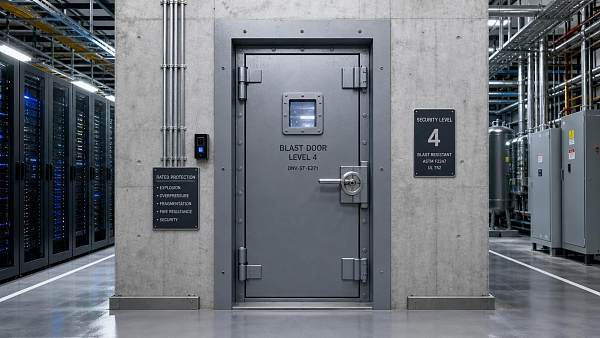
A blast event loads a door in ways that differ from burglary attack, fire exposure, or daily traffic. Pressure arrives fast, pushes hard, and can turn weak hardware, frames, or anchors into failure points.
That is why blast resistant steel doors are rated by tested resistance to specific blast conditions, not by steel gauge alone. A thicker leaf may help, but thickness without system design means little.
In practice, the door assembly matters as much as the slab. Frame reinforcement, hinge strategy, latch engagement, anchorage, glazing details, and surrounding wall construction all influence actual performance.
This system view aligns with how SHPS covers physical security infrastructure. Protective doors are rarely isolated products. They belong to a broader risk framework that includes material science, compliance testing, and site deployment realities.
What a blast rating is really describing
A rating usually connects several variables: explosive charge weight, standoff distance, expected reflected pressure, impulse, and permitted damage level. Some standards also define acceptable deformation and whether the door remains attached.
This matters because two blast resistant steel doors can both be called heavy duty while serving very different purposes. One may protect against a low to moderate external event. Another may be specified for severe petrochemical or defense conditions.
The rating should answer three practical questions:
- What blast load was the assembly tested or engineered to resist?
- What level of damage or deformation is considered acceptable?
- Does the installed opening remain functional, attached, and protective after the event?
Without those answers, comparisons between suppliers can become misleading. Marketing language such as reinforced, high-strength, or military grade does not replace documented performance data.
Where blast resistant steel doors are most relevant
Interest in blast resistant steel doors is growing across sectors where a single failure can disrupt safety, production, data integrity, or regulated operations. The issue is no longer limited to military compounds.
Typical use environments include energy plants, chemical processing sites, data centers, transport hubs, financial facilities, government buildings, laboratories, and selected logistics assets.
In these settings, blast threats may come from accidental explosions, process incidents, external attacks, or vehicle-borne hazards. The rating decision therefore links directly to site zoning and consequence analysis.
How to match the rating to the real threat
Selecting blast resistant steel doors starts with scenario definition. If the threat model is vague, the specification will also be vague, and that usually leads to overbuying or dangerous underspecification.
Start with credible blast assumptions
Threat inputs may come from security assessments, process hazard reviews, insurer guidance, or public sector design criteria. The important point is consistency across the project team.
If one consultant models external attack and another assumes internal accidental explosion, the same opening could end up with conflicting design logic.
Decide what level of damage is tolerable
Not every opening must remain fully operable after an event. Some locations only need life protection and controlled failure limits. Others need continuity, re-entry, or protection of mission-critical equipment behind the door.
This is often where cost and performance diverge. Higher ratings can add weight, hardware complexity, lead time, and installation demands.
Check the surrounding construction
A door rated for severe loads can still underperform if installed in an inadequate wall. The opening should be reviewed as a complete protective assembly, including anchors, edge conditions, and adjacent structural elements.
The specification details that change project outcomes
Once the rating target is clear, attention shifts to details that often decide whether blast resistant steel doors work as intended in the field.
- Opening direction affects pressure response, escape strategy, and security zoning.
- Hardware selection must consider latch strength, hinge durability, and emergency egress requirements.
- Manual or powered operation changes maintenance, reliability, and integration demands.
- Glazed vision panels, louvers, and penetrations require their own blast-compatible design.
- Corrosion protection matters in offshore, chemical, and humid environments.
There is also a growing need to coordinate blast protection with other performance layers. Many facilities want fire resistance, forced-entry resistance, acoustic control, and access control integration within the same door set.
That multi-requirement approach reflects a broader SHPS perspective. Protective openings now sit inside connected security ecosystems rather than stand-alone perimeter hardware decisions.
Why compliance evidence should drive supplier comparison
In procurement, documentation quality often tells more than a brochure. Reliable blast resistant steel doors should come with clear test references, engineering assumptions, fabrication details, and installation conditions.
A useful supplier review typically includes the following points:
- Recognized test standard or engineering basis
- Rated pressure and impulse values
- Defined deformation or hazard level criteria
- Frame, anchor, and wall interface requirements
- Maintenance guidance and hardware replacement path
- Previous application evidence in similar critical facilities
This is especially important in cross-border sourcing, where terminology can vary. A strong B2B evaluation process should separate genuine compliance readiness from vague claims of heavy-duty security.
Common mistakes when selecting blast resistant steel doors
Several avoidable errors appear repeatedly in critical facility projects.
- Choosing by appearance or thickness instead of tested performance.
- Ignoring the wall and anchor design around the opening.
- Combining blast, fire, and access requirements too late.
- Assuming one rating works for every building zone.
- Underestimating installation tolerances and maintenance access.
A door protecting a hardened control room should not be specified the same way as a secondary service entrance. Zoning, occupancy, and asset criticality should influence every opening schedule.
A practical path for the next decision
A sound decision on blast resistant steel doors usually begins with a short internal checklist. Define the threat basis, map critical spaces, confirm performance priorities, and request evidence in a comparable format.
From there, compare complete assemblies rather than isolated leaf materials. Review how each option fits structural conditions, access control needs, lifecycle maintenance, and compliance expectations.
For projects involving high-value assets and regulated environments, the best next step is often a tighter alignment between security design, structural review, and procurement criteria. That approach reduces rework and leads to blast resistant steel doors that are not only stronger on paper, but more credible in operation.
Have questions about this sector analysis, or seeking best practices specific to your niche? Drop us a line below and let the senior consultants at MHLS assist you.
We respect your privacy. Your information is strictly confidential.
Recommended News
 Physical Security System Engineering: From Risk Assessment to System DesignUnmanned Terminal FellowExplore physical security system engineering, from risk assessment to integrated design, procurement and testing. Build a safer, more resilient facility.
 Apple Home Collection Smart Lock and Other Accessories Open for Preorder November 13Biometric Auth ScientistApple Home Collection preorders open November 13, 2026. Explore the LG smart lock’s Matter and Aliro support and what buyers should verify before ordering.
 Choosing Servo-Driven Flap Barriers: Throughput, Safety and Access ControlAccess Control StrategistServo-driven flap barriers can balance throughput, safety and access control. Discover how to compare lanes, test performance and choose with confidence.
 Parcel Locker Network Pricing: Setup Costs, Fees and Contract TermsUnmanned Terminal FellowCompare parcel locker networks pricing, from setup costs and recurring fees to contract terms. Discover hidden charges and choose the right model.
 JR East Plans UWB Walk-Through Gates at 40 Stations in Spring 2028Access Control StrategistJR East plans UWB walk-through gates at 40 stations in spring 2028. Explore the rollout timeline and what suppliers should watch.
 Bank Vault Security Standards: UL and EN Ratings ExplainedVault Structural ArchitectExplore bank vault security standards and learn how UL 608 classes and EN 1143-1 grades differ, what they test, and how to verify certification before you buy.
 Mechanical Lock Hardware Prices: What Buyers Should Budget for Bulk OrdersMr. Gideon CrossMechanical lock hardware price is just the starting point. Discover what drives bulk-order costs and how to compare supplier quotes with confidence.
 IndexBox Forecasts Steady Global Security Keypad Market Growth Through 2035Dr. Valerius ThorneGlobal security keypad market growth is forecast at 3.3% annually through 2035. Explore the smart home and replacement trends shaping demand.
 Choosing an Infrared Safety Sensors Manufacturer: What Buyers Should CheckUnmanned Terminal FellowChoosing an infrared safety sensors manufacturer? Compare safety evidence, integration, environmental performance and lifecycle costs before you buy.
 Choosing a Security Material Testing Service: What to Check for Lock and Safe MaterialsProf. Elara SterlingChoose a security material testing service with confidence. Learn what to check for lock and safe materials, from attack methods and accreditation to reliable reports.
 How Precision Anti-Pick Lock Cylinders Resist ManipulationSecurity Metallurgy ExpertDiscover how precision anti-pick lock technology resists manipulation, and learn what to check when comparing security features, test evidence, and everyday reliability.
 Dermalog Joins NIST FastCAP Program for Contactless Fingerprint TestingProf. Elara SterlingDermalog joins the NIST FastCAP program for contactless fingerprint testing. Discover what this means for biometric identification and digital identity.











