EU EN 1627:2026 Rule Takes Effect for Blast-resistant Doors
On July 15, 2026, the OJEU published the revised EN 1627:2026 standard for security doors, and the change immediately introduced a mandatory combined impact-and-blast resistance test for Blast-resistant Doors exported to the EU market. For manufacturers, exporters, certification teams, testing service providers, buyers, and delivery planners, this is not just a technical update; it directly affects report validity, CE certification updates, and near-term shipment readiness.
What the revised standard now requires
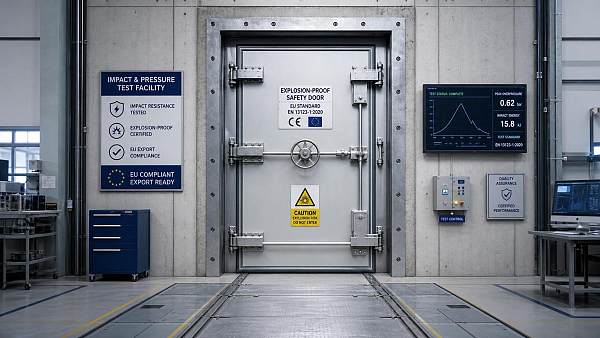
According to the provided event information, the OJEU released the revised EN 1627:2026 on July 15, 2026. The revision adds a mandatory combined resistance test described as an “impact + blast” scenario, stacking IEC 61000-4-27 with EN 13123-2 conditions.
The requirement applies to all Blast-resistant Doors intended for export to the EU market. The rule has no transition period and became mandatory on the same day it was published.
Under the new test condition, the door must maintain structural integrity and locking function under a 50 kPa shock wave combined with a 10 kJ mechanical impact. The provided information also states that this directly affects the validity of type test reports and CE certification updates for Chinese exporters.
Where the immediate pressure is likely to appear
Export programs and shipment preparation
From an industry perspective, exporters are likely to face the earliest impact because market access now depends on whether Blast-resistant Doors align with the newly effective test requirement. The most sensitive business points are likely to be existing EU-bound orders, shipment scheduling, and the document set used to support product entry, especially where prior type test reports were prepared under earlier conditions.
What deserves closer attention is whether internal shipment release checks, customer-facing compliance files, and CE-related documentation still match the revised standard language. Since the input states there is no transition period, companies involved in active export business need to treat this as an immediate compliance issue rather than a future planning item.
Manufacturing and product validation workflows
For manufacturers, the change is likely to affect product validation more directly than general production administration. Analysis shows the new requirement is not simply an additional paperwork item; it ties product acceptance to combined performance under a 50 kPa shock wave and a 10 kJ mechanical impact while preserving structural integrity and locking function.
That means engineering, quality, and compliance teams will likely need to review whether current product configurations, test evidence, and technical files remain usable for EU-facing business. Even where a product was previously qualified, the provided information indicates that report validity may now be in question.
Certification and testing coordination
Certification-related companies and testing service providers are also likely to see immediate effects because the rule change connects directly to type test report validity and CE certification updates. In practice, this may shift attention toward test scope confirmation, document review, and the sequencing between laboratory evidence and certification maintenance.
Observably, the key business issue here is not only whether testing is needed, but also how quickly companies can determine which existing reports remain acceptable for ongoing tenders, customer approvals, or export files. The input does not provide a formal execution interpretation beyond the immediate effectiveness of the rule, so this remains an area requiring close verification.
Procurement and buyer-side qualification checks
Buyers, project procurement teams, and downstream channel participants may also need to revisit supplier qualification checks. Analysis shows that when a mandatory technical requirement changes without a transition period, procurement risk can move from price and lead time to document sufficiency and approval timing.
For this reason, purchasing functions should pay closer attention to whether suppliers can present updated compliance materials, whether bid or specification documents reference the revised standard, and whether delivery commitments rely on reports that may require review under the new rule.
What companies should review now
Recheck the status of existing reports and CE files
Analysis shows the first practical question is whether existing type test reports and CE-related files still support EU market access for the relevant Blast-resistant Doors. Because the provided information explicitly notes an effect on report validity and CE certification updates, companies should review current document sets against the revised EN 1627:2026 requirement as a priority.
Review technical documents used in bids and customer submissions
What deserves closer attention is the wording used in technical offers, tender responses, specifications, declarations, and product compliance packs. If those materials still rely on older test logic or do not reflect the added combined test condition, they may create contract, approval, or delivery friction even before any physical shipment issue appears.
Monitor execution language around certification and acceptance
The input confirms immediate effectiveness, but it does not provide detailed implementation language on how different certification and acceptance scenarios will be handled in practice. Observably, companies should continue tracking official wording, certification interpretations, and customer-side acceptance criteria before assuming that all legacy evidence will be treated in the same way.
Adjust delivery planning where compliance timing matters
From an industry perspective, delivery planning now needs to account for the possibility that compliance review, report updates, or certification adjustments could affect shipment timing. This is especially relevant for orders tied to fixed customer milestones, procurement approvals, or project acceptance documents. The prudent reading is not that delays are already confirmed in every case, but that the compliance path has become a more immediate variable in delivery management.
Why this reads as an execution signal
Analysis shows this development is better understood as an already effective market-access change rather than a distant standards discussion. The absence of a transition period matters because it moves the revision from a watchlist item into an operational issue for any company currently serving the EU market with Blast-resistant Doors.
At the same time, it is also appropriate to understand this as a rule change whose detailed market execution still requires observation. The confirmed facts establish the new test requirement and its immediate force, but the downstream handling of reports, certification updates, procurement acceptance, and customer-side implementation will still need to be watched through actual application.
How this change should be understood for the market
The significance of this event lies less in headline language and more in its compliance effect: a revised EN 1627:2026 requirement now directly intersects with testing, certification, export documentation, and order execution for Blast-resistant Doors entering the EU market. For affected businesses, the most balanced interpretation is that this is an implemented rule change with immediate compliance relevance, while the exact execution pace across certification, procurement, and delivery processes remains something the industry should continue to verify.
Basis of this article and what still needs verification
This article is based on the user-provided news title, event date, and event summary. Source types commonly relevant to developments of this kind include official notices, regulator publications, trade authority information, industry association updates, standards organization documents, and reporting by authoritative media. A specific official source link was not provided in the input, so the exact official reference path still needs to be continuously verified.
Observably, the areas that still warrant follow-up include detailed implementation language, certification interpretation, changes in tender and specification documents, market feedback, and how affected companies are handling execution in practice.
Have questions about this sector analysis, or seeking best practices specific to your niche? Drop us a line below and let the senior consultants at MHLS assist you.
We respect your privacy. Your information is strictly confidential.
Recommended News
 Financial Facility Security: Choosing Vault Doors for Bank BranchesVault Structural ArchitectStrengthen financial facility security with the right bank vault door. Explore certification, installation, locking controls and maintenance before you buy.
 MACO Acquires Majority Stake in Fingerprint Access Provider ekeyProf. Elara SterlingMACO acquires a majority stake in ekey, bringing fingerprint access and door hardware closer together. Discover what the deal could mean for smart buildings.
 Physical Security System Engineering: From Risk Assessment to System DesignUnmanned Terminal FellowExplore physical security system engineering, from risk assessment to integrated design, procurement and testing. Build a safer, more resilient facility.
 Apple Home Collection Smart Lock and Other Accessories Open for Preorder November 13Biometric Auth ScientistApple Home Collection preorders open November 13, 2026. Explore the LG smart lock’s Matter and Aliro support and what buyers should verify before ordering.
 Choosing Servo-Driven Flap Barriers: Throughput, Safety and Access ControlAccess Control StrategistServo-driven flap barriers can balance throughput, safety and access control. Discover how to compare lanes, test performance and choose with confidence.
 Parcel Locker Network Pricing: Setup Costs, Fees and Contract TermsUnmanned Terminal FellowCompare parcel locker networks pricing, from setup costs and recurring fees to contract terms. Discover hidden charges and choose the right model.
 JR East Plans UWB Walk-Through Gates at 40 Stations in Spring 2028Access Control StrategistJR East plans UWB walk-through gates at 40 stations in spring 2028. Explore the rollout timeline and what suppliers should watch.
 Bank Vault Security Standards: UL and EN Ratings ExplainedVault Structural ArchitectExplore bank vault security standards and learn how UL 608 classes and EN 1143-1 grades differ, what they test, and how to verify certification before you buy.
 Mechanical Lock Hardware Prices: What Buyers Should Budget for Bulk OrdersMr. Gideon CrossMechanical lock hardware price is just the starting point. Discover what drives bulk-order costs and how to compare supplier quotes with confidence.
 IndexBox Forecasts Steady Global Security Keypad Market Growth Through 2035Dr. Valerius ThorneGlobal security keypad market growth is forecast at 3.3% annually through 2035. Explore the smart home and replacement trends shaping demand.
 Choosing an Infrared Safety Sensors Manufacturer: What Buyers Should CheckUnmanned Terminal FellowChoosing an infrared safety sensors manufacturer? Compare safety evidence, integration, environmental performance and lifecycle costs before you buy.
 Choosing a Security Material Testing Service: What to Check for Lock and Safe MaterialsProf. Elara SterlingChoose a security material testing service with confidence. Learn what to check for lock and safe materials, from attack methods and accreditation to reliable reports.