
Access Control Solutions Pricing: How to Budget for Hardware, Software, and Installation
Access Control Solutions Pricing: How to Budget for Hardware, Software, and Installation
Access control solutions pricing is often discussed as though it begins and ends with the price of a card reader, biometric terminal, or turnstile. That is rarely how a real project behaves. The visible hardware may be the easiest line item to compare, but it is not always the largest cost and is seldom the only part that determines whether the system works reliably after handover.
For procurement teams, the more useful question is not “What does an access control device cost?” It is “What will it take to secure this entrance, operate it every day, integrate it with the building, and expand it later without replacing the core system?” The answer depends on door condition, credential strategy, controller architecture, software model, cabling routes, life-safety requirements, and the site’s operational rules.
A single staff entrance in a small office and a high-throughput lobby with speed gates are both access control projects, but their cost structure is fundamentally different. The first may be limited by the existing door and lock preparation. The second can be driven by civil works, safety sensors, visitor management, lift integration, and the need to keep traffic moving during peak hours. Treating both as a simple device purchase is how budgets become misleading.
Start with the protected opening, not the product catalogue
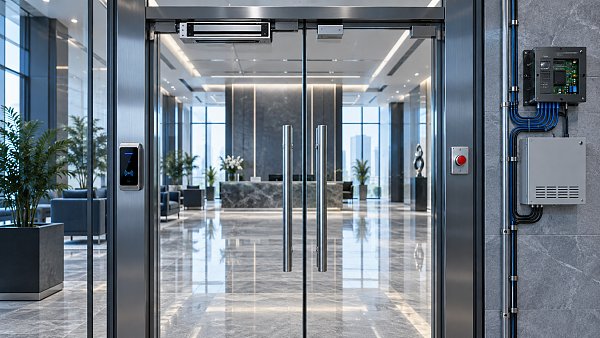
A credible budget starts with an opening-by-opening survey. Each door, gate, locker bank, server-room entrance, vehicle barrier, or controlled turnstile lane should be assessed as a working assembly. The reader is only one component. The opening may require an electric strike, magnetic lock, electric lock body, motorized lock, door controller, request-to-exit device, door contact, emergency release, local power supply, battery backup, enclosure, cable containment, and network connection.
The existing physical condition matters more than many early quotations acknowledge. A timber office door with a compatible lock case may be adapted relatively easily. A fire-rated door, frameless glass door, heritage entrance, aluminium profile system, or perimeter gate may need specialized hardware and approved installation methods. If the access control design conflicts with the door’s fire, escape, or locking arrangement, the apparent savings of a lower-cost reader disappear quickly.
For a restricted facility, procurement should also distinguish between “controlled” and “secure.” A reader that grants access is not automatically sufficient protection against forced entry, tailgating, door propping, credential sharing, or a compromised mechanical override. High-security spaces may require reinforced doors, appropriate lock cylinders, monitored contacts, anti-tamper enclosures, or two-factor authentication. Those elements belong in the budget discussion from the beginning.
The main cost layers behind access control solutions pricing
Most access control budgets can be organized into a few layers. This is more useful than comparing suppliers solely on a per-door number, because it makes omissions visible.
The weighting of these layers changes by application. A cloud-managed smart lock deployment may have modest cabling requirements but higher recurring software and connectivity costs. A wired enterprise system may require more up-front installation work yet offer local operation during an internet interruption. Parcel locker networks add remote monitoring, electronic lock reliability, mobile or PIN-based collection workflows, and, in some regions, cellular connectivity. The pricing model has to follow the operating model.
Hardware pricing: compare the complete door package
When evaluating hardware, ask suppliers to price a complete functional opening. This avoids a familiar problem: one bid seems lower because it includes only a reader and controller, while another includes the lock, monitored door contact, emergency release, enclosure, power equipment, and installation accessories required for operation.
Credential technology also changes the cost and risk profile. Basic RFID cards can be appropriate for many low- to medium-risk applications, but the buyer should understand card format, cloning resistance, key management, replacement procedures, and reader compatibility. Mobile credentials may reduce the logistics of issuing physical cards, yet they can introduce subscription charges, user onboarding work, and dependence on mobile-device policies. Biometric access can remove some credential-sharing concerns, but it needs careful consideration of privacy, enrollment quality, liveness detection, throughput, fallback access, and local legal requirements.
Biometric specifications deserve particular scrutiny. Terms such as facial recognition, vein recognition, or anti-spoofing are not interchangeable claims of security. A buyer should ask what authentication mode is used, how liveness detection is implemented, what happens when a user cannot enroll successfully, and whether performance documentation reflects the intended lighting and traffic conditions. A terminal placed at an outdoor vehicle gate faces a different environment from one in a controlled office corridor.
Turnstiles and speed gates require another level of discipline. Their purchase price may be only part of the commitment. Lane width, throughput expectation, infrared safety curtains, anti-tailgating logic, accessibility requirements, floor preparation, emergency opening behavior, and integration with visitor credentials all affect the final scope. A visually impressive speed gate that creates queues at shift change or nuisance alarms in daily use is not a low-cost solution.
Software costs are where “cheap” systems can become expensive
Software should be evaluated over the expected operating period, not just at initial purchase. Suppliers may use one-time licenses, annual software assurance, per-door subscriptions, per-user pricing, per-mobile-credential fees, cloud-hosting charges, or combinations of these. None is inherently wrong. The issue is whether the commercial model is clear enough for finance and operations to forecast.
Request a written schedule identifying what is included in the base platform: number of doors, operator accounts, audit-log retention, mobile credentials, visitor management, API access, reporting, remote administration, backups, software updates, and technical support. Some systems offer strong core access control but charge separately for integrations that become essential later, such as HR identity provisioning, video management, elevator control, or building management interfaces.
Integration should never be assumed merely because two systems are described as “compatible.” Procurement needs to know whether the connection is native, API-based, middleware-dependent, licensed separately, or dependent on a specific system integrator. It is also worth confirming which party is responsible when an integration fails after a software update. That responsibility can otherwise become blurred between the access control provider, IT team, and third-party platform vendor.
Installation cost is driven by site reality
Installation estimates are most reliable after a site survey. Cable distances, wall and ceiling access, asbestos or other hazardous-material procedures, working-hour restrictions, security clearances, lifts, shutdown windows, and the need to keep doors operational all influence labour and project duration. A new-build project with coordinated containment is a different commercial proposition from retrofitting an occupied hospital, warehouse, bank branch, or multi-tenant building.
There is also a practical divide between physical security installation and IT readiness. Security contractors may install controllers and readers, while internal IT owns IP addresses, switch ports, VLANs, firewall rules, server access, or cybersecurity review. If these dependencies are not planned together, hardware may be fitted but remain unusable while teams wait for network approval. Include a responsibility matrix in the procurement package, especially for cloud-connected systems and distributed sites.
Commissioning should be a priced deliverable, not an informal promise. It should cover door operation, alarm states, emergency release behavior, controller communication, access groups, time schedules, reporting, administrator training, as-built drawings, and handover documentation. For high-security areas, acceptance testing may also need to verify forced-door alarms, door-held-open alarms, interlocking sequences, and integration with protective doors or intrusion systems.
Build a budget around scenarios, not one optimistic total
A useful procurement approach is to ask for a base scope and clearly priced options. The base scope should make every opening operational. Options can then cover mobile credentials, biometric verification, turnstile upgrades, battery backup, remote support, additional software modules, spare readers, expanded audit retention, or future door capacity. This lets decision-makers compare trade-offs without stripping essential functionality from the first proposal.
It is sensible to retain a contingency for unknown conditions in retrofit work, but the contingency should not become a substitute for survey discipline. Suppliers should state assumptions: cable routes available, door type and handing confirmed, suitable power present, network supplied by others, and no structural modification required. Assumptions are not minor legal text; they are often the difference between a controlled project and a change-order dispute.
For multi-site programs, standardization can reduce administrative complexity, training burden, and spare-parts exposure. But standardization should not mean forcing identical hardware into incompatible locations. An indoor wall-mounted reader, an outdoor vandal-resistant reader, a smart locker controller, and a high-security vault access point may share a platform while requiring very different field hardware and installation methods.
Questions that expose hidden costs before award
- Is every quoted door supplied with locking hardware, power, monitoring, emergency release, and all installation accessories?
- Which software functions are included permanently, and which have annual, per-door, per-user, or per-credential charges?
- Can the system continue to enforce local access rules if cloud connectivity or the wider network is unavailable?
- What credentials are supported today, and can the organization migrate later without replacing readers?
- Who owns configuration data, access records, integrations, and administrator rights at contract end?
- What is excluded from the installation scope: civil works, door modification, electrical supply, network equipment, lifts, permits, or after-hours labour?
- What spares, warranty terms, firmware support, and response arrangements are available after commissioning?
The strongest comparison is usually a normalized bill of quantities supported by the same site information, acceptance criteria, and assumptions for every bidder. A low headline quote may still be the right choice, but only after its omissions have been understood and priced. In physical security, incomplete scope is often more expensive than higher-quality equipment.
Access control solutions pricing should therefore be treated as a lifecycle decision. Hardware matters, but so do the door, the network, the software contract, the installer’s ability to work on the actual site, and the system’s capacity to support the next expansion. Buyers who budget for those connections early are less likely to discover that the cheapest reader was attached to the most expensive problem.
Have questions about this sector analysis, or seeking best practices specific to your niche? Drop us a line below and let the senior consultants at MHLS assist you.
We respect your privacy. Your information is strictly confidential.
Recommended News
 Physical Security System Engineering: From Risk Assessment to System DesignUnmanned Terminal FellowExplore physical security system engineering, from risk assessment to integrated design, procurement and testing. Build a safer, more resilient facility.
 Apple Home Collection Smart Lock and Other Accessories Open for Preorder November 13Biometric Auth ScientistApple Home Collection preorders open November 13, 2026. Explore the LG smart lock’s Matter and Aliro support and what buyers should verify before ordering.
 Choosing Servo-Driven Flap Barriers: Throughput, Safety and Access ControlAccess Control StrategistServo-driven flap barriers can balance throughput, safety and access control. Discover how to compare lanes, test performance and choose with confidence.
 Parcel Locker Network Pricing: Setup Costs, Fees and Contract TermsUnmanned Terminal FellowCompare parcel locker networks pricing, from setup costs and recurring fees to contract terms. Discover hidden charges and choose the right model.
 JR East Plans UWB Walk-Through Gates at 40 Stations in Spring 2028Access Control StrategistJR East plans UWB walk-through gates at 40 stations in spring 2028. Explore the rollout timeline and what suppliers should watch.
 Bank Vault Security Standards: UL and EN Ratings ExplainedVault Structural ArchitectExplore bank vault security standards and learn how UL 608 classes and EN 1143-1 grades differ, what they test, and how to verify certification before you buy.
 Mechanical Lock Hardware Prices: What Buyers Should Budget for Bulk OrdersMr. Gideon CrossMechanical lock hardware price is just the starting point. Discover what drives bulk-order costs and how to compare supplier quotes with confidence.
 IndexBox Forecasts Steady Global Security Keypad Market Growth Through 2035Dr. Valerius ThorneGlobal security keypad market growth is forecast at 3.3% annually through 2035. Explore the smart home and replacement trends shaping demand.
 Choosing an Infrared Safety Sensors Manufacturer: What Buyers Should CheckUnmanned Terminal FellowChoosing an infrared safety sensors manufacturer? Compare safety evidence, integration, environmental performance and lifecycle costs before you buy.
 Choosing a Security Material Testing Service: What to Check for Lock and Safe MaterialsProf. Elara SterlingChoose a security material testing service with confidence. Learn what to check for lock and safe materials, from attack methods and accreditation to reliable reports.
 How Precision Anti-Pick Lock Cylinders Resist ManipulationSecurity Metallurgy ExpertDiscover how precision anti-pick lock technology resists manipulation, and learn what to check when comparing security features, test evidence, and everyday reliability.
 Dermalog Joins NIST FastCAP Program for Contactless Fingerprint TestingProf. Elara SterlingDermalog joins the NIST FastCAP program for contactless fingerprint testing. Discover what this means for biometric identification and digital identity.











