
Biometric Doors vs. Turnstiles: Choosing the Right Access Control Solution
A biometric door is generally the stronger choice when the opening must provide a defined physical barrier and restrict entry to a room or secure zone. A turnstile is better suited to regulating pedestrian flow at a controlled boundary, but its resistance to climbing, bypass and forced entry depends heavily on its design and the surrounding enclosure.
The distinction is not the biometric method itself. Either solution can use fingerprint, face or vein recognition. The decision is about what must happen after a person is authenticated: unlock a protective barrier, admit one person through a lane, prevent a second person from following, or maintain safe movement under emergency conditions.
Start with the boundary, not the reader
A biometric door combines a door assembly, locking hardware and a biometric access decision. The door can range from a standard commercial opening with a biometric reader to a protective assembly designed and tested for a specified level of attack resistance. Adding a biometric lock does not, by itself, turn an ordinary door into a protective door.
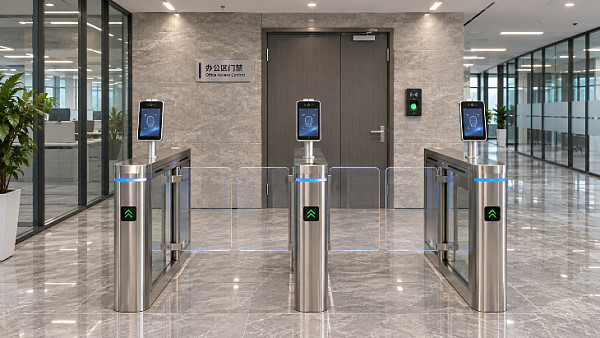
A turnstile is a pedestrian control device. Tripod units, full-height turnstiles and speed gates differ substantially in barrier height, construction, sensing and operating behavior. Some speed gates use glass or other transparent panels and are designed primarily for orderly passage and tailgating detection; a full-height unit can present a more substantial obstacle. Neither category should be assumed to provide a particular forced-entry rating without evidence for the complete installed configuration.
The surrounding construction matters in both cases. A protective door installed in a weak partition, or a turnstile positioned beside an accessible gap, leaves a route around the intended control. Define the protected boundary and its weakest plausible bypass before comparing device features.
Authentication accuracy is only one part of access control
Biometric systems compare a captured sample against an enrolled reference. Fingerprint quality can be affected by skin condition and sensor contamination; face recognition depends on factors such as camera positioning, lighting and user presentation; vein recognition also depends on correct presentation and a suitable sensor arrangement. The relevant question is whether the complete system performs acceptably with the intended users at the intended location.
Evaluate false acceptance and false rejection together, at the proposed operating threshold. A stricter threshold can reduce unauthorized matches while increasing legitimate-user rejections. Supplier figures are useful only when the test conditions, population, enrollment process and threshold are understood. A result obtained under controlled conditions should not be treated as a guaranteed field rate.
Presentation attack detection is a separate requirement from matching accuracy. A system that matches genuine users reliably is not automatically resistant to photographs, artificial fingerprints or other presentation attacks. Ask what attack types and test methods are covered, and whether the evaluated configuration matches the deployed sensor, software version and settings.
Decide how exceptions will be handled before installation. Some users may be unable to enroll or authenticate consistently, and a sensor may be unavailable during maintenance. An alternative credential, staffed procedure or controlled remote release can preserve access, but it must have an authorization and audit process appropriate to the protected area. A fallback that is easy to obtain or impossible to audit can undermine the biometric control.
Throughput depends on the full passage cycle
Published lane or door capacity figures do not necessarily include every step in a real access transaction. The passage cycle includes approaching the reader, presenting the biometric, receiving a decision, opening the barrier, clearing the opening and resetting it for the next person. Retries, users carrying items, visitors and accessibility needs can extend that cycle.
For a preliminary estimate, divide the duration of the busiest arrival period by the expected average passage time per person, then apply a conservative allowance for interruptions. For example, a continuously occupied lane with a six-second average cycle has a theoretical maximum of ten passages per minute; that is not a promised operating capacity. Confirm performance through timed trials using representative users and the proposed security settings.
A door can become a bottleneck when it must close and relock before the next authorization. Conversely, leaving it open for consecutive users improves flow but weakens control over individual passage. A turnstile can separate users into lanes, but adding lanes also requires space, power, monitoring and a plan for accommodating users who cannot pass through the standard lane.
Check arrival patterns rather than relying on daily headcount. Shift changes and scheduled events can create short queues even where average traffic is low. Queue location matters as well: people waiting outside the controlled line should not obstruct public circulation, emergency routes or an adjacent secure entrance.
Tailgating prevention requires detection and a response
Authentication proves that a presented biometric matched an authorized identity; it does not prove that only one person crossed the boundary. A person can follow an authorized user through an ordinary door, particularly if door-holding is socially expected or the door closer leaves a long opening interval.
Turnstiles can use barrier movement, infrared sensors or other detection arrangements to identify passage anomalies. Their effectiveness depends on lane geometry, sensor coverage, user spacing and how the system interprets events. Closely spaced people, carried objects, reverse movement and attempts to climb or pass beneath a barrier should be considered against the actual device design. An alarm is not equivalent to physical prevention: if nobody receives or acts on it, the event may only be recorded.
Where the consequence of an unauthorized entry is high, a controlled two-door vestibule can provide stronger passage control than a single door. An interlock can prevent both doors from being open simultaneously; additional occupancy detection may be needed to assess whether more than one person is inside. Interlocking alone does not establish identity or guarantee single-person occupancy. It also introduces additional cycle time and requires careful emergency release design.
Specify physical resistance as an assembly requirement
For a protective door, request evidence that covers the relevant assembly rather than the door leaf alone. The frame, hinges, lock, strike, fasteners, anchorage and supporting wall all influence resistance. A certificate or test report should identify the applicable standard, claimed rating, tested configuration and permitted installation conditions. Fire resistance, burglary resistance and ballistic resistance address different hazards; one should not be treated as evidence of another.
For a turnstile, inspect the complete perimeter around the lane. Barrier height, panel strength, base anchorage, gaps above and below the unit, and the connection to adjacent fencing or walls determine what kinds of bypass are plausible. A speed gate selected for lobby throughput should not be assumed to resist a deliberate forced entry in the same way as a protective door.
The threat model should also distinguish an opportunistic follower from an attacker with time, tools or assistance. If the required resistance exceeds what the pedestrian gate can demonstrate, use the turnstile as a flow-control layer rather than the sole protective boundary.
Integration and failure behavior need explicit acceptance criteria
Establish which component makes each decision. A reader may perform biometric matching locally, or it may send a result to an access controller or platform. The controller may apply schedules and permissions, while the door or turnstile controller manages the physical barrier. The design should state what happens if communication is delayed, duplicated or lost, and whether cached permissions remain valid.
Confirm the interfaces for authorization, door position, lock status, gate passage, forced opening and alarms. A simple relay signal can release a lock, but it does not necessarily report who actually passed or whether the opening closed. Event timestamps and identifiers should allow an authorization to be reconciled with the corresponding passage or exception. Check that the existing platform can receive and retain the necessary events without relying on unsupported custom integration.
Power-loss behavior is equally important. “Fail-safe” and “fail-secure” describe different lock responses to power loss, but neither label alone establishes that an installation is safe or compliant. A complete review must cover free egress, fire-alarm interfaces, emergency release, power supply, controller failure and the requirements of the applicable jurisdiction. A secure perimeter must not be specified in a way that traps occupants.
For turnstiles, establish whether barriers open, unlock or remain in position under each relevant fault and emergency condition, and whether a separate accessible exit is required. For doors, verify the behavior of the lock, closer and release hardware together. Have the proposed arrangement reviewed by the responsible fire and building authorities where required; do not infer approval from a component certificate alone.
Privacy and maintenance affect the usable design
Biometric data handling can determine whether a proposed configuration is deployable. Identify where templates are created and stored, whether matching occurs on the device or a server, who can administer the system, and how enrollment, deletion and retention are controlled. Encryption, access logging and secure update mechanisms should be assessed as part of the architecture. Applicable privacy and employment rules vary by jurisdiction and may restrict the use of biometrics or require a lawful alternative.
Maintenance requirements differ as well. A door relies on alignment, closing force, locking engagement and the condition of hinges and seals. A turnstile adds moving barriers, drive components and passage sensors that must remain aligned and clear. Both depend on clean, functioning biometric sensors and controlled software updates. Specify how faults are detected, how long an alternative entry procedure can remain in operation and how the secure boundary is maintained during repair.
Making the selection
Choose a biometric protective door when the main requirement is to protect a defined room or zone and the door assembly can be matched to the required resistance. Add passage monitoring or a controlled vestibule if the design must address one-person entry rather than authentication alone.
Choose a biometric turnstile when managing pedestrian flow and identifying passage anomalies are central requirements, and when the unit and surrounding boundary provide sufficient resistance for the assessed threat. A staffed lobby with an inner secure door is a different risk environment from an unattended perimeter.
Where both high traffic and strong protection are necessary, the practical solution may be layered: turnstiles at the monitored circulation boundary and protective doors at the higher-risk rooms. Accept the design only after representative passage trials, fault and emergency tests, integration checks and review of the evidence for the complete installed assemblies.
Have questions about this sector analysis, or seeking best practices specific to your niche? Drop us a line below and let the senior consultants at MHLS assist you.
We respect your privacy. Your information is strictly confidential.
Recommended News
 Physical Security Infrastructure Cost: Budgeting for Installation and MaintenanceUnmanned Terminal FellowUnderstand physical security infrastructure cost and build a smarter budget for installation, maintenance, and long-term ownership.
 Financial Facility Security: Choosing Vault Doors for Bank BranchesVault Structural ArchitectStrengthen financial facility security with the right bank vault door. Explore certification, installation, locking controls and maintenance before you buy.
 MACO Acquires Majority Stake in Fingerprint Access Provider ekeyProf. Elara SterlingMACO acquires a majority stake in ekey, bringing fingerprint access and door hardware closer together. Discover what the deal could mean for smart buildings.
 Physical Security System Engineering: From Risk Assessment to System DesignUnmanned Terminal FellowExplore physical security system engineering, from risk assessment to integrated design, procurement and testing. Build a safer, more resilient facility.
 Apple Home Collection Smart Lock and Other Accessories Open for Preorder November 13Biometric Auth ScientistApple Home Collection preorders open November 13, 2026. Explore the LG smart lock’s Matter and Aliro support and what buyers should verify before ordering.
 Choosing Servo-Driven Flap Barriers: Throughput, Safety and Access ControlAccess Control StrategistServo-driven flap barriers can balance throughput, safety and access control. Discover how to compare lanes, test performance and choose with confidence.
 Parcel Locker Network Pricing: Setup Costs, Fees and Contract TermsUnmanned Terminal FellowCompare parcel locker networks pricing, from setup costs and recurring fees to contract terms. Discover hidden charges and choose the right model.
 JR East Plans UWB Walk-Through Gates at 40 Stations in Spring 2028Access Control StrategistJR East plans UWB walk-through gates at 40 stations in spring 2028. Explore the rollout timeline and what suppliers should watch.
 Bank Vault Security Standards: UL and EN Ratings ExplainedVault Structural ArchitectExplore bank vault security standards and learn how UL 608 classes and EN 1143-1 grades differ, what they test, and how to verify certification before you buy.
 Mechanical Lock Hardware Prices: What Buyers Should Budget for Bulk OrdersMr. Gideon CrossMechanical lock hardware price is just the starting point. Discover what drives bulk-order costs and how to compare supplier quotes with confidence.
 IndexBox Forecasts Steady Global Security Keypad Market Growth Through 2035Dr. Valerius ThorneGlobal security keypad market growth is forecast at 3.3% annually through 2035. Explore the smart home and replacement trends shaping demand.
 Choosing an Infrared Safety Sensors Manufacturer: What Buyers Should CheckUnmanned Terminal FellowChoosing an infrared safety sensors manufacturer? Compare safety evidence, integration, environmental performance and lifecycle costs before you buy.











