
How to Choose Physical Security Systems for Logistics Sites With High Traffic?
How to Choose Physical Security Systems for Logistics Sites With High Traffic?
Choosing physical security systems for logistics sites gets difficult at the point where security measures start interfering with throughput. That is the real problem, not the catalog comparison. A busy logistics facility is not a static building with a few controlled doors. It is a moving environment with trucks arriving in waves, staff working across shifts, contractors entering for limited tasks, parcels changing custody many times a day, and perimeter openings that rarely stay quiet for long. In that setting, a good system is one that reduces unauthorized access, theft exposure, and operational blind spots without slowing the site into self-inflicted inefficiency.
That is why physical security systems for logistics sites should be assessed as an operational control layer, not as a collection of isolated products. Gates, fences, turnstiles, locks, loading bay controls, access credentials, parcel locker protection, and video-linked verification all influence each other. A site can have strong perimeter hardware and still remain vulnerable if pedestrian access is loosely managed. It can have strict staff authentication and still lose assets through unmanaged vehicle circulation or unsecured transfer zones. The selection process needs to start from movement patterns and risk concentration, not from brand names or feature lists.
Start with traffic logic, not hardware categories
High-traffic logistics sites usually fail in predictable places: entry bottlenecks, mixed-use access points, poor separation between people and vehicles, and handover areas where responsibility becomes ambiguous. Before comparing equipment, it helps to map four flows: heavy vehicles, light vehicles, employees, and goods. In some facilities, visitor access and contractor access should be treated as separate flows as well, because their authorization patterns are different from permanent staff.
This sounds basic, but it changes the system architecture. A warehouse with continuous truck movement may need barrier control, plate recognition integration, anti-tailgating logic for pedestrian lanes, and audit trails around loading doors. A parcel sorting hub may care more about internal compartmentalization, package custody protection, and high-reliability credentialing at staff-only zones. A cold-chain or bonded logistics site may add compliance-driven requirements around traceability and restricted storage access. The right choice depends on where delay, intrusion, and loss are most likely to occur.
One common mistake is to treat all access points as equivalent. They are not. A perimeter vehicle gate, a staff entrance turnstile, a maintenance door, a caged high-value storage room, and a smart parcel locker bank each require different resistance, sensing, and monitoring logic. If the same control philosophy is applied everywhere, the result is usually over-control in low-risk areas and weak control where it matters.
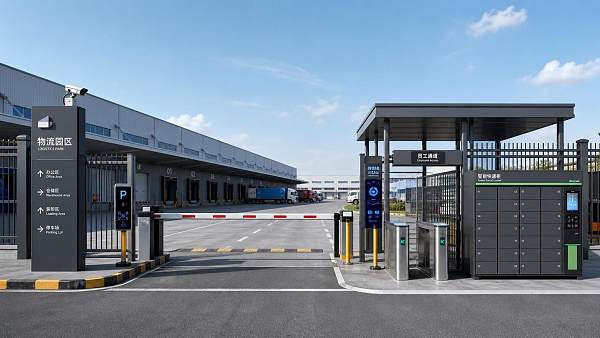
Think in layers: perimeter, circulation, storage, and handover
When practitioners talk about logistics security, they are usually thinking in layers. The perimeter is only the first one. A fence line, gate system, protective door set, and surveillance coverage may deter or detect external intrusion, but they do not solve internal misuse, unauthorized accompaniment, or package diversion. For that reason, system selection works better when the site is broken into security layers with different objectives.
At the perimeter, the question is whether the site can identify, delay, and record entry attempts. This is where vehicle barriers, robust fencing, gate operators, intercom verification, and access-control-linked openings matter. Around pedestrian entry, the concern shifts toward identity assurance and anti-tailgating performance. Speed gates or turnstiles can be useful in logistics settings with large staff counts, but only if they are chosen for traffic volume, life-safety compliance, and sensor reliability rather than appearance.
Inside the site, circulation control often deserves more attention than it gets. Not every authenticated user should be able to move freely between warehouse floor, dispatch office, returns area, server room, locker area, and high-value inventory cage. Electronic locks, mechanical lock cylinders for fallback or selective hard security, access zones, and event logging should be aligned with actual job roles. In practice, many losses occur after a person has legitimately entered the building but moved into a space they did not need to access.
Then there is handover security. Loading bays, dispatch counters, parcel locker interfaces, and transfer vestibules are where physical custody changes. These points need clear access rights, reliable door status monitoring, and a design that prevents opportunistic interference during busy periods. In some operations, this can matter more than adding another camera to the perimeter.
What project managers should actually compare
A selection exercise becomes more useful when the comparison criteria are operationally specific. The basic question is not “Which system is more advanced?” It is “Which system will remain dependable under our traffic pattern, staffing model, and risk profile?” That means looking beyond standard brochures.
The following points usually separate a workable deployment from an expensive frustration:
- Throughput capacity: Can pedestrian lanes, barriers, turnstiles, or locker interfaces process peak volumes without queues becoming a security problem in themselves?
- Authentication quality: Is the site using cards, PINs, biometrics, vehicle identifiers, or combined methods, and what spoofing or sharing risks come with each?
- Failure behavior: What happens during power loss, network interruption, or hardware fault? Does the opening default support both safety and site security?
- Mechanical robustness: For doors, locks, cylinders, barriers, and cabinets, what is the expected wear profile under frequent cycles and possible abuse?
- Integration depth: Can the system exchange events with access control software, alarm monitoring, video systems, or locker management platforms?
- Auditability: Can managers reconstruct who entered, when, through which point, and under what credential or override condition?
- Serviceability: Are replacement parts, firmware support, and local maintenance realistically available for a multi-year operating period?
These are not glamorous criteria, but they are the ones that tend to matter six months after commissioning. The most sophisticated interface loses value quickly if the barrier arm fails under cycle load, if tailgating sensors generate constant false alarms, or if locker door actuators become unreliable in outdoor conditions.
Do not separate electronic control from physical resistance
Another frequent misunderstanding is to assume that digital visibility compensates for weak hardware. It does not. Event logs are useful, but they do not physically delay intrusion. Remote alerts are useful, but they do not replace a protective door, a secure lock body, a tamper-resistant cylinder, or a properly rated enclosure where a high-value asset is actually stored. In logistics environments, especially those handling electronics, pharmaceuticals, bonded goods, or sensitive returns, the mechanical layer still matters.
That is where project teams should ask harder questions about the doors, locking points, and storage units attached to the access system. A reader badge on a flimsy side door creates only the appearance of control. A connected parcel locker with weak compartment construction may still be vulnerable if the cabinet body, lock mechanism, or service access panel is poorly engineered. The same principle applies to internal cages, key cabinets, and restricted storage rooms. Security electronics should verify and record access, while the physical layer should resist forced entry long enough for detection and response to matter.
Where standards and compliance enter the picture
Not every logistics project needs the same testing framework, and that is exactly why teams should avoid making casual assumptions about compliance. Some components may need to align with local fire and egress rules. Some access control devices may need safety-related certifications depending on market and installation type. Protective storage units, safes, or vault elements for cash, documents, controlled goods, or high-value items may be evaluated against standards such as EN 1143-1 in relevant contexts, but that does not mean the entire site should be specified around safe-room logic.
The practical point is this: do not ask whether a system is “certified” in the abstract. Ask which component is certified, to what standard, for what condition of use, and whether that standard is relevant to the risk you are trying to manage. A turnstile tested for pedestrian safety answers a different question from a lock cylinder designed for anti-picking performance. A burglary-resistant storage product addresses a different exposure from a loading bay access controller. Bundling all these under one vague compliance requirement usually leads to confusion in procurement documents.
Biometrics, credentials, and the reality of high-volume use
Biometric verification is often attractive in logistics operations because card sharing and PIN leakage are real issues. Fingerprint, facial recognition, and in some cases vein recognition can reduce simple credential misuse. But the decision is less about novelty than about fit. If staff wear gloves, handle dusty goods, or move rapidly through shift changes, fingerprint performance may vary. If lighting conditions are difficult or people use face coverings, facial systems need careful evaluation. Some environments benefit more from multi-factor logic at sensitive zones than from site-wide biometric deployment.
This is also where throughput matters again. A highly accurate identity check that slows shift entry into a 200-person queue can create pressure for bypass behavior, propped doors, or informal workarounds. In other words, poor ergonomic design becomes a security weakness. The better question is not whether biometrics are superior in theory, but where they improve assurance without disrupting the flow the site depends on.
Smart parcel lockers and unattended transfer points need their own logic
For sites using smart parcel lockers, either for employee collections, outbound handover, or last-mile consolidation, selection criteria should go beyond user interface and app connectivity. The locker is part of the site’s physical security system because it creates a controlled custody point. That means teams should examine enclosure strength, electronic lock reliability, service access protection, compartment monitoring, power backup approach, and network resilience. Connectivity through Ethernet, 4G, or 5G can support operations, but connectivity alone is not security.
A locker bank positioned in a semi-public area often requires supporting controls around camera coverage, lighting, service-door restriction, and user authentication policy. If the locker is integrated with broader access control or building management platforms, the operational value increases because events can be reviewed alongside other access records. That is especially useful when investigating disputes around parcel retrieval or unauthorized opening attempts.
A practical way to narrow the decision
For project managers, the most reliable approach is to rank access points and assets by consequence, not just by frequency of use. A high-frequency entrance is not always the highest-risk opening, and a low-traffic room may hold the site’s most sensitive stock or system controls. Once those priorities are clear, physical security systems for logistics sites can be specified with more discipline: stronger delay measures where loss impact is highest, faster flow controls where operational continuity is critical, and tighter identity assurance where misuse is hard to detect after the fact.
It also helps to ask vendors to respond to actual site scenarios rather than generic requirements. How will the system handle shift change peaks, emergency egress, network downtime, temporary contractor credentials, or after-hours courier access? How are mechanical override and key control managed? What event data is retained, and in what form? These questions reveal more than a feature sheet does.
The right decision usually looks less dramatic than people expect. It is rarely a single flagship device. More often, it is a coherent combination of perimeter control, pedestrian management, resilient locking hardware, selective authentication, monitored transfer points, and integration that gives the site enough visibility to investigate problems and enough physical resistance to contain them. In high-traffic logistics operations, that balance is the difference between a security system that supports the business and one that quietly fights it every day.
Have questions about this sector analysis, or seeking best practices specific to your niche? Drop us a line below and let the senior consultants at MHLS assist you.
We respect your privacy. Your information is strictly confidential.
Recommended News
 Physical Security System Engineering: From Risk Assessment to System DesignUnmanned Terminal FellowExplore physical security system engineering, from risk assessment to integrated design, procurement and testing. Build a safer, more resilient facility.
 Apple Home Collection Smart Lock and Other Accessories Open for Preorder November 13Biometric Auth ScientistApple Home Collection preorders open November 13, 2026. Explore the LG smart lock’s Matter and Aliro support and what buyers should verify before ordering.
 Choosing Servo-Driven Flap Barriers: Throughput, Safety and Access ControlAccess Control StrategistServo-driven flap barriers can balance throughput, safety and access control. Discover how to compare lanes, test performance and choose with confidence.
 Parcel Locker Network Pricing: Setup Costs, Fees and Contract TermsUnmanned Terminal FellowCompare parcel locker networks pricing, from setup costs and recurring fees to contract terms. Discover hidden charges and choose the right model.
 JR East Plans UWB Walk-Through Gates at 40 Stations in Spring 2028Access Control StrategistJR East plans UWB walk-through gates at 40 stations in spring 2028. Explore the rollout timeline and what suppliers should watch.
 Bank Vault Security Standards: UL and EN Ratings ExplainedVault Structural ArchitectExplore bank vault security standards and learn how UL 608 classes and EN 1143-1 grades differ, what they test, and how to verify certification before you buy.
 Mechanical Lock Hardware Prices: What Buyers Should Budget for Bulk OrdersMr. Gideon CrossMechanical lock hardware price is just the starting point. Discover what drives bulk-order costs and how to compare supplier quotes with confidence.
 IndexBox Forecasts Steady Global Security Keypad Market Growth Through 2035Dr. Valerius ThorneGlobal security keypad market growth is forecast at 3.3% annually through 2035. Explore the smart home and replacement trends shaping demand.
 Choosing an Infrared Safety Sensors Manufacturer: What Buyers Should CheckUnmanned Terminal FellowChoosing an infrared safety sensors manufacturer? Compare safety evidence, integration, environmental performance and lifecycle costs before you buy.
 Choosing a Security Material Testing Service: What to Check for Lock and Safe MaterialsProf. Elara SterlingChoose a security material testing service with confidence. Learn what to check for lock and safe materials, from attack methods and accreditation to reliable reports.
 How Precision Anti-Pick Lock Cylinders Resist ManipulationSecurity Metallurgy ExpertDiscover how precision anti-pick lock technology resists manipulation, and learn what to check when comparing security features, test evidence, and everyday reliability.
 Dermalog Joins NIST FastCAP Program for Contactless Fingerprint TestingProf. Elara SterlingDermalog joins the NIST FastCAP program for contactless fingerprint testing. Discover what this means for biometric identification and digital identity.











