
How to Specify Facial Recognition Gates for Secure Building Entry Projects
A building entry project can fail at the point where the gate, biometric terminal, access control platform, and daily user behavior meet. A facial device may recognize enrolled users quickly during a demonstration, yet the installed entrance can still suffer from queues, tailgating, rejected visitors, unsafe lane movements, or privacy objections. For project managers, the correct specification is not “a facial recognition terminal plus a turnstile.” It is a controlled-entry system defined by risk level, traffic pattern, lane behavior, identity workflow, and integration rules.
When specifying facial recognition gates for buildings, start with the entrance decision you need the system to make: who may enter, through which lane, at what time, under what exceptions, and what must happen when identity cannot be verified. The gate hardware, biometric method, anti-tailgating sensors, and software interface should then be selected to support that decision. This approach avoids a common procurement mistake: selecting a recognition device first and trying to make the physical entrance operate around its limitations later.
Define the entry risk before choosing the gate type
Not every building needs the same physical barrier. A corporate office lobby handling employees, visitors, delivery personnel, and occasional public traffic has different requirements from a data center, financial facility, laboratory, residential tower, or restricted operations area. The recognition method may be similar, but lane control and exception handling should not be.
Begin by separating entrances into practical security zones. A main lobby may need rapid, low-friction passage for known users and a managed visitor lane. A staff-only back entrance may need stricter anti-passback logic and higher confidence thresholds. A high-security inner perimeter may require facial verification combined with another credential, such as a card, mobile credential, PIN, or security desk approval.
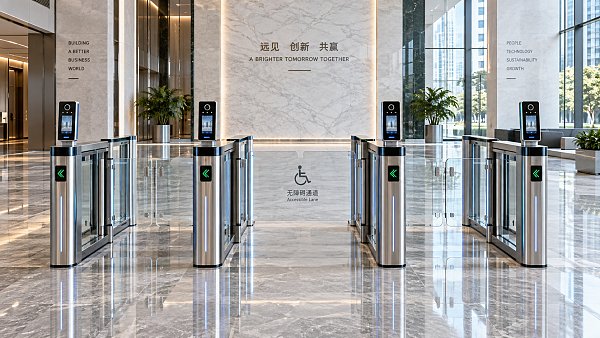
A fast speed gate may be appropriate where authorized people must pass continuously, but it must have sensor coverage capable of detecting an unauthorized second person entering the lane. A full-height barrier may provide stronger physical deterrence, though it can reduce throughput and create more complicated emergency egress, accessibility, and visitor-management considerations. The choice should be made from the required level of controlled passage, not from visual preference.
Map the real traffic pattern, including the inconvenient users
Average traffic figures are not enough. The entrance should be designed around the busiest short interval, the direction of movement, and the users who do not fit the standard employee profile. A lobby can appear lightly used for most of the day but become congested when several teams arrive within minutes, when meetings end, or when access is restored after a fire drill.
Document how people approach the lane. Facial recognition works best when users naturally pass within the terminal’s intended capture zone, at a reasonable distance and angle, without stopping abruptly in front of the gate. Where people approach from multiple directions, enter through a narrow vestibule, wear hats or safety equipment, or carry large items, the mounting position and capture geometry matter as much as the published recognition speed.
- Identify the peak arrival and exit periods rather than relying on daily headcount.
- Separate inbound, outbound, visitor, accessible, and service traffic where possible.
- Check whether users arrive in groups, follow one another closely, or wait near the lane entrance.
- Include people wearing glasses, masks where permitted, helmets, high-visibility PPE, or seasonal outerwear.
- Plan for wheelchairs, mobility aids, luggage, carts, deliveries, and evacuation routes.
An accessible lane should not be treated as an afterthought. It normally needs a clear passage width, a credential-reading and facial-capture position that works for varied user heights, and a controlled opening sequence that does not expose the entrance to uncontrolled passage. The release logic must also be coordinated with life-safety requirements. Gates that remain closed during normal operation may need to unlock, open, or allow free egress under the building’s required emergency conditions. That behavior must be confirmed early with the relevant design and safety stakeholders.
Specify the biometric decision, not just “face recognition”
Facial recognition performance depends on image capture, algorithm behavior, enrollment quality, lighting, subject movement, and the threshold chosen by the access policy. A specification should therefore state the intended authentication mode and operating conditions rather than simply requesting “high accuracy.”
For building entry, the key distinction is between identity matching and the action that follows. In a typical one-to-many mode, the system compares a live face against an enrolled database and returns a match decision. In a one-to-one workflow, the user first presents a credential and the face is used to confirm that the person matches the credential holder. The second approach can be useful where the project requires stronger identity assurance or where the enrolled population is large and policy calls for a more controlled process.
Liveness detection should be assessed as part of the complete spoofing-risk model. A terminal should be evaluated for its ability to distinguish a present person from attempts involving printed images, displayed images, replayed video, or other presentation attacks relevant to the site. The practical question is not whether a supplier uses the word “liveness,” but what attack types the installed configuration is expected to resist, what conditions can reduce performance, and what response is triggered when liveness cannot be established.
Do not specify a threshold so aggressively that ordinary users are repeatedly rejected at the entrance. An excessively strict matching threshold can create queues and encourage guards or reception staff to override events informally. A threshold that is too permissive can increase the risk of accepting the wrong person. The appropriate setting depends on the zone, the presence of a second credential factor, the quality of enrollment, and the consequences of a mistaken acceptance or rejection. Commissioning should include controlled tuning under actual lobby lighting and user flow, with a documented approval process for any changes.
Enrollment is part of the security design
Poor enrollment produces poor access decisions. The project should define who can enroll people, how identity is checked before enrollment, whether images are captured at a supervised station, how duplicate records are handled, and how access is removed when a person leaves the organization or no longer has authorization. A technically capable gate cannot correct an unreliable identity database.
For contractors, temporary staff, and visitors, determine whether facial templates are necessary at all. A temporary QR code, mobile credential, escorted entry, or reception-issued card may be more appropriate depending on duration, security policy, and privacy rules. Avoid expanding biometric enrollment simply because the terminal can support it.
Anti-tailgating performance needs lane-level requirements
Tailgating is a physical behavior problem, not only a biometric problem. The first person may be correctly identified, while a second person follows through the opening before the panels close. A terminal mounted near a gate does not automatically prevent this outcome.
Specify the lane’s detection arrangement, passage logic, and response behavior. Infrared sensor arrays, passage-zone monitoring, direction detection, and obstacle sensing can help distinguish a single authorized user from a close follower, a person entering from the wrong direction, or someone lingering inside the lane. However, the system response must match the site’s risk tolerance. A gate may alarm, attempt to close after safe clearance, notify security personnel, create a video event, or require local intervention. It should not close in a way that creates a foreseeable injury risk.
Ask suppliers to describe how the gate handles several realistic events: two people entering together, a child walking beside an adult, a person stepping back after recognition, a user carrying a package, and a person trying to reverse through the lane. Also establish whether the system distinguishes an alarm event from a confirmed denial of access. Security teams need usable event records, not a large volume of ambiguous alerts.
Design the integration architecture before tender release
Facial recognition gates typically interact with more than one system: access control software, identity or employee databases, visitor management, elevator control, video surveillance, building management interfaces, and sometimes emergency systems. Integration questions can become expensive when they are left until installation.
Decide which system is the authority for credentials and permissions. In many projects, the access control platform remains the source of access rules, while the facial terminal provides biometric authentication and the gate controller executes the physical opening command. This arrangement helps preserve consistent schedules, anti-passback rules, door groups, audit records, and revocation procedures. Where the facial device maintains its own user database, clarify synchronization frequency, conflict handling, offline behavior, and deletion procedures.
The tender documentation should identify the required interfaces and event exchange. At a minimum, define whether the system must pass approved, denied, forced passage, tailgating, door or gate fault, emergency release, and communication-loss events to the central platform. Also define what happens when the network connection fails. Some sites need local operation using a synchronized permissions cache; others may require the lane to remain locked, open, or switch to a guard-managed process. There is no universally correct choice because the security consequence of an outage differs by entrance.
Do not overlook time synchronization and audit quality
When gate events, biometric decisions, and camera footage are reviewed after an incident, timestamps must align. Confirm the method for time synchronization across terminals, controllers, servers, and video systems. Event logs should identify the lane, direction, event type, and relevant credential or user record without exposing unnecessary biometric information to general operators.
Privacy and data handling should shape the specification
Biometric entry projects involve sensitive personal information. The project team should establish the purpose for using facial recognition, who can access enrollment and audit functions, where data is stored, how long it is retained, and how users are informed. Requirements will depend on the applicable jurisdiction, building policy, employment arrangements, and contractual obligations, so legal and privacy review should occur before the system design is finalized.
From a technical procurement perspective, ask whether the system stores facial images, biometric templates, or both; whether templates are encrypted at rest and in transit; whether data can be exported; and how deletion is verified. Role-based permissions should separate routine operators from personnel who can enroll, change matching settings, export logs, or administer integrations. A reception operator may need to confirm a visitor appointment, but should not necessarily have access to biometric records.
Provide a practical alternative route for people who cannot or do not use facial recognition where required by policy or applicable rules. That alternative should remain secure and auditable. A card-only exception process may be appropriate, but it should not create an unmanaged side entrance that bypasses the intended access controls.
Write acceptance tests around building conditions
Factory demonstrations and laboratory claims are not a substitute for site acceptance. The final specification should require testing after installation, when the actual camera angle, lighting, reflective surfaces, lane geometry, network conditions, and user behavior are present. Test cases should be agreed before handover so that all parties measure the same operating outcomes.
- Verify authorized passage for enrolled users approaching at normal walking speed and from expected approach angles.
- Test denied access, expired permission, failed liveness, and unreadable or unavailable biometric conditions.
- Confirm the physical gate response to close-following, wrong-way passage, obstructions, and attempted simultaneous entry.
- Test integration events in the access control platform, including correct lane identification and timestamps.
- Simulate communication loss and power-related behavior according to the approved security and life-safety design.
- Confirm emergency release, accessible-route behavior, manual override, and recovery after an alarm or fault.
Commissioning should also include operational handover. Security and facilities teams need clear instructions for enrollment, exception entry, alarm response, lane reset, cleaning of sensors and camera windows, firmware change control, and escalation when recurring false rejects or tailgating alarms appear. A gate system becomes unreliable when staff compensate for unresolved faults with permanent manual overrides.
Questions that expose weak proposals
A proposal is incomplete when it lists recognition speed and terminal screen size but says little about lane behavior, interface responsibility, privacy controls, or failure modes. Ask suppliers to provide a site-specific layout showing terminal positions, lane widths, sensor areas, accessible passage, queue space, equipment cabinets, power and network requirements, and maintenance access. The drawing should show how people will actually enter and leave, not only where equipment can fit.
Also request a clear responsibility matrix. One party may supply the gate, another the biometric terminal, another the access control software, and another the electrical installation. Without defined ownership, faults can be passed between vendors: the gate opens but the event is missing, the terminal matches but the controller does not receive the command, or the network is present but user records are not synchronized. The project manager should require named responsibility for design coordination, interface testing, commissioning, documentation, and post-handover support.
The strongest specification treats facial recognition as one decision point in a controlled entry process. When the lane, identity policy, biometric settings, anti-tailgating response, privacy controls, and system interfaces are aligned before procurement, the resulting entrance is more likely to remain secure without becoming an obstacle to the people who use it every day.
Have questions about this sector analysis, or seeking best practices specific to your niche? Drop us a line below and let the senior consultants at MHLS assist you.
We respect your privacy. Your information is strictly confidential.
Recommended News
 Financial Facility Security: Choosing Vault Doors for Bank BranchesVault Structural ArchitectStrengthen financial facility security with the right bank vault door. Explore certification, installation, locking controls and maintenance before you buy.
 MACO Acquires Majority Stake in Fingerprint Access Provider ekeyProf. Elara SterlingMACO acquires a majority stake in ekey, bringing fingerprint access and door hardware closer together. Discover what the deal could mean for smart buildings.
 Physical Security System Engineering: From Risk Assessment to System DesignUnmanned Terminal FellowExplore physical security system engineering, from risk assessment to integrated design, procurement and testing. Build a safer, more resilient facility.
 Apple Home Collection Smart Lock and Other Accessories Open for Preorder November 13Biometric Auth ScientistApple Home Collection preorders open November 13, 2026. Explore the LG smart lock’s Matter and Aliro support and what buyers should verify before ordering.
 Choosing Servo-Driven Flap Barriers: Throughput, Safety and Access ControlAccess Control StrategistServo-driven flap barriers can balance throughput, safety and access control. Discover how to compare lanes, test performance and choose with confidence.
 Parcel Locker Network Pricing: Setup Costs, Fees and Contract TermsUnmanned Terminal FellowCompare parcel locker networks pricing, from setup costs and recurring fees to contract terms. Discover hidden charges and choose the right model.
 JR East Plans UWB Walk-Through Gates at 40 Stations in Spring 2028Access Control StrategistJR East plans UWB walk-through gates at 40 stations in spring 2028. Explore the rollout timeline and what suppliers should watch.
 Bank Vault Security Standards: UL and EN Ratings ExplainedVault Structural ArchitectExplore bank vault security standards and learn how UL 608 classes and EN 1143-1 grades differ, what they test, and how to verify certification before you buy.
 Mechanical Lock Hardware Prices: What Buyers Should Budget for Bulk OrdersMr. Gideon CrossMechanical lock hardware price is just the starting point. Discover what drives bulk-order costs and how to compare supplier quotes with confidence.
 IndexBox Forecasts Steady Global Security Keypad Market Growth Through 2035Dr. Valerius ThorneGlobal security keypad market growth is forecast at 3.3% annually through 2035. Explore the smart home and replacement trends shaping demand.
 Choosing an Infrared Safety Sensors Manufacturer: What Buyers Should CheckUnmanned Terminal FellowChoosing an infrared safety sensors manufacturer? Compare safety evidence, integration, environmental performance and lifecycle costs before you buy.
 Choosing a Security Material Testing Service: What to Check for Lock and Safe MaterialsProf. Elara SterlingChoose a security material testing service with confidence. Learn what to check for lock and safe materials, from attack methods and accreditation to reliable reports.











