How to Specify High-Throughput Servo Motor Speed Gates for Peak Traffic Hours
At 8:45 a.m., an entrance that feels smooth at midday can become a pressure point. Employees arrive in waves, visitors wait for reception approval, delivery staff appear at the same doors, and one slow or falsely triggered lane can create a queue that spills into the lobby. For project managers, the question is not simply whether a gate opens quickly. It is whether the entire entrance system can process real people, with bags, badges, hesitation, and occasional exceptions, without compromising safety or access-control integrity.
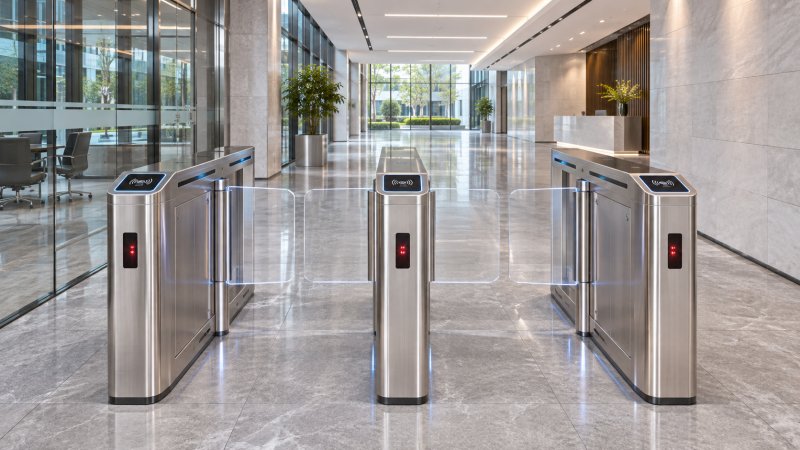
That is why specifying high throughput servo motor speed gates requires a broader view than comparing a supplier’s advertised opening time. A credible specification must connect peak-flow demand to lane geometry, servo drive performance, infrared sensing, authorization logic, emergency behavior, maintenance access, and the building systems around the gate.
The right decision is rarely the gate with the fastest-looking datasheet figure. It is the gate configuration that maintains predictable, safe throughput when the building is under its highest daily stress.
Begin with the traffic model, not the product brochure
Many specifications begin with a desired number of lanes. A more reliable process starts with the people-flow model. Ask how many authorized users must pass through during the busiest 5-, 10-, or 15-minute period, rather than relying only on total building occupancy. A corporate tower with 2,000 occupants may have a sharply concentrated morning arrival pattern; a hospital may experience continuous but irregular flow; a metro-connected campus may see several intense surges across the day.
Then separate traffic into realistic user groups. Staff using mobile credentials may move quickly. Visitors may pause, search for a QR code, or require intercom assistance. Users with trolleys, wheelchairs, luggage, or large equipment need wider passage and should not be treated as normal-lane traffic. A single mixed-use gate often becomes the hidden bottleneck in an otherwise well-designed bank.
A practical planning equation is:
Required lane capacity = peak arrivals during the chosen period ÷ effective operating minutes ÷ target usable capacity per lane.
The important phrase is usable capacity. Manufacturers may state high theoretical passage rates under controlled conditions: one person at a time, ready credential, ideal spacing, no alarms, and no uncertainty about direction. Actual throughput is lower when people bunch together, stop at the reader, follow closely, or need a second authorization attempt. Project teams should therefore request the basis of every throughput claim: credential type, lane width, opening mode, detection settings, passage direction, and test conditions.
It is also wise to design for an operational reserve. If every lane is expected to run at its absolute maximum during the morning rush, a disabled lane, a reader fault, or a visitor intervention will quickly turn into a visible queue. Capacity headroom is not wasted equipment; it is resilience.
What the servo motor changes—and what it does not
Servo-driven speed gates are valued because they offer controlled acceleration, deceleration, and positioning of the glass or barrier wings. Compared with simpler drive arrangements, a well-engineered servo system can support brisk response while reducing harsh impacts at the end of travel. It can also provide more consistent barrier movement across repeated cycles, which matters during prolonged high-use periods.
But “servo motor” alone is not a performance guarantee. The gate’s mechanical design, barrier mass, control tuning, transmission components, sensing logic, and operating mode determine how that motor performs in a live entrance. A fast motor paired with poorly calibrated safety detection may repeatedly slow down or reopen. A strong drive mechanism cannot compensate for readers located awkwardly or an access-control decision that takes too long.
When reviewing high throughput servo motor speed gates, ask suppliers to describe the complete motion sequence: credential presentation, authorization signal receipt, barrier opening, monitored passage, tailgating decision, barrier closure, and recovery after an aborted passage. This sequence reveals more than an isolated “opening time” number.
Specify the lane as a passage experience
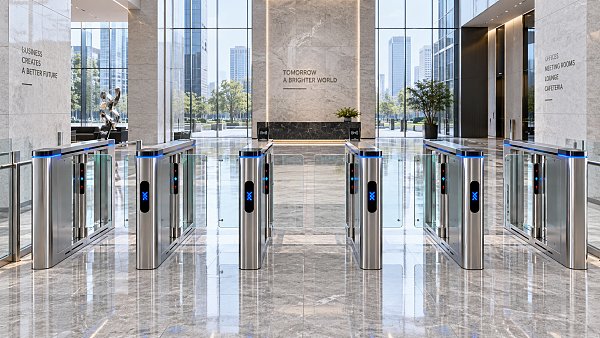
A speed gate is not just a barrier. It is a guided passage corridor. Lane width, cabinet length, reader placement, illumination, and barrier height all influence whether users move naturally or hesitate.
Standard lanes may suit badge-carrying office populations, but a site with winter coats, backpacks, laptop bags, or frequent visitors may benefit from a less restrictive geometry. Wider lanes improve accessibility and accommodation, yet they also create a larger detection area and may require more careful sensor configuration to maintain anti-tailgating performance. The answer is usually a deliberate mix: several standard lanes for routine traffic and one or more accessible lanes placed where they can be supervised and reached without disrupting the main flow.
Barrier height deserves the same attention. Taller panels may better discourage unauthorized crossing or climbing, particularly in high-security workplaces, data centers, financial facilities, or restricted operational zones. However, taller barriers add visual presence and can affect the perceived openness of a lobby. They should be selected according to the risk assessment, not as an automatic upgrade.
Directionality matters as well. Reversible lanes are useful when morning inbound traffic is much greater than outbound traffic, but the switching rules must be defined. Will a central access-control platform change directions on a schedule? Can a security officer override the setting? What happens if a person approaches from the non-permitted side while the lane is transitioning? These are small operational details until the first peak-hour crowd exposes them.
Throughput depends on the entire authorization chain
A beautifully engineered gate cannot process people faster than the identity system can make decisions. The gate controller, card reader, mobile credential reader, QR scanner, biometric terminal, visitor-management platform, and access-control panel all contribute to transaction time.
For fast employee traffic, the user journey should be tested from approach to exit. A reader that requires users to stop directly in front of it will reduce flow, even if the gate opens rapidly. Mobile credentials can be convenient, but their real performance depends on handset positioning, Bluetooth or NFC configuration, policy settings, and how consistently users understand the interaction. Facial or other biometric credentials may remove the need to present a token, but they require thoughtful placement, liveness assurance, privacy governance, lighting review, enrollment planning, and an efficient fallback process.
Integration requirements should be written clearly. The speed gate should communicate with the designated access-control system through supported, documented interfaces. The project team should define who owns the decision logic, how events are timestamped, what alarm events are sent upstream, and whether the system records invalid entry attempts, reverse passage, forced barrier movement, or tailgating alarms. Avoid assuming that all alarms have the same meaning across vendors.
Safety sensing and security detection must work together
Peak throughput creates a difficult balance. If the gate closes too conservatively, it remains open for excessive time and may allow unauthorized following. If it closes too aggressively, normal users can feel rushed, alarms increase, and safety concerns rise. The objective is not the shortest possible open period; it is a stable, well-monitored passage cycle.
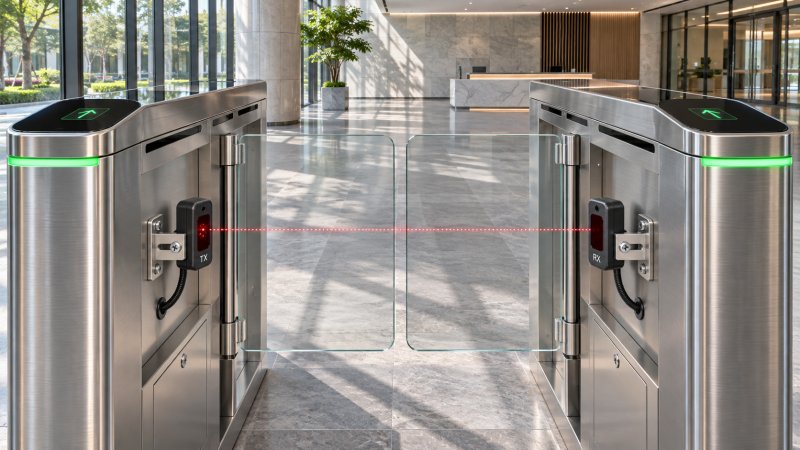
Multi-beam infrared arrays are central to this process. They can monitor approach, occupancy, direction, passage completion, obstruction, and abnormal movement patterns. Procurement documents should not merely request “infrared sensors.” They should ask how many detection zones are monitored, where beams are positioned, how the system distinguishes a legitimate user from a second person entering behind them, and how it responds to a bag, cane, stroller, or wheelchair.
Tailgating performance should be evaluated honestly. No pedestrian gate can eliminate every form of determined intrusion, particularly when an authorized person deliberately holds a passage open. The practical aim is to deter casual unauthorized entry, detect suspicious passage patterns, generate usable alarms, and give staff or connected security systems enough information to respond. In sensitive areas, speed gates may need to be part of a layered design that includes staffed reception, video surveillance, visitor screening, and zone-based access permissions.
Ask for a demonstration of nuisance-alarm handling. A system that sounds frequent alarms for normal behavior can lead staff to ignore alerts, while a system tuned too loosely may fail to flag meaningful incidents. The correct settings depend on the site population and should be adjustable during commissioning.
Do not leave emergency operation until late in the project
Emergency egress requirements vary by jurisdiction, building use, and fire strategy. The gate specification must align with the approved life-safety design and relevant local codes. Depending on the application, barriers may need to open, retract, or move to a defined fail-safe position when a fire alarm is activated, power is lost, or an emergency release is triggered.
These behaviors should be documented as cause-and-effect scenarios, not vague statements such as “fire alarm compatible.” Clarify whether the gates fail open or remain secured under particular events, whether they require a dry contact or network command, how long backup power must support orderly operation, and what happens when communication to the access-control platform is unavailable.
For sites where security continuity is essential, distinguish between life-safety release and routine network failure. A gate should never create an egress hazard, but its behavior during controller, reader, or network faults should still be planned, tested, and understood by security operations.
A specification checklist that prevents expensive assumptions
Before issuing a tender or approving a preferred supplier, turn operational expectations into measurable requirements. The schedule should cover more than dimensions and finishes. It should include:
- Peak arrival, departure, and visitor-flow assumptions, with required reserve capacity.
- Number of standard, accessible, and reversible lanes, including planned direction modes.
- Servo drive design, barrier movement sequence, duty expectations, and recovery behavior after obstruction.
- Clear passage width, cabinet dimensions, barrier height, glass or panel construction, and lobby interface requirements.
- Credential technologies and the full access-control integration architecture.
- Infrared detection coverage, anti-tailgating logic, alarm outputs, and adjustable sensitivity parameters.
- Fire alarm interface, emergency release behavior, power-loss mode, and backup-power responsibility.
- Environmental conditions such as dust, humidity, temperature variation, sunlight exposure, and indoor/outdoor transition zones.
- Maintenance access, replaceable wear components, diagnostics, local service response, spare-parts availability, and training.
Finish selection should be addressed without allowing it to dominate the decision. Stainless steel grades, powder-coated surfaces, glass treatments, top-lid materials, and indicator lighting all affect the appearance and cleanability of a public entrance. Yet the most attractive cabinet will not rescue a lane layout that produces queues or a sensor configuration that frustrates users.
Use site acceptance testing to validate the promise
Factory testing is valuable, especially for verifying mechanical operation, controller configuration, interfaces, and finish quality before delivery. Still, the meaningful test happens after installation, with the actual readers, credentials, access-control logic, power supply, network conditions, and intended user population.
Project managers should agree on site acceptance criteria before commissioning begins. Test routine authorized passages, close-following attempts, reverse movement, blocked barriers, invalid credentials, reader outages, network interruptions, emergency release, and restoration to normal service. Run repeated flow trials rather than judging performance from a few individual passages. Where possible, include people unfamiliar with the system; they often reveal usability problems that trained installers do not encounter.
Record settings at handover. The detection parameters, timing values, firmware versions, integration drawings, wiring diagrams, and escalation contacts should be part of the operational file. This matters months later when a building manager asks why one lane behaves differently after a software update or a change in occupancy patterns.
The procurement decision: choose dependable flow, not a headline speed figure
For a project manager, high throughput servo motor speed gates are an investment in both security and the daily mood of a building. A smooth entrance is easy to overlook; a congested or unreliable one becomes everyone’s problem before the workday has begun.
The strongest specification begins with observed peak traffic, accounts for real user behavior, and treats the gate as one part of a connected physical security system. Evaluate servo motion, sensing, lane design, access-control response, emergency behavior, and maintainability as a combined operating model. When those elements are aligned, the entrance can move people quickly without making security feel fragile—or making users feel processed by a machine.
Have questions about this sector analysis, or seeking best practices specific to your niche? Drop us a line below and let the senior consultants at MHLS assist you.
We respect your privacy. Your information is strictly confidential.
Recommended News
 Physical Security Infrastructure Cost: Budgeting for Installation and MaintenanceUnmanned Terminal FellowUnderstand physical security infrastructure cost and build a smarter budget for installation, maintenance, and long-term ownership.
 Financial Facility Security: Choosing Vault Doors for Bank BranchesVault Structural ArchitectStrengthen financial facility security with the right bank vault door. Explore certification, installation, locking controls and maintenance before you buy.
 MACO Acquires Majority Stake in Fingerprint Access Provider ekeyProf. Elara SterlingMACO acquires a majority stake in ekey, bringing fingerprint access and door hardware closer together. Discover what the deal could mean for smart buildings.
 Physical Security System Engineering: From Risk Assessment to System DesignUnmanned Terminal FellowExplore physical security system engineering, from risk assessment to integrated design, procurement and testing. Build a safer, more resilient facility.
 Apple Home Collection Smart Lock and Other Accessories Open for Preorder November 13Biometric Auth ScientistApple Home Collection preorders open November 13, 2026. Explore the LG smart lock’s Matter and Aliro support and what buyers should verify before ordering.
 Choosing Servo-Driven Flap Barriers: Throughput, Safety and Access ControlAccess Control StrategistServo-driven flap barriers can balance throughput, safety and access control. Discover how to compare lanes, test performance and choose with confidence.
 Parcel Locker Network Pricing: Setup Costs, Fees and Contract TermsUnmanned Terminal FellowCompare parcel locker networks pricing, from setup costs and recurring fees to contract terms. Discover hidden charges and choose the right model.
 JR East Plans UWB Walk-Through Gates at 40 Stations in Spring 2028Access Control StrategistJR East plans UWB walk-through gates at 40 stations in spring 2028. Explore the rollout timeline and what suppliers should watch.
 Bank Vault Security Standards: UL and EN Ratings ExplainedVault Structural ArchitectExplore bank vault security standards and learn how UL 608 classes and EN 1143-1 grades differ, what they test, and how to verify certification before you buy.
 Mechanical Lock Hardware Prices: What Buyers Should Budget for Bulk OrdersMr. Gideon CrossMechanical lock hardware price is just the starting point. Discover what drives bulk-order costs and how to compare supplier quotes with confidence.
 IndexBox Forecasts Steady Global Security Keypad Market Growth Through 2035Dr. Valerius ThorneGlobal security keypad market growth is forecast at 3.3% annually through 2035. Explore the smart home and replacement trends shaping demand.
 Choosing an Infrared Safety Sensors Manufacturer: What Buyers Should CheckUnmanned Terminal FellowChoosing an infrared safety sensors manufacturer? Compare safety evidence, integration, environmental performance and lifecycle costs before you buy.