
How to Specify Servo Motor Speed Gates for High-Traffic Corporate Lobbies
Specifying servo motor speed gates for lobbies requires more than choosing an entrance barrier that matches the interior design. In a busy corporate headquarters, the access lane is where visitor experience, employee convenience, life-safety expectations, and security policy meet—often during the same fifteen-minute morning rush.
For project managers, the pressure is familiar. The architect wants an open, premium-looking reception area. Security wants credible tailgating deterrence. Facilities wants equipment that can be serviced without disrupting the building. The IT and access-control teams need reliable integration with credentials, mobile passes, visitor systems, and emergency workflows. A gate that looks impressive in a showroom can still become a daily bottleneck if its lane logic, passage speed, sensor coverage, or recovery behavior is poorly matched to the site.
The right specification begins with the movement of people through the lobby, not with the cabinet finish or a supplier’s headline throughput figure. This guide provides a practical framework for evaluating servo-driven speed gates in high-traffic corporate environments.
Start with the lobby’s real traffic pattern
A corporate lobby is rarely a steady-flow environment. It has sharp peaks: employees entering before work, visitors arriving for meetings, delivery personnel checking in, contractors reporting to security, and staff leaving at the end of the day. In some buildings, tenants use different credentials and access rules. In others, the lobby must accommodate wheelchairs, luggage, cleaning carts, and occasional event crowds.
Before selecting a lane configuration, map the journey from curb or elevator bank to the secure side of reception. Ask where people stop, where they queue, where credentials are presented, and where a guard needs a clear view. A speed gate only works well when the surrounding space supports it. If readers are located too close to the lane, users may pause inside the passage. If the approach zone is narrow, a queue can spill toward elevators or fire exits. If the reception desk sits behind the gates, staff may struggle to help a visitor who has failed authentication.
Project teams should distinguish between average daily volume and peak arrival demand. The latter is what determines whether the entrance feels calm or congested. Use actual badge data where available, supplement it with on-site observation, and include predictable surges such as tenant move-ins, conference days, or weather-driven changes in arrival patterns.
Do not confuse theoretical throughput with usable throughput
Manufacturers may describe high passage capacities under ideal conditions: one credentialed person at a time, familiar users, correct approach speed, and no alarms. A real lobby includes hesitant guests, people looking at phones, colleagues walking side by side, credentials that fail to read, and staff carrying coffee or laptops.
When reviewing capacity, request clarity on how throughput is measured. Is the figure based on continuous authorized passages? Does it include opening and closing time, authentication delay, or the reset time after an invalid attempt? Can the lane maintain practical flow when connected to the building’s preferred credential technology? The most useful planning number is not the most flattering number; it is the number that reflects how people in that specific property will behave at 8:45 a.m.
Why servo drive selection matters beyond “fast opening”
Servo motor speed gates are often selected because they can deliver controlled, responsive barrier movement. Compared with simpler drive arrangements, a properly engineered servo system can provide more precise acceleration, deceleration, position control, and obstacle response. These traits matter in a public-facing entrance, where barrier wings must move briskly enough to maintain flow but predictably enough to avoid creating an intimidating or unsafe passage.
Still, “servo-driven” is not a complete performance specification. Project teams should ask suppliers to explain the behavior of the entire gate system: drive motor, mechanical transmission, control board, barrier material, infrared sensing, access-control interface, and fault recovery logic. A fast motor cannot compensate for inadequate sensor coverage or poor lane geometry.
Key points to clarify include:
- Opening and closing profile: How does the barrier move when a valid credential is presented, when a user hesitates, or when someone reverses direction?
- Obstacle detection and reversal: What happens if a person, bag, wheelchair, or child is within the closing path?
- Duty cycle suitability: Is the drive designed for repeated peak-hour operation rather than light intermittent use?
- Mechanical wear points: Which components are subject to routine adjustment or replacement, and how accessible are they?
- Noise and vibration: In an executive lobby, audible impacts or unstable barrier movement can undermine the perceived quality of the entire security installation.
A good specification describes desired outcomes rather than relying on broad claims. For example, require smooth controlled movement, configurable passage timing, monitored obstruction response, and a documented maintenance procedure. Then ask vendors to demonstrate those outcomes using the anticipated credential and lane configuration.
Tailgating detection should be designed around risk, not marketing language
Corporate lobbies often need to deter unauthorized following without turning every close passage into an alarm event. This is a delicate balance. An overly sensitive system can generate frequent nuisance alarms when employees walk closely during a rush. A weak detection strategy may allow a second person to follow through before the barrier closes.
Infrared sensor arrays are central to this decision. The important question is not simply how many sensors are listed on a datasheet, but whether the detection zones can distinguish a single authorized passage from common tailgating and intrusion patterns. Review how the system responds to someone entering immediately behind an authorized user, someone attempting to pass in the opposite direction, or a person lingering inside the lane.
Tailgating performance also depends on lane width and barrier height. Wider standard lanes improve comfort but may provide more room for an unauthorized companion. Taller or longer glass barriers can create a clearer physical and visual boundary, but they can affect openness, sightlines, and evacuation strategy. There is no universally correct combination. A financial-services office with controlled visitor access may have a different risk profile from a multi-tenant creative campus where reception staff are constantly managing guests.
Define the expected response in advance. Should the gate close if safe to do so? Should it remain open and trigger a local audible signal? Should an event appear at the guard desk or be sent to the access-control platform? Security operations should own this decision, because an alarm that no one can act upon is not meaningful protection.
Lane mix is usually more important than buying identical gates
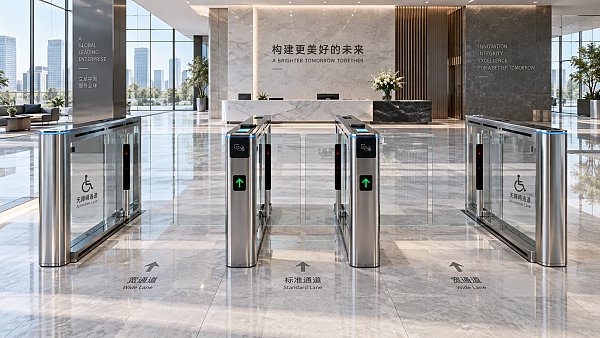
A common planning mistake is specifying a row of identical narrow lanes because the layout appears efficient on a drawing. In practice, high-traffic lobbies usually benefit from a deliberate mix of standard and accessible passages.
Standard lanes support the bulk of credentialed employees. At least one wider lane is typically needed for wheelchair users, visitors with luggage, building service personnel, carts, and emergency operational needs. Depending on the lobby, the accessible lane may also serve as a monitored visitor lane, particularly where reception staff issue temporary badges or need to intervene before access is granted.
Do not leave the accessible lane to the end of the design process. Its position affects queue flow, reception visibility, reader locations, and the overall symmetry of the entrance. It should be accessible without forcing users to navigate around furniture or through a crowded waiting area.
Integration decisions can determine whether the gates feel effortless or frustrating
Speed gates sit at the physical edge of a larger access-control environment. Their performance is shaped by the quality of that connection. A project manager should establish early whether the gates will interface with legacy card readers, mobile credentials, QR visitor passes, biometric verification, elevator controls, or a combination of these systems.
Credential read range and presentation behavior deserve particular attention. If employees must stop, tap, wait, and then step forward, the system will feel slower than a gate with the same barrier opening time but better reader positioning. Conversely, readers configured for long-range detection may need careful tuning to prevent accidental authorizations from nearby users.
Require a documented interface matrix covering inputs, outputs, communication methods, alarm states, lane status, remote unlock, and monitoring requirements. Include the operational cases that are easy to overlook during procurement: lost network communication, reader malfunction, power interruption, fire alarm activation, manual guard override, and a gate held open beyond its normal passage window.
For lobbies with a staffed security desk, consider how alarms will be presented. A guard should be able to understand which lane generated the event, what condition occurred, and whether a response is needed without studying a confusing bank of generic indicators. Integration is not complete merely because a gate opens after a valid card read.
Fire, emergency, and fail-state behavior must be resolved with the authority having jurisdiction
Speed gates are part of an occupied building environment, not standalone security equipment. Their placement and behavior must align with local building codes, life-safety requirements, accessibility obligations, and the approved egress plan. Requirements differ by jurisdiction, so teams should avoid copying a layout from another project without confirming local conditions.
During early design coordination, establish which gates sit on an egress route, how barriers behave during an alarm or power event, who controls emergency release, and whether the clear opening provided is acceptable for the planned occupant flow. The words “fail-safe” and “fail-secure” should never be accepted as vague labels; ask exactly what the barrier does, under which event, and after which command.
Also review the physical environment. Floor flatness, anchoring conditions, cable routes, ceiling constraints, nearby revolving doors, and access to service panels can all affect installation quality. A beautiful gate line with no practical maintenance clearance becomes an expensive future problem.
Build the procurement brief around acceptance tests
For a high-traffic corporate entrance, a generic bill of quantities is not enough. A stronger procurement brief states the use case, operating conditions, integration expectations, and acceptance process. This gives bidders a clearer basis for proposing an appropriate system and gives the project team a defensible way to compare offers.
Ask shortlisted suppliers to address the following during technical review:
- How the proposed servo motor speed gates handle expected peak traffic and mixed user behavior.
- Sensor coverage diagrams for authorized passage, tailgating, wrong-way movement, and obstruction detection.
- Barrier material, height, lane dimensions, and the rationale for the proposed lane mix.
- Access-control compatibility, reader mounting options, and available status or alarm outputs.
- Emergency release and power-loss behavior, subject to the project’s approved life-safety design.
- Preventive maintenance intervals, spare-parts availability, local support arrangements, and recommended commissioning procedures.
Acceptance testing should reproduce the conditions that matter: consecutive valid users during a busy period, an invalid credential attempt, a person following too closely, a user pausing inside the lane, wheelchair passage, guard override, and the relevant emergency mode. Where practical, involve security operations and facilities staff in these tests. They will live with the consequences long after the construction team has handed over the building.
A practical decision rule for project managers
When choosing among competing proposals, resist the temptation to rank systems by speed alone. The best choice is usually the one that produces the most reliable passage experience under real lobby conditions while providing an appropriate level of deterrence, integration, and maintainability.
For most corporate projects, that means selecting a servo-driven gate platform with proven control of barrier movement, thoughtfully designed infrared safety and anti-tailgating sensing, a lane mix that reflects accessibility and service needs, and an integration approach tested against the building’s actual workflows. Design language matters in a lobby, but it should be the visible result of a sound operational decision—not a substitute for one.
Well-specified servo motor speed gates for lobbies do something deceptively difficult: they make authorized people feel as though the building recognizes them, while making unauthorized passage noticeably harder. Achieving that balance starts with a procurement process grounded in traffic behavior, risk, and day-to-day operation.
Have questions about this sector analysis, or seeking best practices specific to your niche? Drop us a line below and let the senior consultants at MHLS assist you.
We respect your privacy. Your information is strictly confidential.
Recommended News
 Financial Facility Security: Choosing Vault Doors for Bank BranchesVault Structural ArchitectStrengthen financial facility security with the right bank vault door. Explore certification, installation, locking controls and maintenance before you buy.
 MACO Acquires Majority Stake in Fingerprint Access Provider ekeyProf. Elara SterlingMACO acquires a majority stake in ekey, bringing fingerprint access and door hardware closer together. Discover what the deal could mean for smart buildings.
 Physical Security System Engineering: From Risk Assessment to System DesignUnmanned Terminal FellowExplore physical security system engineering, from risk assessment to integrated design, procurement and testing. Build a safer, more resilient facility.
 Apple Home Collection Smart Lock and Other Accessories Open for Preorder November 13Biometric Auth ScientistApple Home Collection preorders open November 13, 2026. Explore the LG smart lock’s Matter and Aliro support and what buyers should verify before ordering.
 Choosing Servo-Driven Flap Barriers: Throughput, Safety and Access ControlAccess Control StrategistServo-driven flap barriers can balance throughput, safety and access control. Discover how to compare lanes, test performance and choose with confidence.
 Parcel Locker Network Pricing: Setup Costs, Fees and Contract TermsUnmanned Terminal FellowCompare parcel locker networks pricing, from setup costs and recurring fees to contract terms. Discover hidden charges and choose the right model.
 JR East Plans UWB Walk-Through Gates at 40 Stations in Spring 2028Access Control StrategistJR East plans UWB walk-through gates at 40 stations in spring 2028. Explore the rollout timeline and what suppliers should watch.
 Bank Vault Security Standards: UL and EN Ratings ExplainedVault Structural ArchitectExplore bank vault security standards and learn how UL 608 classes and EN 1143-1 grades differ, what they test, and how to verify certification before you buy.
 Mechanical Lock Hardware Prices: What Buyers Should Budget for Bulk OrdersMr. Gideon CrossMechanical lock hardware price is just the starting point. Discover what drives bulk-order costs and how to compare supplier quotes with confidence.
 IndexBox Forecasts Steady Global Security Keypad Market Growth Through 2035Dr. Valerius ThorneGlobal security keypad market growth is forecast at 3.3% annually through 2035. Explore the smart home and replacement trends shaping demand.
 Choosing an Infrared Safety Sensors Manufacturer: What Buyers Should CheckUnmanned Terminal FellowChoosing an infrared safety sensors manufacturer? Compare safety evidence, integration, environmental performance and lifecycle costs before you buy.
 Choosing a Security Material Testing Service: What to Check for Lock and Safe MaterialsProf. Elara SterlingChoose a security material testing service with confidence. Learn what to check for lock and safe materials, from attack methods and accreditation to reliable reports.











