
How to Specify Smart Building Entry Gates for Secure, High-Traffic Lobbies
A secure lobby gate specification begins with a traffic decision, not a product decision. Project teams need to establish who will pass through the entrance, when peak demand occurs, how visitors are processed, and what level of unauthorized entry the building must deter or detect. A gate that performs well in a lightly used corporate reception can become a daily bottleneck at a multi-tenant office tower, while a fast-moving speed gate may be inappropriate at an entrance where visitor screening and high assurance are the priority.
For most high-traffic lobbies, the practical objective is controlled flow: authorized users should pass with minimal interruption, while tailgating attempts, wrong-way movement, forced entry, and safety incidents are identified quickly enough for the building team to act. Smart building entry gates can support that objective, but only when lane design, credential technology, sensor performance, access-control logic, and operating procedures are specified as one system.
Start with the lobby's real traffic profile
Daily headcount alone is a weak basis for sizing an entrance. The design should focus on short peak periods: the morning arrival window, lunch movements, tenant shift changes, event arrivals, and emergency or weather-related surges. A lobby may handle a modest number of employees over a full day but still require substantial lane capacity when several hundred people arrive within a short interval.
Map each user group separately. Employees with mobile credentials or proximity cards generally move differently from visitors checking in at a desk, contractors using temporary credentials, wheelchair users, delivery personnel, and staff carrying carts or equipment. Combining every group into a single assumed throughput figure often leads to a gate layout that appears adequate in a proposal but performs poorly after occupancy.
For a typical commercial lobby, the entrance plan should answer several operational questions before gate models are compared:
- How many people are expected during the busiest 5-, 10-, and 15-minute intervals?
- What percentage will arrive with a credential already active and ready to present?
- Will visitors receive credentials before reaching the gate line, or will reception staff need to intervene?
- Are there tenant-specific access rights, lift destination controls, or restricted floors to enforce?
- Can one accessible or service lane also handle occasional bulky items without disrupting all pedestrian flow?
- Where can guards or reception staff see alarms, exceptions, and queue formation?
The answers determine the number of standard lanes, the need for a wider accessible lane, and whether a separate visitor route is preferable. They also reveal a common specification mistake: treating a wide lane as a universal relief valve. A wide passage is essential for accessibility and operational flexibility, but it is usually slower to process and may present a larger unauthorized-entry opportunity if it is left open, poorly supervised, or assigned to ordinary traffic during rush periods.
Choose the barrier around the required level of control
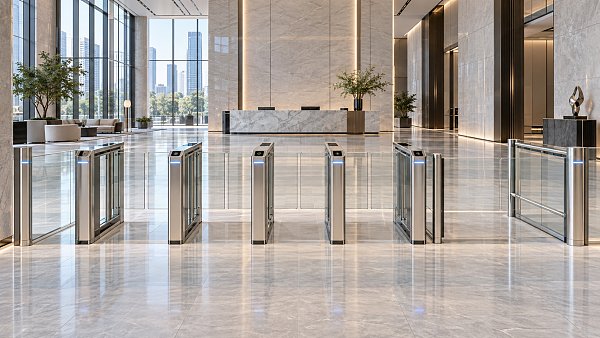
“Entry gate” covers several very different physical approaches. Waist-high tripod turnstiles, optical swing gates, flap barriers, and full-height turnstiles serve different risk profiles. In a premium office lobby, the selection is often an optical or glass-barrier speed gate because it preserves an open reception environment while making authorized access visible and manageable. That choice should not be confused with high-security containment.
Optical lanes can detect passage and discourage casual tailgating, especially when fitted with well-designed infrared sensor arrays and properly tuned control logic. Their effectiveness depends on the geometry of the lane, barrier height, sensor coverage, gate closing behavior, and the response to an alarm. They are less suited to an entrance where preventing physical breach is the primary requirement and a determined intruder is expected.
Full-height turnstiles create a more substantial physical boundary, but their visual impact, egress planning, accessibility implications, and user experience make them better suited to perimeter entrances, staff-only areas, parking interfaces, industrial sites, or separately secured zones than to many public-facing lobbies. Between these extremes are barrier configurations with higher glass wings or more restrictive lane geometry. These may improve deterrence, but they also affect evacuation design, perceived openness, and the consequences of a sensor error.
A useful specification does not ask which gate is “most secure.” It defines the threat the system must address. Casual follow-through, deliberate tailgating, passback, unauthorized visitor access, and forced barrier opening are distinct events. They need different combinations of physical design, credential rules, monitoring, and staff response.
For example, a gate that alarms after two people enter on one credential may be appropriate where a nearby receptionist can intervene. In an unattended lobby, an alarm alone may have little operational value unless it triggers remote video review, an on-site guard response, or a workflow that restricts further access. Security performance should be evaluated as detection plus response, rather than sensor detection in isolation.
Anti-tailgating claims need to be tested in the proposed lane configuration
Tailgating is often the most important reason to deploy smart building entry gates, and also the feature most easily overstated during procurement. A supplier may describe a gate as anti-tailgating because its sensors can recognize multiple bodies or abnormal movement. That is not enough information for a project team to judge performance.
Ask how the system distinguishes between a person following closely, two people walking side by side, a person turning back, an individual pausing in the lane, and a user carrying a large bag. Ask what happens when an unauthorized second person is detected: do the barriers close, hold, reopen, sound a local alarm, create an access-control event, notify a workstation, or require manual reset? Each response has implications for safety, flow, and security.
Sensor performance should also be assessed against the lobby's actual conditions. Bright exterior light, reflective stone or glass finishes, low winter sun, polished floors, loose clothing, umbrellas, luggage, children accompanying visitors, and crowded arrival patterns can all influence how a lane behaves. A demonstration in a controlled showroom is useful, but it is not a substitute for validating the proposed configuration against the building's expected use.
The specification should require a witnessed acceptance process that includes representative use cases. This does not require inventing a universal performance figure; it requires agreeing in advance on the movements and alarm outcomes that matter to the building. Test normal authorized passage, close-following attempts, passage in the wrong direction, passage after a denied credential, a person entering and retreating, repeated invalid presentation, and an obstruction during barrier movement. The owner should also define which events must appear in the access-control log and which must be visible to lobby staff in real time.
Throughput must be measured with the access journey included
Gate manufacturers may state a lane throughput based on ideal credential presentation and uninterrupted walking. That figure can be useful for comparing equipment, but it is not the same as lobby throughput. The practical capacity of the entrance also includes how quickly users approach, locate a reader, present a phone or badge, wait for a barrier to open, clear the lane, and recover from a rejected credential.
Reader placement deserves more attention than it often receives. A reader mounted too close to the barrier can cause users to stop abruptly. A reader that is difficult to locate encourages people to wave cards repeatedly, slowing the queue and creating unnecessary denied transactions. Mobile credential use introduces additional variation because phones may be locked, held in different orientations, or presented from a pocket or wallet. A well-positioned reader, clear but restrained wayfinding, and sufficient approach space can improve flow without adding lanes.
Do not size the system based solely on nominal lane speed. Allow for a lane temporarily out of service, visitor surges, access-control exceptions, and the fact that an alarmed lane can interrupt traffic around it. Where the entrance is business-critical, a layout with reserve capacity and a clear fallback process is generally more resilient than one designed precisely to average daily demand.
Integration decisions can create more risk than the gate hardware
Entry gates should not operate as isolated devices. They sit between the access-control platform, credential management process, visitor system, fire and life-safety controls, video surveillance, and sometimes elevator destination dispatch. The integration scope should be explicit early in the project, especially where the gate supplier, access-control integrator, electrical contractor, and building management team have separate responsibilities.
At a minimum, the gate controller should receive reliable authorization decisions and return meaningful event data. The project team should define the event types required for operation and investigation: authorized entry, denied entry, tailgating alarm, forced opening, obstruction, lane fault, emergency release, and communication loss. Generic “alarm” reporting can leave facility teams unable to distinguish a security issue from a mechanical or sensor condition.
Credential policy also needs to match the gate's operating behavior. Anti-passback rules, visitor expiration, lost-card revocation, mobile credential provisioning, and staff access schedules are all relevant only if the administration process is dependable. A strict anti-passback rule may appear secure on paper but generate frequent exceptions in buildings with multiple entrances or mixed turnstile and open-access routes. Project leaders should examine the whole user journey before enabling restrictions that reception teams cannot realistically manage.
Where biometrics are proposed, the decision should be based on a clear operational need. Biometric readers may reduce reliance on physical cards in some settings, but they introduce enrollment, privacy, consent, fallback credential, data governance, and user-support requirements. They should not be added simply because the gate can accept them. For a large office lobby, reliable card or mobile credentials combined with good lane supervision may offer a more workable balance unless higher assurance is specifically required.
Safety, fire egress, and accessibility are design inputs
Security gates are installed at an entrance used by people under normal, rushed, and emergency conditions. Safety must therefore be evaluated as part of the selection, not reviewed after a preferred model has been chosen. Barrier motion, sensor coverage, obstacle detection, emergency release, and manual override need to be considered alongside the building's egress strategy.
The required response to a fire alarm or other emergency signal should be documented with the responsible life-safety parties. Depending on the approved design, lanes may need to open, unlock, or otherwise allow free egress. The project team should understand what happens if power fails, communications are lost, or a controller fault occurs. “Fail safe” and “fail secure” are often used loosely; the practical behavior at each doorway, in each direction, and under each failure condition should be unambiguous.
Accessibility should be designed into the lane arrangement rather than solved with an exception procedure. The accessible route should be intuitive, consistently available, and controllable without requiring a user to wait for a staff member when the building's operating model does not provide one. Consider wheelchair turning space, the direction of travel, reader reach, sensor behavior around mobility aids, and the use of the lane by people with luggage, pushchairs, or temporary injuries. A compliant clear width is only one part of a usable entrance.
Specify durability and serviceability as lifecycle requirements
High-traffic lobby gates are electromechanical assets exposed to repeated movement, impacts, cleaning activity, and user error. A visually refined barrier can become a recurring operational problem if replacement parts are slow to obtain, diagnostics are opaque, or routine service requires extended lane closures.
Procurement documents should ask for more than a general warranty statement. Require clarity on recommended preventive maintenance, components subject to wear, diagnostic access, remote support capability where applicable, local service coverage, spare-parts availability, software and firmware update responsibilities, and the expected process for a lane fault during business hours. The building team also needs training for basic recovery tasks, such as clearing a minor obstruction, identifying a communication issue, and placing a lane safely out of service.
Finish materials should be chosen for the actual lobby environment. Glass panels, stainless steel, painted surfaces, and reader housings all need to tolerate frequent contact and cleaning without quickly looking damaged. In busy public lobbies, the cost of maintaining appearance can matter as much as the cost of mechanical maintenance. Details such as panel replacement procedures, exposed fasteners, cable access, and the availability of matching components years later affect lifecycle cost more than a low initial equipment price suggests.
Use the procurement process to expose operational gaps
A strong request for proposal should ask bidders to respond to a defined operating scenario, not simply provide a catalogue model and a throughput claim. Give each bidder the same peak-flow assumptions, lane widths, credential types, visitor process, desired alarm actions, integration points, egress expectations, and site constraints. This makes proposals comparable and reveals where a supplier is relying on assumptions that have not been agreed.
Before award, review the physical layout with reception, security, facilities, IT, accessibility, and fire-life-safety stakeholders. A gate line can be technically sound yet fail operationally because reception cannot see a lane alarm, visitors reach the barriers before completing registration, or emergency release is inconsistent with the approved egress plan. Those are coordination issues, but they become equipment problems after installation.
The best specification for a high-traffic lobby is therefore one that treats the gate as a controlled passage system. It defines demand, threat level, user behavior, response ownership, and failure modes before selecting barrier aesthetics or optional features. When those conditions are clear, the project team can select an entrance solution that keeps the lobby open and efficient without making security dependent on optimistic assumptions.
Have questions about this sector analysis, or seeking best practices specific to your niche? Drop us a line below and let the senior consultants at MHLS assist you.
We respect your privacy. Your information is strictly confidential.
Recommended News
 Parcel Locker Network Pricing: Setup Costs, Fees and Contract TermsUnmanned Terminal FellowCompare parcel locker networks pricing, from setup costs and recurring fees to contract terms. Discover hidden charges and choose the right model.
 JR East Plans UWB Walk-Through Gates at 40 Stations in Spring 2028Access Control StrategistJR East plans UWB walk-through gates at 40 stations in spring 2028. Explore the rollout timeline and what suppliers should watch.
 Bank Vault Security Standards: UL and EN Ratings ExplainedVault Structural ArchitectExplore bank vault security standards and learn how UL 608 classes and EN 1143-1 grades differ, what they test, and how to verify certification before you buy.
 Mechanical Lock Hardware Prices: What Buyers Should Budget for Bulk OrdersMr. Gideon CrossMechanical lock hardware price is just the starting point. Discover what drives bulk-order costs and how to compare supplier quotes with confidence.
 IndexBox Forecasts Steady Global Security Keypad Market Growth Through 2035Dr. Valerius ThorneGlobal security keypad market growth is forecast at 3.3% annually through 2035. Explore the smart home and replacement trends shaping demand.
 Choosing an Infrared Safety Sensors Manufacturer: What Buyers Should CheckUnmanned Terminal FellowChoosing an infrared safety sensors manufacturer? Compare safety evidence, integration, environmental performance and lifecycle costs before you buy.
 Choosing a Security Material Testing Service: What to Check for Lock and Safe MaterialsProf. Elara SterlingChoose a security material testing service with confidence. Learn what to check for lock and safe materials, from attack methods and accreditation to reliable reports.
 How Precision Anti-Pick Lock Cylinders Resist ManipulationSecurity Metallurgy ExpertDiscover how precision anti-pick lock technology resists manipulation, and learn what to check when comparing security features, test evidence, and everyday reliability.
 Dermalog Joins NIST FastCAP Program for Contactless Fingerprint TestingProf. Elara SterlingDermalog joins the NIST FastCAP program for contactless fingerprint testing. Discover what this means for biometric identification and digital identity.
 Choosing Security Export Compliance Services: What Providers Should CoverMr. Gideon CrossSecurity export compliance services can help prevent costly delays. Discover what to look for in classification, licensing, screening, and documentation.
 European Security Compliance Standards for Safes: EN 1143-1 vs EN 14450Dr. Valerius ThorneExplore security compliance standards Europe buyers need to know. Compare EN 1143-1 and EN 14450 to choose the right safe with confidence.
 HID Global Acquires inepro ID to Expand RFID and BLE Access SolutionsUnmanned Terminal FellowHID Global acquires inepro ID to expand RFID and BLE access solutions for printers, smart lockers and shared devices. Explore what the deal could mean for your organization.











