
Infrared Speed Gate Safety Controls: How to Prevent Tailgating and False Alarms
A speed gate can appear to operate normally during quiet periods and still fail at the moment that matters most: a rush of closely spaced pedestrians at a lobby entrance, station corridor, staff access point, or controlled facility boundary. One authorized user presents a credential, the wings open, and a second person follows through the same opening. In another lane, a backpack, rolling case, or a person pausing between the wings produces repeated alarms even though no unauthorized passage has occurred.
The core rule for effective infrared speed gate safety control is simple: the system must interpret a moving person as a sequence through a protected volume, not as a single beam break. Tailgating prevention depends on sensor geometry, direction logic, timing windows, wing motion, and access-control events being configured as one control system. False alarms usually indicate that one of those elements is mismatched to the physical lane, real pedestrian behavior, or environmental conditions—not merely that the sensitivity is “too high.”
Why tailgating and nuisance alarms are often linked
Tailgating detection and safety protection use some of the same infrared information, but they make different decisions from it. A safety function asks whether a person or object is in the path of closing wings. A security function asks whether the occupancy pattern represents one authorized passage, an attempted reverse passage, two people entering on one authorization, or an unresolved presence within the lane.
When these functions are poorly separated in the controller logic, operators often try to reduce alarms by lowering sensor sensitivity or extending every timeout. That can hide valid alarms and create a larger tailgating opportunity. The more reliable approach is to identify which decision is wrong:
- Is the system counting two bodies when there is only one person with an unusual profile or carried item?
- Is it failing to distinguish a follower from the authorized person?
- Is the wing closing command arriving while the pedestrian still occupies the safety zone?
- Is an alarm caused by an incomplete transaction, such as a credential read followed by a user stepping away?
- Are ambient light, reflective surfaces, vibration, contamination, or alignment changing the infrared signal?
These questions should be answered before changing thresholds. A lane that is silent because its alarm logic has been weakened is not necessarily secure, and a lane that closes aggressively is not necessarily safe.
The passage model the controller needs to build
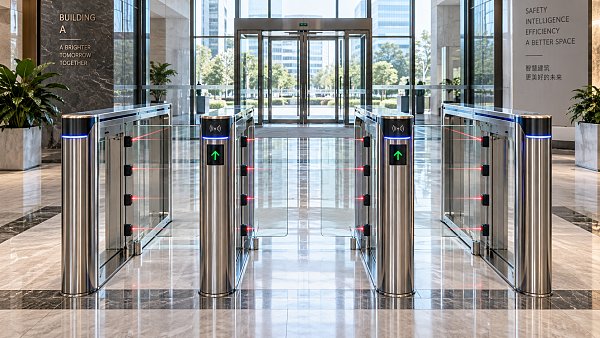
A properly configured speed gate treats the lane as a series of monitored zones. Infrared transmitters and receivers create beams across the opening at different heights and positions. Depending on the gate design, sensors may be located near the entry, inside the wing area, toward the exit, and along the side cabinets. The controller evaluates the order in which beams are interrupted, how long they remain interrupted, and whether the observed sequence is physically plausible.
For a single authorized entry, the expected pattern is generally: credential authorization, approach from the permitted direction, entry-zone interruption, progression through the central zone, exit-zone interruption, then clear lanes. The wing movement must remain compatible with that pattern. An authorized user who stops after passing the first sensor should not be treated the same way as a user who has completed the passage. Likewise, a second person entering close behind may create an occupancy pattern that does not clear between bodies, or it may create a second, distinguishable sequence in a downstream sensor group.
Good anti-tailgating performance therefore does not come from one “anti-passback beam.” It comes from correlated evidence. The controller should know whether a valid credential has been consumed, whether one or more bodies are still present, what direction the movement indicates, and whether the first authorized passage has truly ended.
Direction is more important than raw beam interruption
Any object crossing an infrared beam can cause an interruption. Directional logic determines whether that interruption belongs to an entering person, an exiting person, a reverse movement, or an object temporarily placed near the lane. This is particularly important at bidirectional gates, where one side may be authorized while the opposite direction is restricted.
A direction decision should normally require a sequence across multiple sensor planes rather than a single event. If a person reaches into a lane and withdraws, the system should not count this as a completed passage. If a user enters, hesitates, then backs out, the controller should cancel or resolve the transaction according to the configured policy rather than leave the lane in an ambiguous state. Poorly tuned reversal logic is a frequent source of both false alarms and unintended open-wing behavior.
Sensor layout determines what the software can know
Software cannot reliably infer a condition that the sensor layout does not observe. Before reviewing parameters, inspect the physical arrangement of the infrared array. Sensor positions should cover the relevant body envelope without creating large unobserved gaps between the cabinets and the moving wings. A low beam may detect legs or wheeled items; mid-level beams are useful for torso presence; higher beams can help distinguish body posture and prevent unsafe closure around raised arms or tall carried objects.
The number of beams alone is not a complete specification. Their spacing, height, overlap, and relationship to wing travel are more useful evaluation points. A dense array near the central opening may improve presence protection but still be weak at detecting a close follower entering from the approach side. Conversely, a strong entry detection field may identify a follower but provide limited confirmation that the first person has fully exited.
Alignment must be checked mechanically as well as electronically. A cabinet that shifts slightly after installation, a loose cover, vibration from adjacent doors, or a damaged emitter window can affect beam reception. Dust, fingerprints, tape residue, and cleaning chemical films may attenuate or scatter infrared light. These conditions can look like a software problem because the symptoms appear intermittently.
Set the lane behavior before tuning alarm thresholds
Threshold adjustment should come after the intended operating policy is explicit. A speed gate at a public office entrance may allow authorized users more time to pass and may prioritize smooth recovery from abandoned transactions. A restricted staff-only area may use a shorter authorization-to-entry window, tighter reverse-passage rules, and a more prominent response to an unresolved follower. The physical gate can be similar while the correct logic differs.
Define these behaviors in practical terms:
- Authorization window: How long after a valid credential may a user begin entering the lane? A long window can reduce friction but allows a credential event to remain active after the user has moved away.
- Passage completion: Which sensor sequence confirms that one person has exited? Do not equate wing opening with a completed transaction.
- Occupancy persistence: How long may a sensor field remain occupied before the controller flags obstruction, abnormal dwell, or possible tailgating?
- Follower response: Should the system alarm immediately, maintain open wings for safety while recording the event, attempt controlled closure after the lead user clears, or notify a remote operator?
- Reverse movement: What happens when a person starts in the authorized direction and then retreats? The response should avoid trapping while preventing a second unverified attempt.
- Fail-safe state: During loss of power, fire interface activation, or controller fault, which wing position is required by the site’s life-safety and access policy?
Once those decisions are established, timing values can be tuned to support them. Extending a timeout may be appropriate for users carrying materials or using mobility aids, but it should not become a substitute for detecting whether the lane is actually clear. Similarly, reducing the minimum time between sensor events may improve high-throughput recognition, yet it can make the controller more vulnerable to misclassifying closely moving bodies if the sensor resolution is insufficient.
Wing control must follow safety occupancy, not assumptions
A speed gate wing is a moving barrier, so its motion profile is part of the safety control design. Infrared fields should continuously monitor the zone where wing closure could contact a person or item. The controller should inhibit closure, decelerate, stop, or reverse according to the gate’s intended safety behavior when the relevant field remains occupied.
Problems arise when the protected field is defined too broadly or too narrowly. A broad field may make the gate hesitate every time someone walks near the cabinet edge. A narrow field may allow the wing to begin closing before a trailing arm, bag, or child-sized person is properly detected. The required setting depends on the equipment’s sensor architecture and installation geometry; it should not be copied from another lane without validation.
Do not judge safety only by whether the wings reverse when a hand is placed in the opening. That test examines a limited condition. Real passages involve angled approaches, side-by-side movement, a person pausing in the central area, objects carried behind the body, and people changing direction unexpectedly. The relevant question is whether the moving wings behave predictably whenever the infrared field shows unresolved occupancy.
A practical test sequence for technical acceptance
Testing should reproduce the conditions that produce operational complaints. A simple credential-and-walk-through demonstration is useful, but it rarely exposes tailgating weaknesses. Start with a documented baseline configuration and record each test condition, lane direction, authorization state, sensor response, wing response, alarm output, and recovery behavior. This makes it possible to distinguish a configuration issue from an inconsistent physical sensor signal.
Passage tests that reveal meaningful faults
- One authorized person walking normally, slowly, and at a fast pace.
- An authorized person who stops within the lane before clearing the exit.
- A credential presented without any entry, followed by a different person approaching later.
- One person entering with a backpack, tote, long coat, umbrella, or rolling item where such items are expected in normal use.
- A second person following at decreasing separation distances after one authorization.
- Two people attempting side-by-side entry where lane width makes that physically possible.
- Entry followed by reversal before full passage completion.
- Movement from the unauthorized side while the opposite direction is active.
Each test should produce a defined result. For example, a close follower may trigger an audible or silent alarm while wings remain open until the protected passage zone is clear. Forcing immediate closure on detected tailgating can create a collision risk; ignoring it creates a security gap. The preferred response depends on the gate’s mechanical design, local operating policy, and whether trained staff or remote monitoring can act on the alarm.
Also test recovery. After an alarm, the lane must return to a known state: locked, available, held open by policy, or awaiting operator reset. Repeated false alarms often become operationally damaging because the gate remains unavailable or staff repeatedly override it. Recovery behavior is therefore part of performance, not an administrative detail.
Environmental causes that imitate tailgating events
Infrared arrays are robust when correctly installed, but the surrounding environment still matters. Strong direct light, reflective flooring or glass, glossy metal finishes, and sunlight entering at a changing angle can affect optical conditions. The impact depends on the sensing method and receiver design, so the correct response is to inspect the manufacturer’s diagnostic information rather than assume every unexplained interruption is a person.
Nearby automatic doors can create air movement that shifts hanging signs, loose barriers, or decorative materials into a detection field. Cleaning crews may leave temporary objects near the exit zone. In narrow lobbies, queue lines can place waiting pedestrians inside or close to the sensor envelope. These are not minor housekeeping issues when the controller uses occupancy data to decide whether it is safe to close or whether a second passage is occurring.
A useful diagnostic distinction is repeatability. If alarms occur during certain daylight periods, after cleaning, when adjacent doors operate, or only in one lane, inspect optical and installation conditions first. If they occur consistently with a particular user behavior, such as close following or lingering, review logic and timing. Random events with unstable receiver values may point to alignment, wiring, contamination, or component faults.
What should be documented for a defensible evaluation
A gate specification should describe more than throughput and cabinet dimensions. Request the sensor-zone drawing, the logic used to identify direction and passage completion, available alarm outputs, configurable timing parameters, wing obstruction behavior, diagnostic indicators, and integration points with the access-control system. It should also be clear whether the system can distinguish safety presence from security passage counting, and what event information is available to investigate an alarm afterward.
During commissioning, retain the final parameter set, lane orientation, sensor alignment records, access-control mappings, and test outcomes for normal, abnormal, and recovery scenarios. Without that baseline, later adjustments become guesswork. A complaint that “the gate alarms too much” cannot be resolved reliably unless the team can determine whether the alarm came from a follower pattern, a safety field, an expired authorization, a reverse movement, or a sensor fault.
The strongest infrared speed gate safety control is not the one that reacts fastest to every interruption. It is the one that makes the right distinction: a person who is entitled to pass, a second person using that passage, an occupant who must be protected from moving wings, and an optical event that requires maintenance rather than a security response.
Have questions about this sector analysis, or seeking best practices specific to your niche? Drop us a line below and let the senior consultants at MHLS assist you.
We respect your privacy. Your information is strictly confidential.
Recommended News
 Financial Facility Security: Choosing Vault Doors for Bank BranchesVault Structural ArchitectStrengthen financial facility security with the right bank vault door. Explore certification, installation, locking controls and maintenance before you buy.
 MACO Acquires Majority Stake in Fingerprint Access Provider ekeyProf. Elara SterlingMACO acquires a majority stake in ekey, bringing fingerprint access and door hardware closer together. Discover what the deal could mean for smart buildings.
 Physical Security System Engineering: From Risk Assessment to System DesignUnmanned Terminal FellowExplore physical security system engineering, from risk assessment to integrated design, procurement and testing. Build a safer, more resilient facility.
 Apple Home Collection Smart Lock and Other Accessories Open for Preorder November 13Biometric Auth ScientistApple Home Collection preorders open November 13, 2026. Explore the LG smart lock’s Matter and Aliro support and what buyers should verify before ordering.
 Choosing Servo-Driven Flap Barriers: Throughput, Safety and Access ControlAccess Control StrategistServo-driven flap barriers can balance throughput, safety and access control. Discover how to compare lanes, test performance and choose with confidence.
 Parcel Locker Network Pricing: Setup Costs, Fees and Contract TermsUnmanned Terminal FellowCompare parcel locker networks pricing, from setup costs and recurring fees to contract terms. Discover hidden charges and choose the right model.
 JR East Plans UWB Walk-Through Gates at 40 Stations in Spring 2028Access Control StrategistJR East plans UWB walk-through gates at 40 stations in spring 2028. Explore the rollout timeline and what suppliers should watch.
 Bank Vault Security Standards: UL and EN Ratings ExplainedVault Structural ArchitectExplore bank vault security standards and learn how UL 608 classes and EN 1143-1 grades differ, what they test, and how to verify certification before you buy.
 Mechanical Lock Hardware Prices: What Buyers Should Budget for Bulk OrdersMr. Gideon CrossMechanical lock hardware price is just the starting point. Discover what drives bulk-order costs and how to compare supplier quotes with confidence.
 IndexBox Forecasts Steady Global Security Keypad Market Growth Through 2035Dr. Valerius ThorneGlobal security keypad market growth is forecast at 3.3% annually through 2035. Explore the smart home and replacement trends shaping demand.
 Choosing an Infrared Safety Sensors Manufacturer: What Buyers Should CheckUnmanned Terminal FellowChoosing an infrared safety sensors manufacturer? Compare safety evidence, integration, environmental performance and lifecycle costs before you buy.
 Choosing a Security Material Testing Service: What to Check for Lock and Safe MaterialsProf. Elara SterlingChoose a security material testing service with confidence. Learn what to check for lock and safe materials, from attack methods and accreditation to reliable reports.











