
Security Technology Trends Shaping Commercial Access Control and Physical Security
Commercial security is shifting from isolated hardware to coordinated intelligence
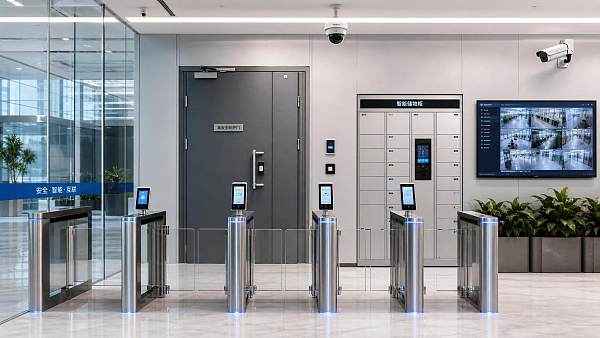
Security technology trends are changing commercial protection in ways that are practical, measurable, and increasingly difficult to ignore.
The old model relied on separate locks, gates, cameras, and guards working in parallel.
That model still exists, but it now looks expensive, fragmented, and slower to respond.
What is emerging instead is a connected physical security stack.
Access control, biometric verification, smart turnstiles, protective doors, safes, lockers, and monitoring platforms are becoming part of one operating layer.
This matters because risk has changed.
Commercial buildings now handle hybrid work patterns, faster visitor flow, stricter audit demands, and more connected assets.
A weak point at an entrance, parcel area, vault room, or server corridor can affect the whole site.
Recent security technology trends also show a broader convergence.
Physical security engineering is no longer separate from software logic, compliance data, or building operations.
That is why market attention is moving beyond product features alone.
Performance under attack, credential integrity, maintenance predictability, and integration readiness now carry equal weight.
The clearest signal is the rise of layered access control
One of the strongest security technology trends is the move from single-point authorization to layered verification.
A badge alone is often no longer considered enough for sensitive areas.
Facilities are pairing credentials with fingerprint, vein recognition, 3D facial recognition, PIN logic, or time-based permissions.
This change is not only about stronger security.
It is also about reducing operational ambiguity.
When an incident happens, a layered system produces cleaner records and clearer accountability.
The same logic is shaping smart locks and internal doors.
Commercial projects increasingly want electronic convenience without giving up mechanical resilience.
That is driving interest in anti-picking cylinders, reinforced lock bodies, liveness detection, and spoof-resistant biometrics.
From recent deployment patterns, the winning systems are not the most complicated ones.
They are the ones that match verification depth to actual risk zones.
Why this shift is accelerating
- Shared buildings now have mixed users, rotating schedules, and temporary access needs.
- Fraud concerns have expanded from forced entry to credential misuse and identity spoofing.
- Compliance reviews increasingly ask for traceable entry events, not just installed hardware lists.
- Cloud-connected platforms make policy changes faster across multiple sites.
Physical barriers are becoming smarter, not less important
Another misconception is that digital security will replace hard physical barriers.
Current security technology trends suggest the opposite.
Mechanical strength and material science are becoming more valuable because connected sites need dependable last-line protection.
This is visible in safes, vault systems, protective doors, and high-security lock cylinders.
Buyers are paying closer attention to EN 1143-1, UL testing, anti-drill structures, composite bodies, and cutting resistance.
The reason is straightforward.
If a connected system controls access efficiently but the barrier fails under attack, the digital layer loses credibility.
This is where SHPS-style market intelligence becomes useful.
It helps connect technical claims with actual resistance standards, material choices, and deployment evidence.
In practice, the market is moving toward blended value.
Electronic control opens and records the event, while mechanical engineering determines how long the asset can truly resist attack.
Flow management is now part of the security conversation
A more visible branch of security technology trends is the redesign of entrances and circulation points.
Commercial sites no longer see turnstiles and speed gates as simple traffic tools.
They are now expected to balance throughput, safety, anti-tailgating, and user experience.
This is especially relevant in offices, transport nodes, logistics parks, healthcare sites, and mixed-use developments.
Servo-driven gates, infrared safety curtains, and multi-sensor anti-tailgating systems are becoming more common because speed alone is no longer enough.
A fast entrance that creates safety disputes or false alarms often increases staffing pressure later.
More notable is the shift in evaluation criteria.
Projects now compare passage logic, recovery behavior after obstruction, maintenance cycles, and software interoperability.
Connected lockers and distributed assets are reshaping perimeter thinking
One of the less discussed security technology trends is the expansion of controlled storage beyond the traditional security room.
Smart parcel lockers, remote cabinets, and distributed delivery points are pushing access control into semi-public environments.
That creates a different security challenge.
The system must remain reliable even when the location has limited supervision, unstable connectivity, or mixed user behavior.
This explains the growing attention on 4G and 5G resilience, lock cycle durability, door status sensing, and remote diagnostics.
The real market shift is that parcel protection is now viewed as part of commercial security infrastructure.
It is no longer treated as a convenience feature sitting outside core risk planning.
This has implications for property operators, insurers, and developers.
Loss prevention now includes package custody, access event records, and tamper response in shared spaces.
What deserves closer attention over the next planning cycle
Not every new feature signals a durable market direction.
The stronger security technology trends are the ones tied to operational pressure, compliance demands, and measurable risk reduction.
Several questions are becoming more useful than broad technology enthusiasm.
- Can the system verify identity without slowing high-volume movement?
- Does the barrier still perform when power, network, or software conditions are imperfect?
- Are mechanical resistance claims supported by recognized tests and material data?
- Can event records support incident review, insurance scrutiny, and compliance checks?
- Will the solution scale across entrances, internal zones, storage points, and future retrofits?
That line of evaluation is why specialist intelligence platforms are gaining value.
They connect supplier visibility, technical interpretation, compliance context, and application evidence in one place.
In a fragmented market, that context is often more useful than a longer feature sheet.
The next move is not bigger spending, but better security alignment
The most important reading of current security technology trends is that convergence is now practical, not theoretical.
Commercial security strategies are becoming more resilient when access control, barriers, biometrics, storage protection, and software oversight are planned together.
That does not require replacing every legacy component at once.
A better starting point is to map where identity risk, forced-entry risk, and operational friction now overlap.
Then compare which entrances, doors, safes, lockers, or turnstiles still operate as isolated points.
From there, the next steps become clearer.
Review high-impact zones first, check standards and test evidence, and watch how integration affects both uptime and accountability.
The businesses that adapt well will not simply adopt more technology.
They will follow security technology trends with sharper judgment, stronger technical filters, and a clearer view of how physical security now supports the wider operating model.
Have questions about this sector analysis, or seeking best practices specific to your niche? Drop us a line below and let the senior consultants at MHLS assist you.
We respect your privacy. Your information is strictly confidential.
Recommended News
 Physical Security System Engineering: From Risk Assessment to System DesignUnmanned Terminal FellowExplore physical security system engineering, from risk assessment to integrated design, procurement and testing. Build a safer, more resilient facility.
 Apple Home Collection Smart Lock and Other Accessories Open for Preorder November 13Biometric Auth ScientistApple Home Collection preorders open November 13, 2026. Explore the LG smart lock’s Matter and Aliro support and what buyers should verify before ordering.
 Choosing Servo-Driven Flap Barriers: Throughput, Safety and Access ControlAccess Control StrategistServo-driven flap barriers can balance throughput, safety and access control. Discover how to compare lanes, test performance and choose with confidence.
 Parcel Locker Network Pricing: Setup Costs, Fees and Contract TermsUnmanned Terminal FellowCompare parcel locker networks pricing, from setup costs and recurring fees to contract terms. Discover hidden charges and choose the right model.
 JR East Plans UWB Walk-Through Gates at 40 Stations in Spring 2028Access Control StrategistJR East plans UWB walk-through gates at 40 stations in spring 2028. Explore the rollout timeline and what suppliers should watch.
 Bank Vault Security Standards: UL and EN Ratings ExplainedVault Structural ArchitectExplore bank vault security standards and learn how UL 608 classes and EN 1143-1 grades differ, what they test, and how to verify certification before you buy.
 Mechanical Lock Hardware Prices: What Buyers Should Budget for Bulk OrdersMr. Gideon CrossMechanical lock hardware price is just the starting point. Discover what drives bulk-order costs and how to compare supplier quotes with confidence.
 IndexBox Forecasts Steady Global Security Keypad Market Growth Through 2035Dr. Valerius ThorneGlobal security keypad market growth is forecast at 3.3% annually through 2035. Explore the smart home and replacement trends shaping demand.
 Choosing an Infrared Safety Sensors Manufacturer: What Buyers Should CheckUnmanned Terminal FellowChoosing an infrared safety sensors manufacturer? Compare safety evidence, integration, environmental performance and lifecycle costs before you buy.
 Choosing a Security Material Testing Service: What to Check for Lock and Safe MaterialsProf. Elara SterlingChoose a security material testing service with confidence. Learn what to check for lock and safe materials, from attack methods and accreditation to reliable reports.
 How Precision Anti-Pick Lock Cylinders Resist ManipulationSecurity Metallurgy ExpertDiscover how precision anti-pick lock technology resists manipulation, and learn what to check when comparing security features, test evidence, and everyday reliability.
 Dermalog Joins NIST FastCAP Program for Contactless Fingerprint TestingProf. Elara SterlingDermalog joins the NIST FastCAP program for contactless fingerprint testing. Discover what this means for biometric identification and digital identity.











